/* ---- Google Analytics Code Below */

Thursday, July 21, 2016

DSC Surveys Data Science Techniques

Index to useful article lists from Data Science Central.  Click through to their site for search details.  Join the the group.  Very nicely done articles from introduction to in-depth.  I have not linked them all, but go to DSC for more.

" ... These techniques cover most of what data scientists and related practitioners are using in their daily activities, whether they use solutions offered by a vendor, or whether they design proprietary tools. When you click on any of the 40 links below, you will find a selection of articles related to the entry in question. Most of these articles are hard to find with a Google search, so in some ways this gives you access to the hidden literature on data science, machine learning, and statistical science. Many of these articles are fundamental to understand the technique in question, and come with further references and source code.

Starred techniques (marked with a *) belong to what I call deep data science, a branch of data science that has little if any overlap with closely related fields such as machine learning, computer science, operations research, mathematics, or statistics. Even classical machine learning and statistical techniques such as clustering, density estimation, or tests of hypotheses, have model-free, data-driven, robust versions designed for automated processing (as in machine-to-machine communications), and thus also belong to deep data science. However, these techniques are not starred here, as the standard versions of these techniques are more well known (and unfortunately used) than the deep data scienceequivalent. To learn more about deep data science,  click here. Note that unlike deep learning, deep data science is not the intersection of data science and artificial intelligence.

Finally, to discover in which contexts and applications the 40 techniques below are used, I invite you to read the following articles:
   40 Data Science Techniques
  1. Linear Regression 
  2. Logistic Regression 
  3. Jackknife Regression *
  4. Density Estimation 
  5. Confidence Interval 
  6. Test of Hypotheses 
  7. Pattern Recognition 
  8. Clustering - (aka Unsupervised Learning)
  9. Supervised Learning 
  10. Time Series 
  11. Decision Trees 
  12. Random Numbers 
  13. Monte-Carlo Simulation 
  14. Bayesian Statistics 
  15. Naive Bayes 
  16. Principal Component Analysis - (PCA)
  17. Ensembles 
  18. Neural Networks 
  19. Support Vector Machine - (SVM)
  20. Nearest Neighbors - (k-NN)
  21. Feature Selection - (aka Variable Reduction)
  22. Indexation / Cataloguing *
  23. (Geo-) Spatial Modeling 
  24. Recommendation Engine *
  25. Search Engine *
  26. Attribution Modeling *
  27. Collaborative Filtering *
  28. Rule System 
  29. Linkage Analysis 
  30. Association Rules 
  31. Scoring Engine 
  32. Segmentation 
  33. Predictive Modeling 
  34. Graphs 
  35. Deep Learning 
  36. Game Theory 
  37. Imputation 
  38. Survival Analysis 
  39. Arbitrage 
  40. Lift Modeling     ..... " 
Follow us on Twitter: @DataScienceCtrl 

Wednesday, July 20, 2016

Fabric Software for Visual Programming

New way to visually program.  I built software for years, so understand the embedded power,  but always believed there had to be a better way.  Can visual methods be precise enough to construct algorithms, and reduce errors and document its own process?   Visuals shown are impressive: 

" ...  Fabric have just announced that it will be introducing a new visual programming tool which the company believes will be make creation both easier and more dynamic. SIGGRAPH 2016 will mark the debut of the software.

An addition to the existing Canvas visual programming suite, Blocks which will ship with Fabric Engine 2.3 will expand on the existing functionality and Blocks allows users to create solutions they’d previously only been able to envision through writing code.

“Blocks are Canvas graph containers for user-provided functionality within a preset – the “block” inside a “for” loop is literally a Canvas graph. With Blocks, technical directors can create complex presets (either graphically or with code) exposing only the controls that make sense for non-technical users to modify. Users can then modify the preset by filling in the content of the blocks – visually — without needing to know all the details of the preset.” Explains the company in their announcement.... " 

When and Why of Causation


Adam kelleher
Physics PhD; Principal Data Scientist at BuzzFeed  : Thoughtful Medium piece:

" ... So what is causality good for? Anytime you decide to take an action, in a business context or otherwise, you’re making some assumptions about how the world operates. That is, you’re making assumptions about the causal effects of possible actions. Most of the time, we only consider very simple actions: I should eat, because the causal effect of “eating” on “hunger” is negative. I should show more impressions of this ad, because the causal effect of impressions on pageviews is positive. What about more complex interventions? What about the downstream effects? Maybe showing more impressions of the ad increases pageviews of it, but it draws traffic away from something more shareable, reducing traffic to the site as a whole. Is there a way to make all of the downstream causal effects obvious? Is there a way to make causal assumptions explicit, so their merits can be discussed, and our model of the world can improve?  ... "  

Buying Disruption in Personal Care

Buying into Disruption.

Unilever Buys Dollar Shave Club for $1 Billion   
Deal represents a big win for Dollar Shave Club’s investors.
Unilever announced on Tuesday evening that it is getting into the razor business, by agreeing to acquire Dollar Shave Club.

No financial terms were disclosed, but multiple sources close to the deal tells Fortune that Unilever  UK  is paying $1 billion in cash for the Santa Monica, Calif.-based business. That same source says that Unilever approached Dollar Shave Club about the acquisition.

Dollar Shave Club founder and CEO Michael Dubin will continue to run the company, which will operate its direct-to-consumer razor business as an independent entity. The acquisition should help Dollar Shave Club expand faster into new geographies (it’s currently in three countries), and significantly improve its distribution abilities in existing markets. ... " 

(Update) Discussion in Retailwire.

Macy's Tests Watson AI

In Yahoo Finance.  some of the details are interesting. Most interesting would be, the value of services a system provides, beyond just specials based on loyalty information and location.

" ... Macy's is testing a mobile tool using artificial intelligence that lets shoppers get answers customized to the store they're in — like where a particular brand is located or what's in stock — that they would normally ask a sales associate face-to-face.

The tool, which the nation's largest department store chain calls a "mobile companion," can be accessed for now through a browser and will accept questions in 10 U.S. locations about products, services and facilities. It uses natural language and offers feedback in seconds.

It's developed by IBM Watson — the Jeopardy-winning "cognitive computing" service and is designed to keep learning more about the store's customers. That's a key element as Macy's seeks to spur sluggish sales, make being at the store more enjoyable and distinguish itself from online portals and specialty retailers.  .. " 

VR for Marketing

Always looking for real life applications beyond the game.   Marketing is an engagement angle.

3 Ways Virtual Reality Is a Marketing Game Changer
Virtual reality is all the rage for gamers, but what does it mean for marketing?  by Larry Kim

Automatic Tutors

In The Echo, a quite long ago talk with Daniel Hillis about the web, about knowledge and its evolultion.   Also the realm of 'automatic tutors' and what they could mean when having access to universal knowledge.  How are these like bots and virtual assistants emerging today?  We certainly have stored much more knowledge today, but its hardly universal or complete.  Semantic webs and Linked Data are still not common in industry.   Why?    "Aristotle" (the Knowledge Web)  by W. Daniel Hillis  ....

Procter Tests Direct Online Subscription

In MarketWatch:  Procter tests direct online subscription service for Tide Pods.  Already available from Amazon via a Dash button.  This finally circumvents major channels like Amazon and Wal-Mart.   This was, in the past, avoided to not disturb important channel relationships.

Tuesday, July 19, 2016

Semantifying the Use of Data

Was recently involved in a project  thinking about how semantics can be a good way to make the best use of your data.  Make real sense of data and how it is related to other data.  Here is the argument, with a rough architecture. It is more work, constructing and maintaining, but well worth considering.   Semantify -ing, they are calling it. 

Predicting Bots Everywhere

The CEO of Automation Anywhere on How Robotic Process and Automation will Transform the Workplace  by Jacob Morgan

What is in this episode and what you should care:

Mihir Shukla is the CEO of Automation Anywhere, an enterprise software company. They are redefining how work gets done by introducing the idea of a digital workforce platform and digital workers that work alongside human employees. This combination is designed to help the human employee accomplish more than they ever could alone. Automation Anywhere has 300 hundred employees in 10 offices worldwide. Mihir’s goal is to become one the world’s largest employer without having any employees. How will they accomplish this? Projections show in the next four years, Automation Anywhere will reach 3 Million software bots worldwide which are producing at the capacity of 3 Million people. While they are a software company, the production levels are so high that they are the world’s largest employer in the digital age.  .... " 
 

Tactile Intelligence

 Intelligence requires sensors,  so the sense of touch needs to be refined for robots to have complete intelligence.  Good piece on developments in this area:

 Why Tactile Intelligence Is the Future of Robotic Grasping
By Vincent Duchaine

The simple task of picking something up is not as easy as it seems. Not for a robot, at least. Roboticists aim to develop a robot that can pick up anything—but today most robots perform “blind grasping,” where they’re dedicated to picking up an object from the same location every time. If anything changes, such as the shape, texture, or location of the object, the robot won’t know how to respond, and the grasp attempt will most likely fail.

Robots are still a long way off from being able to grasp any object perfectly on their first attempt. Why do grasping tasks pose such a difficult problem? Well, when people try to grasp something they use a combination of senses, the primary ones being visual and tactile. But so far, most attempts at solving the grasping problem have focused on using vision alone.   ...  " 

Nest Camera with AI

In CWorld:  Nest camera detects people in its images.  Continue to see more examples of the use of AI pattern matching methods in consumer systems, like face recognition for system access.

Microsoft Dynamics

Brought to my attention for examination and review.   Microsoft Dynamics is an  amalgam of Microsoft's CRM and ERP offerings.  How will this ultimately be integrated to systems like Linkedin after acquisition? As a skill and HR database to provide resources for analysis?  Indications are that this will be further integrated in coming days.

   Via Wikipedia:

Microsoft Dynamics is a line of enterprise resource planning (ERP) and customer relationship management (CRM) software applications. Microsoft Dynamics applications are delivered through a network of reselling partners who provide specialized services.[1] Very few installations are made without the aid, and cost, of these resellers. In its 2013 update, the first since 2009, Microsoft removed many capabilities of users to access features such as report-writing without the intervention, and cost, of members of their approved reseller network .[2] Microsoft Dynamics is part of Microsoft Business Solutions. Dynamics can be used with other Microsoft solutions, such as SharePoint, Yammer, Office 365, Azure and Outlook. The Microsoft Dynamics focus industries are retail, service, manufacturing, financial services, and public sector. Microsoft Dynamics provides business solutions for both small & medium businesses and Enterprise . ....  " 

Monday, July 18, 2016

On Useful Intelligence Augmentation

A talk with Pattie Maes about Intelligence augmentation, a favorite topic,  We had been members of the Media lab years ago, and had been intrigued by her practical consumer applications of AI.   She continues to address useful AI, in Echo: 

" ... Maes: I started out doing artificial intelligence, basically trying to study intelligence and intelligent behavior by synthesizing intelligent machines. I realized that what I've been doing in the last seven years could better be referred to as intelligence augmentation, so it's IA as opposed to AI. I'm not trying to understand intelligence and build this stand-alone intelligent machine that is as intelligent as a human and that hopefully teaches us something about how intelligence in humans may work; instead what I'm doing is building integrated forms of man and machine, and even multiple men and multiple machines, that have as a result that one individual can be super-intelligent. So it's more about making people more intelligent and allowing people to be able to deal with more stuff, more problems, more tasks, more information. Rather than copying ourselves, I'm building machines that can do that. ... " 

Another in Aisle Scanning Test

RetailWire contains a good piece on in aisle checkout, covering many of the impediments to its implementation. A long time retail tech subject here.   Tested it in many contexts:  by Tom Ryan:

A new Sam’s Club opening on July 21 in Columbia, SC will be one of the first Sam’s in the country to offer Scan & Go shopping.

The Scan & Go mobile app promises to make members’ checkout process faster and more convenient by allowing shoppers to scan UPC codes on items as they load them into their carts. When done shopping, customers pay directly on their phone from anywhere in the club and bypass the checkout line.

Unfortunately, Scan & Go-type technologies seem to be in continual trial mode despite the promoted advantages of walk-around budget monitoring and speedier checkout. .... "  

Analytics and Performance Management

Good piece by John O'Rourke  because it addresses how analytics can be directly connected to business process.  Part of every business  process is to understand how and why things are operating now, and are likely to operate under contextual changes in the future.   Then linking the measurement to specific action.    Always like to see that emphasis.

More Virtual Humanity

In CNet: 

Justine Cassell has taken her virtual assistant Sara on a road trip.

They're in Tianjin, China, where Carnegie Mellon University's associate dean of technology strategy and impact traveled to offer a glimpse of tomorrow at this week's Annual Meeting of New Champions.

Sara, for "socially aware robot assistant," has spent the past several days greeting hundreds of people coming to the event, hosted by the World Economic Forum, at a station showcasing the office of the future.

A life-size face and torso on a big-screen TV, Sara served as the front end to the event app. That presentation might make you think of Max Headroom, the stuttering AI character from the 1980s show. But Sara is as professional as Max was wacky.  ... " 

Pokemon Go and Retail

Is Pokemon Go the new phenomenon, and will it bring augmented reality mainstream?   I do remember when this was expected of 4 Square too.   Interesting emerging stats in Adweek article below: 

" .... Nintendo's surprise hit Pokémon Go mobile app is going gangbusters, increasing the gaming company's value by $7 billion.

The location-based game, which came out Thursday, uses augmented reality to place Pokémon characters in the real world for users to find and collect. The mobile app became immensely popular almost immediately and is already causing small businesses to tweak their in-store marketing. Tech vendor Similar web predicts the app will amass more daily active users than Twitter in the coming days.  .... " 

And more about location than augmented reality, in Time,

Sunday, July 17, 2016

Data Driven Business Strategies

 I like the closer to business process premise ....  Following up.

Gartner Report: Mastering Data and Analytics: ‘Table Stakes’ for Digital Business

Executive Summary: 

“The transformation to digital business is not incremental.”

The time is now for today’s marketing and analytics leaders to boldly pioneer not just new data-driven strategies, but entirely new data-driven business models. According to Gartner, enterprises not working to develop digital business models and supporting infrastructure today will find themselves functionally behind within three years. ...''

with registration

New: Digital Industry Insider

Digital Industry Insider:  

"The future of industry is digital. GE and BI Studios have co-created Digital Industry Insider, dedicated to bringing you what you need to know about digital industrial news and events.

 .... Produced by BI Studios, Business Insider’s content marketing division, Digital Industry Insider is a digital content hub, specifically-designed to fuel organic story discovery and elevate the discussion around digitization in core industries like aviation, energy and healthcare.

With the Industrial Internet poised to outpace the consumer internet by 2020 – weighing in at $225 billion in potential market size – bringing the world’s biggest machines online and helping them communicate is the next industrial revolution. Digital Industry Insider is convening this conversation, unpacking this new frontier and its impact. ... " 

Nielsen on CPG Innovation

In FoodNavigator:

Nielsen unveils 2016 breakthrough innovation winners: There will be more change in CPG in the next five years than there was in the last 50

In 2015, the top 25 food and beverage companies generated 45% of category sales in the US but drove just 3% of total category growth from 2011 to 2015, with a compound annual growth rate (CAGR) of just 0.1%, according to Nielsen data. So if they are not driving growth, who is?

Private label drove 23% of the growth and grew at a 2.6% CAGR, while mid-tier companies drove 25% of the growth and grew at a CAGR of 3.2% over the same period, says Nielsen in its 2016 breakthrough innovation report. But it was the “long and mighty tail” of 20,000 companies below the top 100 who drove 49% of all category growth, with a CAGR of 6.3%.

“Our belief is that there will be more change in CPG in the next five years than there was in the last 50. Successful firms of the future will master consumer experiences, not just consumer goods.”  ... .
'

Google Building a Matrix?

In Adage:

What could the Alphatrix look like?

If Alphabet has its way, in a few years, we'll be living in connected homes intelligently powered by Google Home wearing Google VR headsets on our faces. We'll swap those out for Google Glass-like augmented reality devices when we leave the house. We'll wear connected clothing with built-into gestural controls powered by Google's Project Jacquard. We'll hop into self-driving cars powered by Android Auto. Waze will shift from monitoring traffic patterns to determining them.

Alphabet's Sidewalk Labs hints that it will soon be building connected cities from scratch. Imagine cars, traffic lights, parking spots, moving sidewalks, restaurants, retailers, hospitals and homes all instantly and harmoniously choreographed into one seamlessly orchestrated, um, matrix. Healthcare IT News has even suggested that Google Cloud Machine Learning could be used for "population health management" (maybe we will become batteries after all). ..... "

Semantic Ecosystems

Continuing a look at modern ontology capabilities,  We did work with Stanford's KSL to build ontologies of corporate data.

Semantic Ecosystems

Create a semantic ecosystem—evolve from disparate data to actionable knowledge.

TopQuadrant’s solutions empower people by providing them with connected, business-relevant information—an ecosystem of actionable knowledge. Using TopQuadrant’s TopBraid solutions, organizations transform diverse information into semantic assets.

Find out how TopQuadrant can help link your information assets to create a semantic ecosystem where meaningful interactions between people, applications and data occur consistently with a speed, accuracy and intelligence previously not possible.  ... " 


Reading TopQuadrant’s Blogs:
The Semantic Ecosystems Journal

Composing the Semantic Web – A TopBraid Developer’s Blog

Saturday, July 16, 2016

Better Digital Work Methods Needed

Again, I would point to some of our work on this to first and foremost getting all the right data to people as they need it to both support decisions and make constraints clear.   Further supported by analytic/cognitive agents.

  See Business Sphere.   Sadly, I don't think this was taken forward very well,  It sits stagnant,  except perhaps in the financial industry.  I am struck by observations that we still start with a big pile of Lego blocks, looking for new data and new solutions, repeating this each and every time.   Done often even in 'modern' data science.   Very wasteful.

Can we achieve a better, more effective digital workplace?
As a confluence of new apps and devices steadily flow into the enterprise, they're encountering a growing sense that the digital workplace has become too complex and fragmented to be properly effective. What can organizations do? .... by Dion Hinchcliffe   ... 

The Importance of Carefully Considering Outliers

Good short piece by Rick Delgado on the concept of outliers.  Very important that both the analyst and the decision maker understands this idea as it relates to collected data and decision problem.  Frequently brought up here (See below)  and in every consulting connection.  The article is non technical.

Friday, July 15, 2016

Predictive Models Improving Automated Decisions

Useful points,   Though there is is the question on 'how predictive' and how precise such models can be.

How Predictive Models Improve Automated Decisions
Written by: Colleen McClintock   ... 

Agility is a key focus and benefit in the discipline of decision management. Agility, in the decision management context, means being able to rapidly adjust and respond to business and market-driven changes. Decision management technologies allow you to separate the business logic from your systems and applications. Business analysts then manage and make changes to the business logic a separate environment. And they can deploy their changes with minimal IT involvement and without a full software development cycle. With decision management, changes can be implemented in a fraction of the time required to change traditional applications. This ability to address frequently changing and new requirements that impact key automated decisions makes your business more agile.

Being able to rapidly make and deploy changes is important. But how do you know what changes to make? Some changes, like those defined by regulations and contracts, are straightforward. If you implement the regulations or contract provisions accurately, the automated decision will produce the required results and therefore, make good decisions. However, many decisions don’t have such a direct and obvious solution. .... " 

Using GPS Underwater

Had studied alternative to GPS for location in indoor spaces.   Had not realized the complexity of it working underwater.  Say for locating and directing underwater drones.   In the Atlantic.  ....

Towards Adaptable Leaders

Could not be more correct, especially in the world of changing technology and business. But what do they look like, and what do they have to be adaptable to?    Admit to not knowing everything?  More.

A New Biology

Including the work of a biological game theorist.

From matchbook-sized models of living human organs to the surprising alternative-energy implications of symbiotic giant clams, the work of three new faculty members represents the changing face of bioscience at Penn.  ... By  Trey Popp

The Problem with Thinking You Know

Very key and interesting teaching conundrum.  I will be working with a varied group of students this fall, and the situation has come to mind.    by Bertand Meyer:

" ... The human mind is flexible; when taught well, many people can learn many subjects. But there is one case of absolute impossibility: you cannot learn something if you think you already know it -- and do not. ...  " 

Sounds obvious, but its not unless you make a point of measuring it.  But then how do you measure this understanding without a perfect test?

This also relates to management that believe they know something and can't learn otherwise.

Based on his experience teaching introductory programming.    Well worth understanding by anyone who teaches.

Considerable discussion in CACM.

Thursday, July 14, 2016

Twitter and other Social Connections

Many of the blog posts here are also on my twitter feed:  @FranzD    that feed also repeats information from other information streams I am connected to in Advanced Tech, Retail, AI, Analytics and Cognitive.   Follow me there.   The blog is also repeated in Flipboard.

O'Reilly Newsletter on AI

O'Reilly newsletter on AI value and  hype.  Good overview of the topic with links to some key indicators and topics.  Positive and negative.  When will the disruption occur?  How does this relate to cognitive capabilities?  They have started issuing a newsletter on the topic, and based on their offerings in other areas, should be useful to get.

Understanding How Neurons Compute

In CACM:  We still don't understand fully how the activity of neurons cause our brain to work.   New work gathers data that may give us a better understanding,   The inspiration from astronomy and the model of an observatory is interesting.  Big Data indeed.  The convergence of big and small.   In Nature:

" ... Inspired by the large-scale sky surveys with which astronomers explore the cosmos, neuroscientists in Seattle, Washington, have spent four years systematically surveying the neural activity of the mouse visual cortex. The Allen Brain Observatory’s first data release, on 13 July, provides a publicly accessible data set of unprecedented size and scope, designed to help scientists to model and understand the human brain.

The project is part of an ambitious ten-year brain-research plan announced in 2012 by the Allen Institute for Brain Science. Designed to catalogue neurons and their electrical characteristics in minute detail, the initiative aims to enable new insights into how perception and cognition arise. ... " 

Holacracy as Alternative Business Organization

Had heard this term before, but forgotten its exact meaning, seems this is still very uncommon.  I wonder what VCs think about this approach to managing their money?

For Zappos’ Tony Hsieh, ‘Holacracy’ Is the Right Fit
Zappos CEO Tony Hsieh’s rather unusual lifestyle has often raised eyebrows. Despite a net worth of $840 million, he lives in a trailer (albeit a nice Airstream one) in the middle of downtown Las Vegas with his dog and two pet alpacas. And the shoe magnate personally owns only four pairs of shoes.

But one of the most unusual things about Hsieh is how he runs his business. Credited with taking the company from nearly nothing in 1999 to the multi-billion-dollar household name it is today, Hsieh has organized Zappos as a holacracy. A quick Google search will tell you holacracy involves removing power from management and spreading it across the firm; creating self-organizing teams, and the like. But how does this play out among real people, within the walls of one of the most successful internet companies in America? ... "

Wednesday, July 13, 2016

NodeXL: Creating Network Graphs from Excel


Simple, clever idea.

These are network graphs created with NodeXL, a template for graphing network data in Excel® (2007, 2010, 2013 and 2016).

NodeXL is a template for Microsoft® Excel® (2007, 2010, 2013 and 2016) on Windows (XP, Vista, 7, 8, 10) that lets you enter a network edge list into a workbook, click a button, see a network graph, and get a detailed summary report, all in the familiar environment of the Excel® spreadsheet application.  .... 

More.   .... 

How Amazon Prime Day Links to Amazon Technology

Extract from a much longer CGT article.   Indication of percent changes from last year and rankings versus exact numbers of interactions.  Since most of the technologies are very new, this may not be very indicative of their longer term success.  Procter clinched all the top marks using Dash ordering.

Highlights from Amazon's Prime Day
By CGT Staff — 07/13/2016

The second annual Prime Day was the biggest day ever for Amazon. Amazon announces that customer orders surpassed Prime Day 2015 by more than 60 percent worldwide and more than 50 percent in the United States. It was also the biggest day ever for Amazon devices globally and record Prime Day for each Amazon device category including Fire TV, Fire tablets, Kindle e-readers and Alexa-enabled devices. Prime Day was a great savings day too – members globally saved more than double on deals over Prime Day 2015.   .... 

Prime Day 2016 highlights from the United States:
·         Amazon devices were up over 3x compared to Prime Day last year.
·         Biggest day ever for Amazon Echo – up over 2.5x compared to previous record day.
·         The most popular Amazon Dash Button brands purchased on Prime Day were Cascade, Charmin and Tide.  .... " 

Value of Functional Packaging

Always an interesting idea, and augmented reality and smartphones bring new capabilities forward. When will they actually create engagement, provide value?    To be clear,  the examples don't have to be that technological:

" ... In  June, Zappos ran a campaign called #ImNotaBox, which involved shipping boxes printed with a variety of templates for cutting and folding the empty packaging into a number of new functional items, according to Adweek. By following the instructions, recipients could give a Zappos box a second life as a smartphone holder, geometric planters and a decorative 3-D llama, among other things.

Zappos’ campaign speaks both to the importance of retailers finding new ways to provide experiential enjoyment beyond just the product being purchased, and to the serious look that retail is taking at promoting waste reduction and reusability.   ... " 

More discussion In Retailwire.

Google Starts to Allow Forgetting

Have not heard about this anywhere else, but has some fascinating implications.  In the past we always assumed that knowledge would persist.  May that be a thing of the past from the point of view of the search engine and online history?   Already required by law in Europe, now moving to the US.   Article on this  In CWorld.  by Evan Schuman.
  

Retail Cyber Scams Advance

In Knowledge@Wharton.  A forward looking piece on the current and coming waves of cyber scams in retail.   Good thing to watch as we continue to add new channels to buying and also to sharing information in general.    Some recent connections have sensitized me to the dangers in retail. Worthwhile overview.

Tuesday, July 12, 2016

Amazon Echo and Business Intelligence

Been looking at potential business applications of the Amazon Echo.  Like many virtual advisory applications, you can think of potential 'hands free'  scenarios, but these are relatively rare in the back office.  And rarer yet in stationary situations.     Sisense, a business intelligence supplier, believes there is engagement value in such an advisor.  CWeek is skeptical, as I am, but am looking forward to a demonstration:

" .... So what is Sisense actually doing here?
In the case of Amazon Echo, Sisense is allowing business users to ask questions and hear results in real time. Apparently, that is driving an increased efficiency and engagement. The idea being that a business user won't run a query about, say, regional Midwest sales this year versus last in a visualization tool. Instead, a user will ask Amazon Echo to perhaps play a song that matches the sentiment of salespeople in the U.S. versus those in Europe. Or something like that. Apparently, the ease of conversation drives increased engagement with data and opens access to BI insights. Or something. It's all about humanizing data consumption, apparently  ....  " 

Data World Provides Data Resources

Activity in the semantic data world,   Dean Allemang mentioned and quoted.   Toward an improvement of the use of data assets.    An indication of increased open ontology development?

PRESS RELEASE
Austin, TX – July 11, 2016 – data.world, a new company that makes it fast and easy to find and use data to solve problems, has officially launched today. Led by Bazaarvoice founder (NASDAQ: BV) and former CEO Brett Hurt and three former HomeAway executives, data.world is building the most meaningful, collaborative, and abundant data resource in the world by dismantling the barriers between people and data. With data.world, people who work with data can quickly and easily discover, prepare, and share it, as well as effectively collaborate in real time to solve important problems.   .... 

“Open data, which is data that can be freely used, modified, and shared by anyone for any purpose, is shaping up to be one of the most important forces impacting humanity today,” said Hurt, co-founder and CEO of data.world. “This movement can speed our cure for cancer, help keep governments accountable, curtail climate change, and positively impact other important world issues. We’ve built data.world to facilitate these breakthroughs – by allowing professional and amateur data scientists, analysts, and researchers to instantly find, use, and share data.”   .... 

“data.world is tackling a fundamental problem: how to make data interoperable to help people and machines unlock data’s value faster. This is a significant step forward for the semantic web community – and a more comprehensive approach than I’ve seen before.” – Dean Allemang, semantic web expert, author and Principal Consultant at Working Ontologist, LLC.    ... " 

Pokemon Go Explodes

Pokemon has been around for a long time.   We examined the brand long ago.   The idea of using augmented reality to create games that overlapped the real world with images to create quest missions is also an old idea.  But the idea has never clicked, until now.  It has been building  to humorous, and sometimes dangerous effect.  With little or no promotion.  See introduction in 2015.  Even Advertisers are noticing.   Forbes explains it.   In AdAge:

Pokémon Go Goes Viral With No Big Marketing Blitz
Game Could Be Opportunity for Retailers to Sponsor 'Pokéstops'
By Maureen Morrison   ....    " 

Mistakes Managers Make with Analytics

In the HBR:  Good points, mostly about process and application, rather than technology.   Worth a look.    Obvious to any manager, if they don't buy the hype, and not necessarily complete.

Archetypes and Branding

Thinking about the brand personality.  I have never seen this done particularly well. Does it end up  constricting, decreasing innovative channels?  Here is another approach. 

Is Machine Learning Driving AI?

Always thought ML was part of AI.   In Datanami: An interesting distinguishing point is made

" .... The authors quotes Jaime Carbonell, a professor of computer science at Carnegie Mellon University, as noting” “Machine learning essentially is the engine that is driving modern artificial intelligence.”

Machine learning “often deals with unbalanced data sets in which the ultimate focus of decision making is precisely the outlier cases,” that is, the extreme cases that contrast sharply with typical data and provide opportunities for the “most important learning opportunities.”

Ignoring the rare cases, or outliers, means “you cold miss everything [in a data set] that is interesting,” Carbonell asserted. .... " 

Monday, July 11, 2016

Free eBook: 23 Reasons to Get Excited About Data

Below, links to a free eBook that covers a number of practical and exciting applications of data analytics. Nicely done,  selected from our collegial group on the use of Watson Analytics.   More and link here.


By Forsyth Alexander :  

In a lot of ways, data gets a bad rap. Businesses have been collecting and analyzing data for decades. As a result, simply saying “data” is enough to conjure images of someone poring over a thick stack of spreadsheets, manually going through row after row to identify trends and figure out what to do with them. Who can really get excited about that? Not me.

The thing is, data doesn’t deserve its reputation. It’s the spreadsheets, the reports in table form, the tiny numbers on paper or on a screen that are daunting. Data itself has value because without it, we’re limited to making decisions based on instinct or gut feel. Occasionally, that might work out, much like how a broken 12-hour clock is right two times a day.

Data analysis technology makes it possible to make immediate decisions based on facts and sound statistics, giving companies a leg up on their competition. And what business doesn’t love competitive advantage?

So, basically, data is not boring. Data is exciting, especially if you get something out of it. Check out this e-book for 23 reasons for you to get excited about data with insightful commentary from a group of great social media influencers, who we call the Watson Analytics Predictioneers.  ... ." 

Design Museum Foundation

Of interest, on design museums.  In a sense some of our innovation spaces were aimed at showing evolving design.    So interested in the concept.

" ... Hope you are having a great week. This week’s presenter for the ISSIP Service Innovation Weekly Speaker Series is Sam Aquillano, Founder and Executive Director of Design Museum Foundation. .... 

http://designmuseumfoundation.org/
https://www.linkedin.com/in/samaquillano

Sam Aquillano is Founder and Executive Director of Design Museum Foundation, a national network of local design museums operating three sites Design Museum Boston, Design Museum Portland in Oregon, Design Museum San Francisco, and growing across the country. Their mission is to educate the world about the importance of design in our lives. Design is everywhere, so the museum has no permanent address — instead, Sam and his team turn the museum inside out and turn entire cities into locally-focused, nomadic design museums. Sam earned a BFA in Industrial Design from Rochester Institute of Technology and went on to design consumer electronics at Bose Corporation, as well as to teach design at Wentworth Institute of Technology, MassArt, and Babson College — where he earned his MBA. With a passion for design, creativity, and learning, Sam creates a long-term vision for the museum and leads a dedicated team while managing key programs and strategic operations. In 2013 Sam and his team were named one of BostInno’s 50 on Fire.  ... " 

ISSIP Service Innovation Weekly Speaker Series
Wed 7:30 am pacific time (San Francisco time zone)/ 10:30am EST
Co-hosts: Haluk Demirkan, Jim Spohrer, Yassi Moghaddam, DJ Christman, Heather Yurko
http://www.timeanddate.com/worldclock/converter.html

Join WebEx meeting
https://issip.webex.com/issip/j.php?MTID=m980f2a9da470d264408be87884cdcb2a

Meeting number: 927 413 167      Meeting password: innovation

Join by phone  +1-415-655-0002 US Toll
Access code: 927 413 167   ..... " 

Building Information Systems

In VRFocus:  On the obvious connections of virtual reality to Building information Models  (BIM).   Had examined this some years ago in firefighting and first respondent systems.

Robotic Ships

Creating robotic ships.  Rolls Royce experiments with augmented reality to control and deploy the idea.  Implications for efficient future supply chains.

Bot Functionality in Skype Conversation

MS appears to be serious in augmenting conversations through new levels of intelligence.  Still primitive, but the direction is interesting ...  Ultimately adding intelligent actors to group conversations.

In CWorld: 
' ... Want to have a group trivia contest on Skype? Microsoft announced updates to the bot functionality in Skype on Friday that let digital quizmasters and other automated participants take part in group text conversations.

Developers that use the functionality can open their robotic conversation partners to groups of friends and coworkers, similar to what Slack offers today. Skype also now supports visual cards that let users see pictures, receipts and more, similar to what Facebook offers bot makers through tools for Messenger ... " 

Cisco on Connectivity, IOT and Innovation

Innovation in the Age of Hyper-Connectivity
Andreas Mai, Director Smart Connected Vehicles at Cisco Systems

An interview

Sunday, July 10, 2016

Digital Transformation Playbook

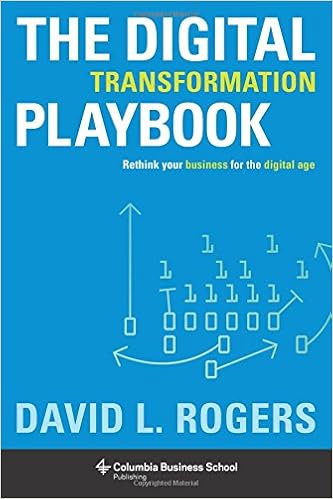
Recently brought to my attention and In the middle of reading. The Digital Transformation Playbook: Rethink Your Business for the Digital Age (Columbia Business School Publishing) Apr 5, 2016
by David L. Rogers     Non technical.  Relatively up to date.  Easily scannable.  Talks about my favorite topic of data assets.

" .... Rethink your business for the digital age.

Every business begun before the Internet now faces the same challenge: How to transform to compete in a digital economy?

Globally recognized digital expert David L. Rogers argues that digital transformation is not about updating your technology but about upgrading your strategic thinking. Based on Rogers's decade of research and teaching at Columbia Business School, and his consulting for businesses around the world, The Digital Transformation Playbook shows how pre-digital-era companies can reinvigorate their game plans and capture the new opportunities of the digital world. ... " 

Need to Lead in Data and Analytics

From McKinsey: In a new survey, executives say senior-leader involvement and the right organizational structure are critical factors in how successful a company’s analytics efforts are, even more important than its technical capabilities or tools. ... " 

Innovation Lessons from Lego

Have followed Lego fpr motivating innovation for years, but never saw it used internally.  Whats the barrier?  Culture?  Seen as too trite?

Lessons from Lego: Low risk innovation tools for everyone! 
by Evan Shellshear

LEGO has earned the right to celebrate. Not only are kids playing with more mini LEGO people than there are human beings on the planet but in 2015, they were nominated by Forbes as the most powerful brand in the world. For a company which was on the brink of bankruptcy in 2004, the toy maker has made an amazing turnaround. They restructured, hired a new CEO, and forged more licensing partnerships than ever before. Most importantly, they discovered the secret to some of the world’s most successful, low risk innovation strategies.

These strategies helped LEGO create a powerful brand envied by every other company in the world. However, successes like these are not, and need not be, restricted to global companies with billions in revenue.

The point of low risk innovation tools is that one can use them to test ideas in any setting and with any budget. Whether you are a cash strapped startup or a Forbes 500 firm, sustainable innovation can be your ticket to success.

Out of LEGO’s lessons and that of hundreds of other companies, I have distilled the most successful techniques to innovate cheaply and effectively. They are all contained in the book Innovation Tools and, as an additional bonus, the readers of the Innovation Excellence community can get the Kindle version for free this week by clicking here. Among others, my book answers questions regarding how strategies used by companies like LEGO are able to turn companies around from looming bankruptcy to industry leading success. ....  " 

Saturday, July 09, 2016

Amazon Robot Arms Race

Good overview ....   What characteristics of robotic capability are most involved?

How Amazon Triggered a Robot Arms Race
In 2012 Jeff Bezos scooped up warehouse automation firm Kiva. Everyone else is still trying to catch up.    by Kim Bhasin  .... 

Business Process Modeling and the Future of Work

A starting approach to build a data science, or a cognitive model, is to work from  a business process model.   Ultimately any improvement changes a way of doing things.   Making it faster, better, cheaper.  Even a very simple,  even sketch of a model can remind us what we are doing, what data we need, and how we can measure the results.

Business process models (BPM)  have been doing this for some time for more complex processes.   And during an earlier, cognitive era,  we directly  used rules and process flow to model the reasoning parts.  In machine learning, there are methods like decision trees, which more directly model a portion of a process.  Decisions are by their nature cognitive.

Yet still have not seen enough integration of BPM and cognitive.   Especially in a way they could be used to sell and deliver starter proof of concepts.   To clients or management.   And to experiment with alternatives in their implementation and value.

I was told that IBM was experimenting with the idea, but had not seen much input.    Then came upon the article here  

Not yet convinced that this is simple enough to construct the kind of easy templates for Process+Cognitive+Analytics I would like to see done.  But it does appear to be a good start.   Digging deeper.   I also like the mention of Sense-Respond-Learn which takes it to stronger elements of cognitive.

Open Source Game Sand Boxes for AI

Always liked the idea of setting up 'sandbox' environments where new technologies could be tested under varying contexts.    Good to see this being done here in AI with open source.  Will like to see some examples. Why not invite humans to specific experiments?

" ... Microsoft has published the source code for its Project Malmo, allowing anyone to conduct artificial intelligence experiments in the world of Minecraft with a little programming.

It unveiled the project, then known as AIX, back in March, but at the time only a few academics had access to the code. On Thursday, the company made good on its promise to open the source code by publishing it on Github.

Minecraft, the blocky world-building game that Microsoft paid $2.5 billion for two years ago, is an ideal place to test how artificial intelligences will interact with one another and with humans.  .... "

Hybrid AI

The broad term was unfamiliar to me, but turns out I have been a proponent of it for some time.    The most successful applications we did, that ran successfully for decades, were applications of this type.

Still see as different from 'Assistant/Augmentation' AI.   Here human expertise, live or otherwise, is installed, seamlessly, in the system itself.

Manuel Ebert explores how hybrid AI works, its impact on businesses, using it in existing businesses, and what we can expect from hybrid artificial intelligence in the years to come. ...  " 

Imagination Institute

Brought to my attention, The Imagination Institute.

Grants Competition
The Imagination Institute hosted a grants competition titled Advancing the Science of Imagination: Toward an “Imagination Quotient” to test, validate and develop an intervention for imagination and perspective. See here for the list of award recipients.

Event Series
The Imagination Institute also plans to host a series of events to bring together researchers with notable imaginative and creative individuals in academic, cultural, and organizational domains. The purpose of these events is to further refine our understanding of the domain specificity of imagination and of future funding.  ....  "

Friday, July 08, 2016

Starting an IOT Project

Nicely done piece by William Vorhies, which points to previous lessons as well.

IoT 101 – Lesson 3: Everything You Need to Know to Start Your IoT Project

Posted by William Vorhies on July 5, 2016  
Summary:  In this Lesson 3 we continue to provide a complete foundation and broad understanding of the technical issues surrounding an IoT or streaming system so that the reader can make intelligent decisions and ask informed questions when planning their IoT system.     ..... " 

Beacons Now Support NFC

Estimote Supports NFC.  Recall some question about the use of beacons with NFC in a past project.   This advance addresses another RFID related approach.    " .... Google announced last month that its Play Store will start notifying users of pertinent apps they might want to download based off their location. App developers will need beacons to trigger those notifications, and Estimote’s location beacons are one possible choice for them. Though those beacons were released only a few months ago, they're already being updated to include programmable NFC ....  "

Editions of Watson Analytics

Recent Update. To what degree can this breakdown of analytics be useful, and how can it create an automation of data analytics.

A short video on the number of industry editions of Watson Analytics that exist to date.  Completely non technical.

 .. IBM Watson Analytics is a smart data analysis and visualization service on the cloud that helps just about anyone quickly discover patterns and meanings in their data – all on their own. Whether you need to quickly spot a trend or you have a team that needs to analyze report data, there's a Watson Analytics edition for you. ... " 

For more information about how to use Watson Analytics for free, visit www.watsonanalytics.com

Having a Good Day at Work

Can appreciate the thought now that I spend less time at a physical office.  Podcast, with some useful strategies.    " ... How to Have a Good Day:Harness the Power of Behavioral Science to Transform Your Working Life, author Caroline Webb looks at some of the more fascinating recent discoveries that could could help workplaces everywhere become happier spaces.  ... "  

Controlling Smartphones With Your Eyes

In CACM:
" ... In an effort to make eye tracking cheap, compact, and accurate enough to be included in smartphones, a group of researchers is crowdsourcing the collection of gaze information and using it to teach mobile software how to figure out where you’re looking in real time.  ... " 

Thursday, July 07, 2016

Semantic Data Lakes

Via Tim Smith.

Hadoop, Triple Stores, and the Semantic Data Lake, by Alex Woodie

Hadoop-based data lakes are springing up all over the place as organizations seek low-cost repositories for storing huge mounds of semi-structured data. But when it comes to analyzing that data, some organizations are finding the going tougher than expected. One solution to the dilemma may be found in Hadoop-resident graph databases and the notion of the semantic data lake.

Despite their growing popularity, data lakes have taken a bit of heat lately as analyst firms like Gartner call into question their long-term viability. Without a way to organize the schemaless data that people are shunting into Hadoop en masse, the data lakes risk becomes convoluted quagmires, where data goes in and nothing useful comes out.   ....  " 

Latency in Voice Command Response

The inside story of how Amazon created Echo, the next billion-dollar business no one saw coming ... by Eugene Kim, Dave Limp   Creating the Echo.  .....

Reaction:  The Challenge of latency in answering questions.  how important is it?   Not sure I agree that the latency delay in performing a task is the most important thing.  I wold prefer a slightly slower answer to a question if I was more assured of it being correct.   Especially in an expert interaction.   Latency is nicely measurable, and so it is often used. ....

Predicting Crime

In Forbes: An update on the use of predictive analytics for crime prediction and prevention.   With a number of suppliers in the space described.   Looks to be mostly about the capture of crime related statistics, the precise predictive methods in use are not covered.  Have the algorithms progressed as much as the sensory leverage?

Prevention of Systemic Risk

Here about financial risks.  And in fact what are systemic risks?  Here appears to be defined by risks that are driven by external context and that are not considered in the design of the system.   Major changes in the economy is an obvious example.  In such cases,  basic systems assumptions fail.

More generally the Wikipedia writes:  " ... In finance, systemic risk is the risk of collapse of an entire financial system or entire market, as opposed to risk associated with any one individual entity, group or component of a system, that can be contained therein without harming the entire system. ... " 

 In Knowledge@Wharton.

Microsoft Betting its Future on AI

Microsoft beyond AI and into how the world is presented in conjunction with data and intelligence.

In theVerge: " ... Satya Nadella bounded into the conference room, eager to talk about intelligence. I was at Microsoft’s headquarters in Redmond, WA, and the company’s CEO was touting the company's progress in building more intelligent apps and services. Each morning, he told me, he puts on a HoloLens, which enables him to look at a virtual, interactive calendar projected on a wall of his house. Nadella appeared giddy as he described it. The system was intelligent, productive, and futuristic: everything he hopes Microsoft will be under his leadership. ... " 

Wednesday, July 06, 2016

Reading People

More psych, on reading people.  I like the fact that quoted are less university researchers and more people that need to read people as a business.  Good links to more.

Machine Learning Images from Mobile Video

Continued interest in fast image analysis.  Has implications for the perception of images, and thus space and what exists within it.

Google acquires image recognition startup Moodstocks to bolster machine learning efforts by Maria Deutscher, 

   "... Google acquires image recognition startup Moodstocks to bolster machine learning efforts  by Maria Deutscher   " ... The Paris-based startup has developed an image recognition tool specifically optimized to process media captured via mobile devices. ... " 

Social Engagement Metric and Marketing

Challenging a metric is usually useful.  In Adage:  Related to project we did.

Why Google's 'Time Spent' Metric May Not Be the Best Measure
Marketers Need an Accurate Way to Measure How Their Content Is Performing    By Jerrid Grimm.

Data Science in the Amazon Supply Chain

I worked in the design and implementation of supply chain systems for many years in the enterprise. The following article gives a high level overview of what a category and technology leader, Amazon, is doing in this space today.

   It also illustrates the breadth of what is considered supply chain in the enterprise.   Slightly disagree that all of this is 'optimization'.  It is mostly incremental improvement of complex decision processes .... under rapidly changing context.

21 data science systems used by Amazon to operate its business
Posted by Vincent Granville  in DSC
Most of these systems are or should be used by most large organisations, for business optimization. ....  " 

Nestle Open Innovation Platform

Via Idea Connection.   Former colleague and P&Ger Pete Blackshaw is quoted.

" ... In an interview with The Drum, Pete Blackshaw, global head of digital and social media at Nestlé, said:  '…the way that will work is we will take businesses challenges from within Nestlé. That might be how to figure out the next generation Nescafe or figure out the Internet of Things for Nespresso, and it will allow entrepreneurial technology start-ups to almost bid for the opportunity and then we have to respond in a certain amount of time.'  ... " 

Tuesday, July 05, 2016

Single Use IOT Devices

Provoking piece. Thinking of applications like the Amazon Dash as a means to attach to narrow markets.  And also thinking about the security.   As mentioned, it is about convenience.  But also about how that convenience can be attached to location, leading to focusing of replenishment.

In ReadWrite: The Ridiculous World of Single-Use IoT Devices by Ryan Matthew Patterson

" ... There is also a rise of single-use IoT devices that only do one thing, and that one thing is only really useful in occasional circumstance. It’s actually difficult to find many cases of single-use IoT devices in today’s ecosystem.  ....   Perhaps the biggest example of this category is the Amazon Dash Button. We’ve written about this device before, both in how its original purpose takes the concept of IoT too far and how its extended purpose could make IoT technologies more useful. ... "

Zero Knowledge Proofs

Intriguing introduction to zero knowledge proofs using graphs, with implementing Python code. Technical, but worth a look.  " ... In this post we’ll get a strong taste for zero knowledge proofs by exploring the graph isomorphism problem in detail. In the next post, we’ll see how this relates to cryptography and the bigger picture. The goal of this post is to get a strong understanding of the terms “prover,” “verifier,” and “simulator,” and “zero knowledge” in the context of a specific zero-knowledge proof. Then next time we’ll see how the same concepts (though not the same proof) generalizes to a cryptographically interesting setting. ... " 

Anatomy of a Unicorn

McKinsey: Podcast: Anatomy of a unicorn: Why tech start-ups are staying private

Up-and-coming technology companies are no longer racing to list their shares on public markets. A massive increase in late-stage venture capital has enabled many start-ups to reach valuations of more than $1 billion while remaining in private hands. ... " 

Spoken Voice Recognition

In Datanami: Has improved considerably recently ...  I have been following improvements in Siri, Cortana and Echo, and the abilities are now considerable.  Now can we just control how we speak when we use language to these devices?  And do they always need individual training to be effective?

Gartner Says Shift in Tech Focus

Gartner produces interesting statistics. 
" ... While investment in new technology for products and services continues to be a priority (55% of the CEOs ranked it in their top 2), a focus on innovating in the way their companies engage with customers was a top priority for more CEOs (58%).      They are recognizing that changing market conditions, particularly more tech-savvy business buyers, requires them to become more industry and business focused, to adapt their sales practices, and to think about new delivery models.

And, more importantly, they feel this shift is paying off where it counts.  42% of the CEOs cited improvements in customer experience and service as the key change that has driven more wins (Incidentally, the combination of new or better products was only 15%). ... " 

Food Retail and Consumer Technology

Digital Tech in Retail:

" ... The shopper is disrupting the retail food scene much more than technology, speakers at last week's FMI Connect show in Chicago said. Technology needs to shift from a focus on serving retailers to a focus on serving consumers who have integrated digital technology into their lives and shopping habits, said Enda McShane, CEO of Velocity Worldwide and Darius Technologies. ... " 

Monday, July 04, 2016

Teaching People to Innovate

In Innovation Excellence:  Can you teach people to innovate?  Good piece:    by Jeffrey Phillips
" ... The answer to this question is:  no.  You cannot teach people to innovate.  You can teach them tools and techniques like TRIZ or trend spotting.  You can teach them process methodologies that lead them from customer needs to ideas to prototypes to customer validation tests.  You can teach them to think about innovation outcomes that are more disruptive or radical than incremental change.  You can show them Doblin’s Ten Types model to help them think through the potential outcomes of an innovation activity.  But until they understand that innovation is a holistic implementation of all of these factors, and requires them to release their fear, uncertainty and doubt, you are hammering jello to a wall.  It will not stick.  The wall must be removed as the knowledge is applied. ... " 

Wearables Replacing Smartphones?

A number of design changes seem to be pointing that way. More convenience and intelligence with better use of other senses could make it happen.   More In CWorld.

Sunday, July 03, 2016

Global Digital Flows

From McKinsey

Digital globalization: The new era of global flows
By James Manyika, Susan Lund, Jacques Bughin, Jonathan Woetzel, Kalin Stamenov, and Dhruv Dhingra

Conventional wisdom says that globalization has stalled. But although the global goods trade has flattened and cross-border capital flows have declined sharply since 2008, globalization is not heading into reverse. Rather, it is entering a new phase defined by soaring flows of data and information.

Exploding digital flows in a deeply connected world ... Remarkably, digital flows—which were practically nonexistent just 15 years ago—now exert a larger impact on GDP growth than the centuries-old trade in goods, according to a new McKinsey Global Institute (MGI) report, Digital globalization: The new era of global flows. And although this shift makes it possible for companies to reach international markets with less capital-intensive business models, it poses new risks and policy challenges as well.  ... " 

Boxie Gathers Stories

I was reminded of this MIT Media Lab 'Lab Cast'.    An old example, but made me think of gathering and telling stories.  " .... Boxie is a mobile interactive robotic camera built with the goal of actively capturing stories about its environment and the people within it. ....  ".   We considered it for internal 'pedia' construction, but it was not culturally compliant.

A Personal Pharmacy Assistant

Growth of the focused personal assistants.   Named 'Pillo'.   Had looked closely at how pharma use compliance could be achieved in the past.  Consider professional advice given or implied.

Meet 'Pillo,' the robot that aims to be your personal pharmacy
This precious robot is the pharmacist of the future. "Pillo" can monitor health data, give nutrition information and even distribute medication.  .... "    by Ryan Sedmak

IOT and Vending Machines: Coke and SAP

Good points, we had looked at related applications with vending,  service communications and kiosks, before the advent of IOT.   Cognitive application of supply chain efficiencies can also be considered.

In Readwrite: IoT and vending machines: Connecting an already distributed network  by Amanda Razani. 

Smart vending machines are an excellent example of how the “Internet of Things” (IoT) can affect business models and revenue flow. ... The vending industry is going through a sea of change. The access to data that is generated by connected devices has changed the way companies can operate and the way in which they generate revenues. Constant connectivity allows companies to offer customers a product utility as a service, as seen in vending machines.

With user customization, improved security, smart payments and continuous monitoring of inventory and consumption patterns, opportunities for vending machines to dispense new products in more profitable ways, using a network of connected devices are limitless.

Traditional vending machines have evolved, since they were first introduced almost a century ago. Technology that includes more digital capabilities, has transformed them into smart, connected machines.  ... 

 ....  chipmaker Intel have stepped in with smart solutions, enabling a new breed of connected, smart vending machines that offer lower operating costs and cloud connectivity.  With these solutions, machine operators can diagnose and repair systems remotely, and receive real-time updates, such as supply and operating status, that can be used to optimize delivery schedules and improve inventory tracking and controls.

Includes a case study of Coke and SAP.

Saturday, July 02, 2016

Behavior as Permission to Act

Former colleague Martin Lindstrom looks at the shaping of store behavior.   In Fastcompany: 

" ... How Your Grocery Store And Your Coworkers Unconsciously Shape Your Behavior  ... Without realizing it, we're constantly recalibrating how much "permission" we have to act in certain ways.   ... " 

A Designers Guide to AI

AI from a design perspective.   Most often these days see it from a engineers or data science view.   We should also consider it from the point of view of what the decision maker needs.   Good lengthy piece.

" ....  designers know the basics: The principles of user-centric design lay the groundwork for building a great AI system. The approach is rooted in anthropology, and it has taught designers to do a lot of things well. The best designers know how to create things that people want, and understand how, to use. But until recently, that’s where the design process stopped.  ... " 

by Patrick van Hoof   ... With number of design oriented links.

Set Diversity Optimization

A topic not often distinctly mentioned, but it is an element of many problems.  Should get more attention.  In Open Data Science.   Contains a number of good business examples.   A broad definition of decision success.  Might be a good idea to always think of problems this way so that measures used and solutions are thought of in the same way.  Technical:

" ... Consider the following problem: for a number of items U = {x_1, …x_n} pick a small set of them X = {x_i1, x_i2, ..., x_ik} such that there is a high probability one of the x in X is a “success.” By success I mean some standard business outcome such as making a sale (in the sense of any of: propensity, appetency, up selling, and uplift modeling), clicking an advertisement, adding an account, finding a new medicine, or learning something useful.   .... " 

Friday, July 01, 2016

Empirical Creativity

Imagination Man ...

Scott Barry Kaufman has been called “the leading empirical creativity researcher of his generation.” Now he wants to use the tools he’s developed to unleash the “quiet potential” of vulnerable people—including kids like him—and help them flourish. .... 

Earlier this year Kaufman published Wired to Create: Unraveling the Mysteries of the Creative Mind, co-authored with journalist Carolyn Gregoire, in which he argues that creativity—with all of its questioning, close observation, and thinking differently—can be another (or even better) way to evaluate smarts than traditional measures. “You can have a very high IQ and still be ‘dumb’ in my opinion,” he says, “if you score low on things like intellectual curiosity and openness to experience.”

He wrote the book “to bring together the latest science on creativity and get it out there to a popular audience as a platform for talking about the importance of creativity and imagination as a way of living. A lot of it comes out of research I’ve been conducting [on ideas] like the importance of ‘openness to experience.’”

By  Joann Greco

Cooperation of Humans and AI

A key element of neear future tech.   How do we work with AI?   Will it be able to solve 'societal' issues?    Or is that something we have to do ourselves?

The Partnership of the Future
Microsoft’s CEO explores how humans and A.I. can work together to solve society’s greatest challenges. By Satya Nadella

Advanced machine learning, also known as artificial intelligence or just A.I., holds far greater promise than unsettling headlines about computers beating humans at games like Jeopardy!, chess, checkers, and Go. Ultimately, humans and machines will work together—not against one another. Computers may win at games, but imagine what’s possible when human and machine work together to solve society’s greatest challenges like beating disease, ignorance, and poverty.

Doing so, however, requires a bold and ambitious approach that goes beyond anything that can be achieved through incremental improvements to current technology. Now is the time for greater coordination and collaboration on A.I. ... " 

Microsoft Wants Linkedin's Algorithms?

What is more important for Microsoft, the data from its huge member base, or the algorithms that Linkedin has developed to utilize that data?     Have never noticed anything particularly magic in Linkedin systems.  Except for sheer volume and architecture management.  If anything their interfaces have seemed shaky.  But perhaps there some hidden science there.   Computerworld says its the algorithms. 

Being a Change Agent via Analytics

Like the simplicity angle ....

How to be a change agent using analytics By Lisa Bodell

What does it mean to be a change agent in business today? When I spoke to the audience at IBM Vision 2016 in May 2016, the theme was from the title of my book, Kill the Company. Yes, it’s a provocative title—and it’s intended to be. Too many companies today suffer from what I call “the twin evils of complexity and complacency.” I believe that the leaders of companies, and indeed, people up and down the organization chart, need to be change agents. They need to kill the company—metaphorically speaking—to challenge the status quo and help their organizations break free of rules, structures and ways of working that have outlived their usefulness.

Of course, it’s not really the companies themselves that we should kill. Instead, what I think people need to do is to kill the things that hold our companies back. We need to eliminate complexity and complacency in the form of organizational inertia and the endless, enervating processes and procedures that can sap an organization’s energy and stifle innovation. ....  "