


Like to see much more about this.... planning is tough, and rarely done completely. Analytic and AI methods require considerable attention to detail and process. Doing planning well with these methods is probably difficult. Visualization does help.
AI, Robots, Data Software Helping Create New Approach for Planning Cities of the Future
Purdue University News in ACM
By Chris Adam
Purdue University researchers have developed a unique strategy to plan future cities, by streamlining building information modeling software through new approaches to data. Purdue's Jiansong Zhang said the methodology facilitates full software development based on data from industry foundation classes, "for any task in the life cycle of an [architecture, engineering, and construction] project." Zhang added that the researchers created a visualization program deployed via the new technique. Said Zhang, "The new method can help eliminate missing or inconsistent information during software development." The data encompasses all sectors, functions, and life-cycle stages of software development for construction projects. .... "
Showing posts with label Strategic Planning. Show all posts
Showing posts with label Strategic Planning. Show all posts
Friday, June 21, 2019

Monday, May 27, 2019
Automation ROI
Perspectives on value measurement, when and how.
Measuring Automation ROI by Deloitte
Maximizing your mileage...
Taking a strategic, holistic approach to automation ROI during the planning phases helps to build a more robust business case, demonstrating how enterprise automation can drive competitive advantage and how you’ll save money. ... "
Measuring Automation ROI by Deloitte
Maximizing your mileage...
Taking a strategic, holistic approach to automation ROI during the planning phases helps to build a more robust business case, demonstrating how enterprise automation can drive competitive advantage and how you’ll save money. ... "
Wednesday, February 06, 2019
JP Morgan's AI Initiatives
A Podcast and transcript. Useful case study. in Knowledge@Wharton
Apoorv Saxena, global head of AI and machine-learning services for JPMorgan Chase, discusses the bank's AI initiatives.
When America’s biggest bank, JPMorgan Chase, hired Apoorv Saxena in August 2018 as its global head of AI and machine-learning services based in San Mateo, Calif., finance industry watchers saw that as a sign that the bank was making a big bet on artificial intelligence to shape its future strategies. Saxena previously headed product management for cloud-based artificial intelligence at Google. At JPMorgan Chase, he also oversees asset and wealth management artificial intelligence technology.
According to Saxena, AI will help financial services companies expand banking penetration worldwide, launch new products and deepen customer engagements. AI has helped technology companies and others outside of traditional banking enter financial services, such as with mobile banking and digital money offerings. However, only firms that can earn customer trust, meet regulatory compliance requirements and enhance customer service will make the cut, he notes. Meanwhile, regulations will have to come up to speed with the impact of AI’s advances and help make way for the industry to grow. The U.S. could learn some useful lessons from other countries like China, as it seeks to promote innovation as well as growth at scale, he adds.
JPMorgan Chase is making a significant investment in AI research, Saxena notes. For now, he is focusing on building “a rock-star team” to lead AI initiatives at the bank, he says on social media. Knowledge@Wharton spoke with Saxena at the recently held AI Frontiers conference in San Jose.
An edited transcript of the conversation follows. ... "
Apoorv Saxena, global head of AI and machine-learning services for JPMorgan Chase, discusses the bank's AI initiatives.
When America’s biggest bank, JPMorgan Chase, hired Apoorv Saxena in August 2018 as its global head of AI and machine-learning services based in San Mateo, Calif., finance industry watchers saw that as a sign that the bank was making a big bet on artificial intelligence to shape its future strategies. Saxena previously headed product management for cloud-based artificial intelligence at Google. At JPMorgan Chase, he also oversees asset and wealth management artificial intelligence technology.
According to Saxena, AI will help financial services companies expand banking penetration worldwide, launch new products and deepen customer engagements. AI has helped technology companies and others outside of traditional banking enter financial services, such as with mobile banking and digital money offerings. However, only firms that can earn customer trust, meet regulatory compliance requirements and enhance customer service will make the cut, he notes. Meanwhile, regulations will have to come up to speed with the impact of AI’s advances and help make way for the industry to grow. The U.S. could learn some useful lessons from other countries like China, as it seeks to promote innovation as well as growth at scale, he adds.
JPMorgan Chase is making a significant investment in AI research, Saxena notes. For now, he is focusing on building “a rock-star team” to lead AI initiatives at the bank, he says on social media. Knowledge@Wharton spoke with Saxena at the recently held AI Frontiers conference in San Jose.
An edited transcript of the conversation follows. ... "
Monday, March 26, 2018
Graphs and Task Planning
Technical Perspective: A Graph-Theoretic Framework Traces Task Planning By Nicole Immorlica
Communications of the ACM, Vol. 61 No. 3, Page 98
10.1145/3176187
Algorithmic game theory has made great strides in recent decades by assuming standard economic models of rational agent behavior to study outcomes in distributed computational settings. From the analysis of Internet routing to the design of advertisement auctions and crowdsourcing tasks, researchers leveraged these models to characterize the performance of the underlying systems and guide practitioners in their optimization. These models have tractable mathematical formulations and broadly applicable conclusions that drive their success, but they rely strongly on the assumption of rationality.
The assumption of rationality is at times questionable, particularly in systems in which human actors make most of the decisions and in systems that evolve over time. Humans, simply put, are bad at thinking about the impact of their actions on their environment and their future. We see this every day in the way we manage our time. Students cram for exams despite planning not to, and even though it is well documented that well-spaced studying produces improved learning results with equal effort. Humans in lab experiments also consistently exhibit similar irrational time-inconsistent planning and procrastination behavior.
(Abstract)
Thursday, February 22, 2018
Time Inconsistent Planning
Could such a method be used to plug into process models to include planning functions?
Time-Inconsistent Planning: A Computational Problem in Behavioral Economics By Jon Kleinberg, Sigal Oren
Communications of the ACM, Vol. 61 No. 3, Pages 99-107 (Abstract)
10.1145/3176189
In many settings, people exhibit behavior that is inconsistent across time—we allocate a block of time to get work done and then procrastinate, or put effort into a project and then later fail to complete it. An active line of research in behavioral economics and related fields has developed and analyzed models for this type of time-inconsistent behavior.
Here we propose a graph-theoretic model of tasks and goals, in which dependencies among actions are represented by a directed graph, and a time-inconsistent agent constructs a path through this graph. We first show how instances of this path-finding problem on different input graphs can reconstruct a wide range of qualitative phenomena observed in the literature on time-inconsistency, including procrastination, abandonment of long-range tasks, and the benefits of reduced sets of choices. We then explore a set of analyses that quantify over the set of all graphs; among other results, we find that in any graph, there can be only polynomially many distinct forms of time-inconsistent behavior; and any graph in which a time-inconsistent agent incurs significantly more cost than an optimal agent must contain a large "procrastination" structure as a minor. Finally, we use this graph-theoretic model to explore ways in which tasks can be designed to motivate agents to reach designated goals. .... "
(Full article requires subscription)
Time-Inconsistent Planning: A Computational Problem in Behavioral Economics By Jon Kleinberg, Sigal Oren
Communications of the ACM, Vol. 61 No. 3, Pages 99-107 (Abstract)
10.1145/3176189
In many settings, people exhibit behavior that is inconsistent across time—we allocate a block of time to get work done and then procrastinate, or put effort into a project and then later fail to complete it. An active line of research in behavioral economics and related fields has developed and analyzed models for this type of time-inconsistent behavior.
Here we propose a graph-theoretic model of tasks and goals, in which dependencies among actions are represented by a directed graph, and a time-inconsistent agent constructs a path through this graph. We first show how instances of this path-finding problem on different input graphs can reconstruct a wide range of qualitative phenomena observed in the literature on time-inconsistency, including procrastination, abandonment of long-range tasks, and the benefits of reduced sets of choices. We then explore a set of analyses that quantify over the set of all graphs; among other results, we find that in any graph, there can be only polynomially many distinct forms of time-inconsistent behavior; and any graph in which a time-inconsistent agent incurs significantly more cost than an optimal agent must contain a large "procrastination" structure as a minor. Finally, we use this graph-theoretic model to explore ways in which tasks can be designed to motivate agents to reach designated goals. .... "
(Full article requires subscription)
Sunday, October 29, 2017
Planning for AI
Do you plan for direct value delivery, people augmentation, to replace people, or to provide outright magic ?
Planning for AI
What you need know before committing to AI.
By Mike Loukides
Do you have your AI strategy? If you don't, be prepared to lose. Or at least, so say the consultants, tech journalists, and pundits. You can't possibly be a competitive modern company without an AI strategy.
We are the last people to say that AI isn't important, or that having an AI strategy isn't a good thing—or even that, if you don’t start thinking about AI initiatives now, you’ll end up behind. Artificial intelligence is a game changer: it’s a revolutionary cluster of technologies that has the potential to make fundamental changes in how we live and work. However, much of what we read gets the cart before the horse. An AI strategy, if it's just an AI strategy, doesn't get you very much. An AI strategy that’s just an AI strategy is a weird managerial superstition: pour magic AI sauce over everything, and it will be awesome.
It needs to be said, though it should go without saying: don't build an AI strategy without first thinking about your business objectives. Better: incorporate AI into your business strategies rather than building an AI strategy. Think about how AI can help you achieve your goals; don’t make it a goal in itself. On her blog Quam Proxime, Kathryn Hume counsels established enterprises against the temptation to become “AI-first.” Instead, they should be “something-else-first-with-an-AI-twist.” Enterprises need AI systems to work smart, to take advantage of their data, to learn about and improve on their past performance. Enterprises don’t need AI to become something new that they don’t yet understand. They need AI to build on the strengths they already have, and become what they already are, but better. That’s how to be innovative and transformational; and if, along the way, you come up with ideas and products that disrupt your current practices (and your industry), so much the better. ... "
Planning for AI
What you need know before committing to AI.
By Mike Loukides
Do you have your AI strategy? If you don't, be prepared to lose. Or at least, so say the consultants, tech journalists, and pundits. You can't possibly be a competitive modern company without an AI strategy.
We are the last people to say that AI isn't important, or that having an AI strategy isn't a good thing—or even that, if you don’t start thinking about AI initiatives now, you’ll end up behind. Artificial intelligence is a game changer: it’s a revolutionary cluster of technologies that has the potential to make fundamental changes in how we live and work. However, much of what we read gets the cart before the horse. An AI strategy, if it's just an AI strategy, doesn't get you very much. An AI strategy that’s just an AI strategy is a weird managerial superstition: pour magic AI sauce over everything, and it will be awesome.
It needs to be said, though it should go without saying: don't build an AI strategy without first thinking about your business objectives. Better: incorporate AI into your business strategies rather than building an AI strategy. Think about how AI can help you achieve your goals; don’t make it a goal in itself. On her blog Quam Proxime, Kathryn Hume counsels established enterprises against the temptation to become “AI-first.” Instead, they should be “something-else-first-with-an-AI-twist.” Enterprises need AI systems to work smart, to take advantage of their data, to learn about and improve on their past performance. Enterprises don’t need AI to become something new that they don’t yet understand. They need AI to build on the strengths they already have, and become what they already are, but better. That’s how to be innovative and transformational; and if, along the way, you come up with ideas and products that disrupt your current practices (and your industry), so much the better. ... "
Wednesday, September 27, 2017
Unified Retail Planning
Very thoughtful piece in ChainStoreAge, the Introduction ...
" ... Using Unified Retail Planning to Break Out of Functional Silos
Retail today isn’t for the faint-hearted. A recent quote from business magnate and investor Warren Buffet is quite telling, “I think retailing is just too tough for me, just generally.”
The sector is undergoing profound transformation and only time will tell who the winners will be. In any case, it is evident that retailers no longer can afford to sustain inefficient operations. The ability to keep operational costs in check is essential for profitability and even survival.
Three Types of Operational Costs
In retail, three kinds of costs dominate: space, staff and stock. The relative importance of each expense varies by retail segment and company. Proportionally, apparel retailers typically have the largest cost of space (real estate and leases), while grocery retailers have the largest staff costs (store personnel), and specialty retailers fall somewhere in between.
Improvements in each of these cost areas – space, staff and stock – can have a significant impact on the bottom line. Consequently, you can be sure that the merchandising, store operations, and supply chain departments at any given retailer are constantly honing their processes for improved efficiency. .... "
" ... Using Unified Retail Planning to Break Out of Functional Silos
Retail today isn’t for the faint-hearted. A recent quote from business magnate and investor Warren Buffet is quite telling, “I think retailing is just too tough for me, just generally.”
The sector is undergoing profound transformation and only time will tell who the winners will be. In any case, it is evident that retailers no longer can afford to sustain inefficient operations. The ability to keep operational costs in check is essential for profitability and even survival.
Three Types of Operational Costs
In retail, three kinds of costs dominate: space, staff and stock. The relative importance of each expense varies by retail segment and company. Proportionally, apparel retailers typically have the largest cost of space (real estate and leases), while grocery retailers have the largest staff costs (store personnel), and specialty retailers fall somewhere in between.
Improvements in each of these cost areas – space, staff and stock – can have a significant impact on the bottom line. Consequently, you can be sure that the merchandising, store operations, and supply chain departments at any given retailer are constantly honing their processes for improved efficiency. .... "
Tuesday, December 27, 2016
Strategic Thinking Skills
This time of year always seems to a good time to think about good strategy. HBR Considers that everyone should be thinking about this.
Strategic Thinking ... 4 Ways to Improve Your Strategic Thinking Skills by Nina Bowman
So what specific steps can you take to be more strategic in your current role?
Start by changing your mindset. If you believe that strategic thinking is only for senior executives, think again. It can, and must, happen at every level of the organization; it’s one of those unwritten parts of all job descriptions. Ignore this fact and you risk getting passed over for a promotion, or having your budget cut because your department’s strategic contribution is unclear. ,,, "
Strategic Thinking ... 4 Ways to Improve Your Strategic Thinking Skills by Nina Bowman
So what specific steps can you take to be more strategic in your current role?
Start by changing your mindset. If you believe that strategic thinking is only for senior executives, think again. It can, and must, happen at every level of the organization; it’s one of those unwritten parts of all job descriptions. Ignore this fact and you risk getting passed over for a promotion, or having your budget cut because your department’s strategic contribution is unclear. ,,, "
Monday, October 10, 2016
Intelligent Smart City Marketing
Via MIT:
Intelligent Marketing in Smart Cities Crowdsourced Data for Geo-Conquesting
Bo-Wei Chen, Monash University
Wen Ji, Chinese Academy of Sciences
The authors’ approach for intelligent marketing in smart cities uses large-scale crowdsourcing based on mobile user behavior for market planning. The approach tracks user trails via mobile devices to help marketers analyze crowd flows for geo-conquesting. ... "
Intelligent Marketing in Smart Cities Crowdsourced Data for Geo-Conquesting
Bo-Wei Chen, Monash University
Wen Ji, Chinese Academy of Sciences
The authors’ approach for intelligent marketing in smart cities uses large-scale crowdsourcing based on mobile user behavior for market planning. The approach tracks user trails via mobile devices to help marketers analyze crowd flows for geo-conquesting. ... "
Sunday, July 24, 2016
Autonomous Selection of Mars Laser Targets
 An example of autonomy for a complex system. Here the Curiosity Rover on Mars. At one level this is similar to closed loop process control, but with more complex sensor analysis being done in that loop.
 Assume this increases accuracy, speed in going through analysis goals ... and even decreases targeting labor required to enact, thus decreasing cost. So is closed loop process control we did in manufacturing, though the adjustments here appear to start to arise to the strategic. Article and image examples:
From the Jet Propulsion Lab:
" .... NASA's Mars rover Curiosity is now selecting rock targets for its laser spectrometer -- the first time autonomous target selection is available for an instrument of this kind on any robotic planetary mission.
Using software developed at NASA's Jet Propulsion Laboratory, Pasadena, California, Curiosity is now frequently choosing multiple targets per week for a laser and a telescopic camera that are parts of the rover's Chemistry and Camera (ChemCam) instrument. Most ChemCam targets are still selected by scientists discussing rocks or soil seen in images the rover has sent to Earth, but the autonomous targeting adds a new capability. ... "
Sunday, July 10, 2016
Digital Transformation Playbook
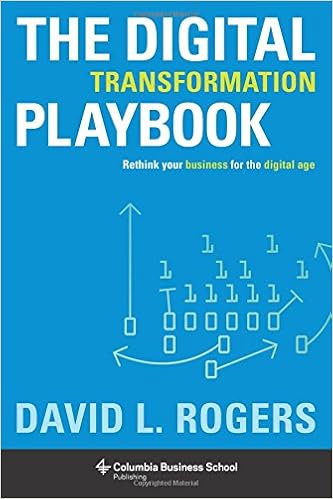 Recently brought to my attention and In the middle of reading. The Digital Transformation Playbook: Rethink Your Business for the Digital Age (Columbia Business School Publishing) Apr 5, 2016
by David L. Rogers Non technical. Relatively up to date. Easily scannable. Talks about my favorite topic of data assets.
" .... Rethink your business for the digital age.
Every business begun before the Internet now faces the same challenge: How to transform to compete in a digital economy?
Globally recognized digital expert David L. Rogers argues that digital transformation is not about updating your technology but about upgrading your strategic thinking. Based on Rogers's decade of research and teaching at Columbia Business School, and his consulting for businesses around the world, The Digital Transformation Playbook shows how pre-digital-era companies can reinvigorate their game plans and capture the new opportunities of the digital world. ... "
Wednesday, March 16, 2016
A Digital Transformation Playbook
Brought to my attention by a correspondent at Columbia
The Digital Transformation Playbook: Rethink Your Business for the Digital Age (Columbia Business School Publishing) Hardcover – April 5, 2016
by David L. Rogers
On order, they write:
Rethink your business for the digital age.
Every business begun before the Internet now faces the same challenge: How to transform to compete in a digital economy?
Globally recognized digital expert David L. Rogers argues that digital transformation is not about updating your technology but about upgrading your strategic thinking. Based on Rogers's decade of research and teaching at Columbia Business School, and his consulting for businesses around the world, The Digital Transformation Playbook shows how pre-digital-era companies can reinvigorate their game plans and capture the new opportunities of the digital world.
Rogers shows why traditional businesses need to rethink their underlying assumptions in five domains of strategy―customers, competition, data, innovation, and value. He reveals how to harness customer networks, platforms, big data, rapid experimentation, and disruptive business models―and how to integrate these into your existing business and organization. ... "
The Digital Transformation Playbook: Rethink Your Business for the Digital Age (Columbia Business School Publishing) Hardcover – April 5, 2016
by David L. Rogers
On order, they write:
Rethink your business for the digital age.
Every business begun before the Internet now faces the same challenge: How to transform to compete in a digital economy?
Globally recognized digital expert David L. Rogers argues that digital transformation is not about updating your technology but about upgrading your strategic thinking. Based on Rogers's decade of research and teaching at Columbia Business School, and his consulting for businesses around the world, The Digital Transformation Playbook shows how pre-digital-era companies can reinvigorate their game plans and capture the new opportunities of the digital world.
Rogers shows why traditional businesses need to rethink their underlying assumptions in five domains of strategy―customers, competition, data, innovation, and value. He reveals how to harness customer networks, platforms, big data, rapid experimentation, and disruptive business models―and how to integrate these into your existing business and organization. ... "
Tuesday, November 17, 2015
Marketing Planning, Fast and Slow
Some interesting thoughts on planning in CustomerThink. I would like more thoughts on operational planning and decision making now that we have more and faster data.
" ... With less than two months remaining in 2015, many marketers have already started planning their marketing efforts for 2016, and most others will begin their planning process over the next few weeks. To develop a successful marketing program for a B2B company, marketers must make several important decisions, and those decisions require answers to a number of questions. Some of the most critical questions are ... "
" ... With less than two months remaining in 2015, many marketers have already started planning their marketing efforts for 2016, and most others will begin their planning process over the next few weeks. To develop a successful marketing program for a B2B company, marketers must make several important decisions, and those decisions require answers to a number of questions. Some of the most critical questions are ... "
Wednesday, August 26, 2015
Making Smarter Long term Decisions
In K@W: A classic issue. And with the rocking of the market lately, an important one.
If we were rational, we would make choices based on our long-term goals, not our short-term desires. Spoiler alert: We’re not, and we don’t — which can present real dangers to us as individuals and as a society. But recent research from Wharton operations and information management professor Howard Kunreuther and Elke Weber of Columbia University suggests that it’s possible to hack our decision-making processes for the better. Their working paper is titled, “Aiding Decision Making to Reduce the Impacts of Climate Change.”
In an interview with Knowledge@Wharton, Kunreuther talks about the flaws in our thinking that lead us to ignore major long-range problems until they become imminent disasters, and how, with the right incentives and strategies, we could be nudged into wiser behaviors. ... "
If we were rational, we would make choices based on our long-term goals, not our short-term desires. Spoiler alert: We’re not, and we don’t — which can present real dangers to us as individuals and as a society. But recent research from Wharton operations and information management professor Howard Kunreuther and Elke Weber of Columbia University suggests that it’s possible to hack our decision-making processes for the better. Their working paper is titled, “Aiding Decision Making to Reduce the Impacts of Climate Change.”
In an interview with Knowledge@Wharton, Kunreuther talks about the flaws in our thinking that lead us to ignore major long-range problems until they become imminent disasters, and how, with the right incentives and strategies, we could be nudged into wiser behaviors. ... "
Thursday, June 25, 2015
McKinsey: Digital Hives: Creating A Surge Around Change
" .... Leading-edge digital platforms similarly take center stage in Arne Gast and Raul Lansink’s “Digital hives: Creating a surge around change.” Based on four case studies, the article illustrates how executives can harness the power of social media to engage large and widely dispersed groups of employees by encouraging new ideas and ways of working, driving organizational change, and even helping to formulate better strategy. ... "
Tuesday, June 16, 2015
Nash and Business Strategy
In K@W: John Nash lives on in business strategy. A Podcast:
" ... Nash’s body of work in game theory earned him the 1994 Nobel Prize in Economic Sciences along with game theorists Reinhard Selten and John Harsanyi. He became a household name thanks to the 2001 film A Beautiful Mind. Based on the book by Sylvia Nasar, the movie — which won the Academy Award for Best Picture — stars Russell Crowe as Nash and depicts his battles with paranoid schizophrenia.
Wharton management professors Keith W. Weigelt and Louis A. Thomas, who count game theory among their research specialties, discussed why Nash’s work will endure on the Knowledge@Wharton show on Wharton Business Radio on SiriusXM channel 111. (Listen to the podcast at the top of this page.) ... "
" ... Nash’s body of work in game theory earned him the 1994 Nobel Prize in Economic Sciences along with game theorists Reinhard Selten and John Harsanyi. He became a household name thanks to the 2001 film A Beautiful Mind. Based on the book by Sylvia Nasar, the movie — which won the Academy Award for Best Picture — stars Russell Crowe as Nash and depicts his battles with paranoid schizophrenia.
Wharton management professors Keith W. Weigelt and Louis A. Thomas, who count game theory among their research specialties, discussed why Nash’s work will endure on the Knowledge@Wharton show on Wharton Business Radio on SiriusXM channel 111. (Listen to the podcast at the top of this page.) ... "
Saturday, May 16, 2015
P&G Reviews Media Buying, Planning
An opportunity for new kinds of analytics in media planning. A space that I was closely involved in. In Adage: " .... P&G to Review Massive Media Planning and Buying Business Across North America In 2014, P&G Spent $2.7 Billion on U.S. Measured Media ... "
Wednesday, May 06, 2015
Seed Strategy
Seed Strategy has merged with Burke
" .. Seed Strategy grows big ideas for brands around the globe. Our clients can expect smart strategic thinking, head-turning creative and lasting relationships driven by the thrill of the process and the sweetness of success. ... "
" .. Seed Strategy grows big ideas for brands around the globe. Our clients can expect smart strategic thinking, head-turning creative and lasting relationships driven by the thrill of the process and the sweetness of success. ... "
Thursday, April 23, 2015
Human in the Loop Planning
Attended excellent CSig talk today by Subbarao Kambhampati and Kartik Talamadupula of ASU and IBM Watson on Human-in-the-Loop Planning and Decision Support.
Human in the Loop Planning (HILP) is a classic example of studying how people interact with smart systems. These systems are getting much smarter, but how they interact and cooperate with people is still a problem. You can say that any advisory system has components of planning systems. In the enterprise we looked at many such systems, and delivered a few. Yet there are many 'challenges' that still exist in making such systems work, still not resolved after decades of work.
The slides from the talk give an excellent overview of work still underway. Recording replay. Also, they point to their much more detailed tutorial on the subject. An interesting aspect, an idea we never addressed directly, they call: "Planning for Crowdsourcing". Since we were involved with marketing problems, which dealt with consumer group activities, this could have been of much use to us.
If you have any interest in applied AI for commercial use, this is an area to follow.
Human in the Loop Planning (HILP) is a classic example of studying how people interact with smart systems. These systems are getting much smarter, but how they interact and cooperate with people is still a problem. You can say that any advisory system has components of planning systems. In the enterprise we looked at many such systems, and delivered a few. Yet there are many 'challenges' that still exist in making such systems work, still not resolved after decades of work.
The slides from the talk give an excellent overview of work still underway. Recording replay. Also, they point to their much more detailed tutorial on the subject. An interesting aspect, an idea we never addressed directly, they call: "Planning for Crowdsourcing". Since we were involved with marketing problems, which dealt with consumer group activities, this could have been of much use to us.
If you have any interest in applied AI for commercial use, this is an area to follow.
Wednesday, April 22, 2015
Knowing what Part of your Knowledge and Data Matters
 K&W: Talk and transcript. And you can add to this, data as an asset, both structured and unstructured. Data can be turned into applicable knowledge with analytics, which nicely combines all of these concerns and measurements. See tab link Data Assets for more here on that topic.
" ... In the corporate world, businesses are regularly graded on the value of their assets: They report to their shareholders about the physical assets they own, their cash in hand, and revenues and profits, both past and expected. But when it comes to measuring their knowledge assets — the value of those can be harder to gauge. However, the entrepreneurial management of knowledge assets can be critical to the success of any business.
In this interview with Knowledge@Wharton, Wharton management professor Ian MacMillan, who is also director of the Sol C. Snider Entrepreneurial Research Center, and Wharton adjunct professor Martin Ihrig, who is also a practice professor in the University of Pennsylvania’s Graduate School of Education, talk about how organizations can determine which of their knowledge assets are the most strategically relevant, and how best to deploy them. ... "
Subscribe to:
Posts (Atom)