


 This has seen lots of press. The largest swiss army knife, reviewed in the Guardian. Lots of demand, most likely as a conversation piece as opposed to a practical solution. Brought to mind many of the things we do in IT today. Is it a model for Google? Is it SAP for the large enterprise? My knife has a couple of blades and a corkscrew, quite sufficient.
Wednesday, December 20, 2006
Swiss Army IT Model
This has seen lots of press. The largest swiss army knife, reviewed in the Guardian. Lots of demand, most likely as a conversation piece as opposed to a practical solution. Brought to mind many of the things we do in IT today. Is it a model for Google? Is it SAP for the large enterprise? My knife has a couple of blades and a corkscrew, quite sufficient.

Tuesday, December 19, 2006
NY Times and Consumer Generated Media
Pete Blackshaw, longtime colleague, writes in his always lively consumer generated media blog about an article in the NY Times on consumer generated media: " ... the writer, Keith Schneider, using Nielsen BuzzMetrics as his backdrop, asks all the right questions about whether CGM, and in particular CGM analysis and text-mining, is destabilizing the typical "go to market" strategy for most brands ...". Fascinating view of where all this is going, where measurement is ultimately the driving force. Quote from the NY Times article:
" ... the branding game has changed radically, largely because of the myriad choices the Internet provides consumers and because of the economic influence of widespread Web pontificating, known as the blogosphere, which barely existed as a popular force until about four years ago...As consumers eagerly post word-of-mouth commentary in online communities, message boards and Web logs, a straightforward question confronts brandmeisters: Who wins and who loses as time-tested practices of mass production and mass marketing are undermined by the informed and often cranky voices of the knowledge age?... "
Monday, December 18, 2006
Google Patents
A colleague writes to remind me of Google's patent searches: Patents site, which searches full text on all US patents, this search, returns only about 740 patents assigned to IBM, far fewer than there are, from a database of about 7 million. So appears to be far less inclusive than that of the USPTO office. I like the simple search, though. Its also not well known that you can search for US patents in a normal Google search by entering the word 'patents:' in front of the number, e.g. 'patent:4288291'. One odd thing, I used to often use Google's UPC code search by typing in just a 10-digit UPC/Bar code to ID a grocery item and also get some sample prices. Now when you do that I note that it sends you to a UPC search site.
Sunday, December 17, 2006
IBM's Dogear
From IBM Think Research Magazine: Fetch!. An article on their Dogear social bookmarking research. IBM's Think Research is a development journal I have followed for years. IBM positions Dogear as the first social bookmarking method that is usable by organizations. They are planning to announce offerings that deliver some of their internal social technology work:


" ...Social bookmarking services have dramatically changed the way we find information on the Internet. Popularized by a service named del.icio.us, these Web-based applications provide a centralized place to store, organize and share Internet bookmarks. There are two distinguishing characteristics of social bookmarking systems. The first is the use of keywords, or tags, that a user enters to describe the links he or she saves. These tags allow users to organize and display their collection with labels that are meaningful to them. Furthermore, multiple tags allow bookmarks to belong to more than one category, a limitation of the traditional hierarchically organized folders found in most Web browsers. The second significant characteristic of these social bookmark applications is the social nature of their use. While bookmark collections are personally created and maintained, they are typically also visible to others. As a result, users benefit by getting pointers to new information from others while at the same time getting a general sense of what other people's interests are ...."
Saturday, December 16, 2006
Dove Solicits Ads
Unilever's Dove is the latest brand to solicit consumer generated ads for a TV spot. Details here.
Friday, December 15, 2006
Is this the Way to Run a Meeting?
I have spent some time in the last month getting up to speed in the Second Life (SL) virtual world. I worked with similar things, notably Blaxxun, back in the 90s. Always have been interested in highly visual interfaces, so this is a great example that I awaited with anticipation. It also has received much interest from the business world.
I received an invitation from IBM to attend a tour of their new virtual islands today. This was the first time I attended a formal meeting in SL. There were about 50 or so avatar participants and maybe 10 IBM speakers, tour guides and helpers there. Not all of the participants (including me) were highly skilled at controlling their character, so there was lots of bumping, colliding and fidgeting before getting people in their seats. The interface does not lend itself to precise control. Some seated avatars were so large and strangely adorned that I wanted to yell 'down in front'! But it did not actually matter since there was little to see down in front.
Like most SL presentations this consists of words typed in a chat box and supporting visuals. The visuals, though, require some adeptness with zooming in to a screen, also something more of an advanced technique. As a result the visuals were mostly just repetitions of the chat text. While the presentation goes on, you can IM other people in the crowd to create a back conversation, but that too can become confusing, and if you type in the wrong box, your acid comment becomes part of the public presentation!
Once the short presentation was over, we were invited to group teleport to a number of venues that IBM and their clients had developed. Teleporting groups is also something that the interface does not do well, so with each teleport some folks were left behind. You could also fly there, if you knew the way.
One of the venues I was most interested in was the Circuit City store. Last night I had watched as the IBM architects spent some last minute time fixing it up, and that process, done by avatars in virtual space, was fascinating to watch. That worked well, at least in my perception, because there were only a few folks, and they were very focused on a task.
The building of the Circuit City store (In SL search for 'IBM 10') and all of the store venues along a virtual street in SL are very well done. Much effort has been expended to get these looking architecturally good. Inside the store, however, things are different. I have interacted with some real-world store designs, and the CC world is strange indeed, very large aisles and too small products. Once you get more than a few shoppers things become chaotic. Its another case of precision control of your avatar, and a relatively small space, that makes it hard to do anything like they envision. Also, what they are trying to do is create a old style 'a pick and choose store' in a virtual space. People are now used to click- picking things from a screen to do online shopping, they don't need the illusion of aisles. Most stores in SL use click able pictures on the wall to sell their goods.
Once outside of the store you can fly and explore at will, you don't need the precision required in a narrow space. Leaving, I felt that breath of relief when you get out of a too-enclosed space.
What was amazing is the amount of effort that IBM has put into this effort. Dozens of staff and those that I talked to were very enthusiastic about the idea. The SL space also allowed an openness that I had not seen before. On the steps of the virtual Almaden Virtual labs (the real one is in San Jose) I got into some great conversations about virtual space, navigation and data interaction. Made some great connections. That would have been hard to set up otherwise.
I chatted with a colleague about this and his reaction was that IBM is investing in this not for the now, but in the belief that this will become something in the not too distant future. A very good point. Sure the SL interface is klunky and imprecise, but that problem will be solved, perhaps by some other vendor.
So congratulations to IBM to get this work started for us. There is lots to do. Its worth exploring on a not too crowded day. We need to understand how real companies can sell real things in a virtual world. And along the way, just how to have a simple meeting there.
I received an invitation from IBM to attend a tour of their new virtual islands today. This was the first time I attended a formal meeting in SL. There were about 50 or so avatar participants and maybe 10 IBM speakers, tour guides and helpers there. Not all of the participants (including me) were highly skilled at controlling their character, so there was lots of bumping, colliding and fidgeting before getting people in their seats. The interface does not lend itself to precise control. Some seated avatars were so large and strangely adorned that I wanted to yell 'down in front'! But it did not actually matter since there was little to see down in front.
Like most SL presentations this consists of words typed in a chat box and supporting visuals. The visuals, though, require some adeptness with zooming in to a screen, also something more of an advanced technique. As a result the visuals were mostly just repetitions of the chat text. While the presentation goes on, you can IM other people in the crowd to create a back conversation, but that too can become confusing, and if you type in the wrong box, your acid comment becomes part of the public presentation!
Once the short presentation was over, we were invited to group teleport to a number of venues that IBM and their clients had developed. Teleporting groups is also something that the interface does not do well, so with each teleport some folks were left behind. You could also fly there, if you knew the way.
One of the venues I was most interested in was the Circuit City store. Last night I had watched as the IBM architects spent some last minute time fixing it up, and that process, done by avatars in virtual space, was fascinating to watch. That worked well, at least in my perception, because there were only a few folks, and they were very focused on a task.
The building of the Circuit City store (In SL search for 'IBM 10') and all of the store venues along a virtual street in SL are very well done. Much effort has been expended to get these looking architecturally good. Inside the store, however, things are different. I have interacted with some real-world store designs, and the CC world is strange indeed, very large aisles and too small products. Once you get more than a few shoppers things become chaotic. Its another case of precision control of your avatar, and a relatively small space, that makes it hard to do anything like they envision. Also, what they are trying to do is create a old style 'a pick and choose store' in a virtual space. People are now used to click- picking things from a screen to do online shopping, they don't need the illusion of aisles. Most stores in SL use click able pictures on the wall to sell their goods.
Once outside of the store you can fly and explore at will, you don't need the precision required in a narrow space. Leaving, I felt that breath of relief when you get out of a too-enclosed space.
What was amazing is the amount of effort that IBM has put into this effort. Dozens of staff and those that I talked to were very enthusiastic about the idea. The SL space also allowed an openness that I had not seen before. On the steps of the virtual Almaden Virtual labs (the real one is in San Jose) I got into some great conversations about virtual space, navigation and data interaction. Made some great connections. That would have been hard to set up otherwise.
I chatted with a colleague about this and his reaction was that IBM is investing in this not for the now, but in the belief that this will become something in the not too distant future. A very good point. Sure the SL interface is klunky and imprecise, but that problem will be solved, perhaps by some other vendor.
So congratulations to IBM to get this work started for us. There is lots to do. Its worth exploring on a not too crowded day. We need to understand how real companies can sell real things in a virtual world. And along the way, just how to have a simple meeting there.
Thursday, December 14, 2006
Second Life Guide
 Making my way through Second Life: The Official Guide, by Michael Rymaszewski et al. This is a good introduction to the idea of SL, but its not a substitute for at least a demonstration of the real thing. The book does not build a case for SL, assumes you have some enthusiasm already. Its a good skim after experiencing SL, because it will alert you to a number of things you had probably not understood. Good jump start in virtual worlds.
Graphically well done, as should be the case with a visual world. A useful appendix, but no index. Does not give you an alert to the fact that all is not running smoothly in SL of late, with slowdowns and odd behaviors. Mild cautions, but no dirt here. The advanced section on building and scripting is not a manual, but an introduction, the book points to online resources. There is an attached CD with code samples I have not examined as yet. Finally a lot of emphasis on avatar appearance, which I can find distracting.
Wednesday, December 13, 2006
Made to Stick
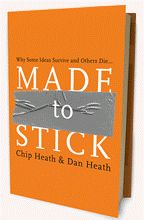
Scott Underwood, correspondent at IDEO, sends along his view of the forthcoming Made to Stick: Why Some Ideas Die and Others Survive , by Chip Heath and Dan Heath. The question is a useful one:
" ... Why do some ideas thrive while others die? And how do we improve the chances of worthy ideas? In Made to Stick, accomplished educators and idea collectors Chip and Dan Heath tackle head-on these vexing questions. Inside, the brothers Heath reveal the anatomy of ideas that "stick" and explain sure-fire methods for making ideas stickier, such as violating schemas, using the Velcro Theory of Memory, and creating "curiosity gaps." ..."Made to Stick website (with a lengthy excerpt).
Tuesday, December 12, 2006
Google Research Video Picks
I recently discovered the videos that Google Research puts together from speakers on their campus. Some very interesting topics about technology, research and directions. They just put together a 'top twenty' thats worth scanning for gems. Example: How to Survive a Robot Uprising.
Monday, December 11, 2006
Coke Teams with YouTube
About Coke's Wishcast effort:
Coke Taps YouTube For Video Card CampaignHere former P&G I-Marketing manager Tim Kopp of Coke invites you with a (rather wooden) video. Will follow this to see if it takes off.
" ... COCA-COLA IS TEAMING UP WITH YouTube for a new joint marketing effort--one that doesn't involve Mentos or exploding Diet Coke bottles. Instead, Coke is sponsoring a page on YouTube that enables users to select or create their own holiday video "cards" to send to friends and family ..."
Sunday, December 10, 2006
Grace Hopper's 100th Birthday
 I see that this past Friday was Grace Hopper's 100th birthday. Here is a personal reminiscense from my first professional IT experience:
In 1975 I was freshly graduated from the University of Pennsylvania with a degree in astrophysics. There were few opportunities for someone with an undergraduate degree in that field, so I took the civil service exam, and ended up taking the train from Philadelphia to Washington for the first time. I had hired on as an analyst for the national Military Command Systems Support Center at the Pentagon. We were some number of floors below the ground, responsible for keeping several military computers running. We were managed by the Navy, so even though we were far below dry earth, when a new officer arrived they were 'piped on board' in shipboard fashion.
Just around the corner from my cubicle was the very humble office of then Captain Grace Hopper. Having always been interested in the history of technology I recognized the name mainly due to her involvement in the development of compilers for the computer language Cobol. She gave a talk a few months after my arrival and I was impressed by her vision. Her talks gave a nod to computer history, which she had been a key part of, but even more so she was sincerely interested in the future of computing. In her talks then and for many years afterward she always carried a length of wire with her as a prop, this wire, she would declare, is a nanosecond ... equating time and computing power. She then would talk about where she thought computing was going. Her views were mainly about numerical rather than symbolic computing, but even in this realm she understood computers were stretching far beyond just numbers.
She was very rarely in her office, even then acting as an ambassador for military computing. I made it a point to stop by one day when she was there and introduced myself, a slightly longhaired young computer neophyte. She was gracious and invited me in. We hit it off because most of my work in school had been about solving differential equations, which had been an interest of hers. I was particularly interested in the pre-compiler world of the computer, when developing code was more like wiring a machine than writing logic. She also spoke about her involvement with Eckert and Mauchly, early pioneers of computer hardware. Looking back I should have had far more questions, but our chat ended far too soon. It was our only meeting, I moved on soon afterward, though we said hi a few more times in the hall.
She was appointed to admiral in 1985 and died in 1992, just as the Web had been developed. What might she have thought about that development? Many millions of non-technical people using 'Hypertext Transfer Protocol' to communicate? Her development of the compiler was a first step from numerical computing to using computers to manipulate text and communicate thoughts freely between ordinary people. She showed the way in the very early years and helped make it happen.
Good short overview of her life and achievements.
FA Dill June, 2004
Saturday, December 09, 2006
Volvo Designed by Women
At a recent futurists meeting (more on that later) Volvo Brand presented about a car designed entirely by, but not necessarily just for women.
" ... When Volvo Cars' all-women team developed the YCC (Your Concept Car), they had a thesis: if you meet the expectations of women you exceed the expectations of men..."
Its a concept car, and as you know, concept cars don't usually go directly to the market, if they are ever sold at all. Ideas in the cars do evolve and are typically integrated into new models. Here is more with lots of pictures.
" ... When Volvo Cars' all-women team developed the YCC (Your Concept Car), they had a thesis: if you meet the expectations of women you exceed the expectations of men..."
Its a concept car, and as you know, concept cars don't usually go directly to the market, if they are ever sold at all. Ideas in the cars do evolve and are typically integrated into new models. Here is more with lots of pictures.
Thursday, December 07, 2006
Operating Theaters of the Future

Recently attended a local meeting on RFID tagging. One presentation at that meeting was by Jim Milkovitch and Jim Waldron of Johnson & Johnson's Ethicon division. They currently have over 150 people and 35 projects working in the area of RFID tagging. One particular area of interest is their work with hospitals to created what they are calling 'operating theaters' of the future. In such an environment anything that enters the room is tagged. Patients, doctors and nurses will wear active (battery powered) tags which will be read at entrance portals. Instruments will carry passive tags. The inventory, movement and use of every object in the room will be micro tracked to determine its use. The use of objects in the theater will be compared to lists of procedures and processes to check for errors. Costs will be automatically determined. This will allow J&J to give value-added capabilities to their instruments and surgical goods. Whats useful here is the linking of sensors to procedure and location. Areas that require very precise manipulation, risk and cost, certainly like surgery, are where we will see early useful of these capabilities.
Power of Your Data
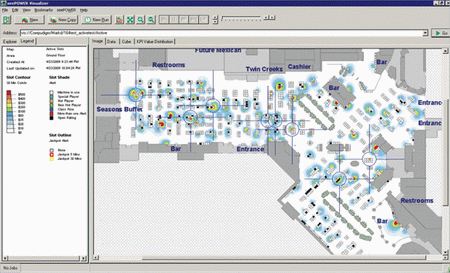 Who deals better with data than the casinos? The Las Vegas company Compudigm here a number of times, in the recent copy of Teradata Magazine (Good mag that I have neglected for too long) , an article by Craig Mullins about advanced analytics, especially consumer behavior. Since most casino customers use loyalty cards and most purchases are made at the point of choice, they can be tracked and analyzed in ways just dreamed of by retail. We met with them a few years ago, and they had just started to work with retail data. Good example of visual abstractions overlayed on location data.
 " ... Traditional business intelligence (BI) enables companies to understand the "here" and "now," and even some of the "why," of a given business situation. Advanced analytics goes deeper into the "why." Employing a business-focused approach, it comprises techniques that help build models and simulations to create scenarios, understand realities, improve decision making and determine forecasts. These techniques include--but are not limited to--data mining, predictive analytics, applied analytics, data visualization and statistics ..."
Wednesday, December 06, 2006
Blacksmith's Gift
Former colleague Dan T. Davis has become an independent author of children's books. " ... The Blacksmith's Gift was awarded the 2005 Benjamin Franklin Award for the 'best independently published juvenile/young adult fiction of the year' ...". Congratulations, Dan. Check out the site.
Monday, December 04, 2006
Big Brands and Brain Waves
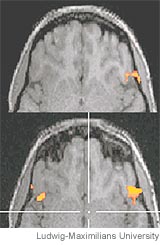 In a recent WSJ article: Biology of Brand Identity, another article on what has come to be called neuromarketing. The images at the right describe the findings that a big brand requires less brain work, top image, than a weaker brand, bottom. This idea has reaped considerable controversy in implying that it could result in a 'buy switch' that could be activated by the right kind of marketing message. This is new research that specifically looks at the strength of brands, and tried to determine how that aspect effects the brain. I believe that this and and related ideas will ultimately become important if they can be validated. . "... use of MRI to gauge consumer response eliminates the risk of dishonest or incomplete answers in market surveys. In an informal experiment, she says she asked a student to name his favorite brand of sneakers, and he said Adidas. But under MRI, the Puma brand evoked a more positive response, and the student admitted that his favorite shoe was a Puma model that was out of his price range ...". Some of my other posts discuss this further and compare it to other biological sensor models.
Shortfuze Machinima
 New correspondent Juhi Shareef of Arup's futures group sends along this link to Shortfuze's Moviestorm, a machinima moviemaking package. We have been experimenting with Reallusion's Iclone. What can businesses do with machinima? It can be used to link prerecorded audio to animated avatars. It can also be used to place prerecorded video into virtual worlds. Or easily set up creative storyboards. Other ideas are welcome.
Sunday, December 03, 2006
Home Robots in Retreat?
PC Mags Lance Ulanoff in his Holiday Robot Buying Guide, writes about the status of home robotics that aim to do real work. Following this for some time, I get a similar read. Though I did see the Roomba prominently displayed at the local Costco. No things we could really use; robot butler, or home maid or laundry helper yet on the horizon.
" ... Wow Wee's Robosapien and Roboraptor and iRobot's Roomba should have been the sparks that ignited the industry. Instead, the lit fuse has been snuffed out. Wow Wee's newest Roboreptile is entertaining, but it has done little to move the industry forward. Meanwhile, the excitement surrounding iRobot's Roomba has dimmed, and the Scooba floor mop has not been a Roomba-like hit. Worse yet, instead of more companies flooding into the consumer robot space, there seem to be fewer. Sony dismantled its consumer robots division and killed off the AIBO and the Qrio, and Radio Shack dumped the Vex robot kit ..."
Friday, December 01, 2006
Expert Systems on Handheld Devices
More Expert Systems Migrate To Handheld Devices
Exsys ports its Corvid expert systems software to run on Hewlett-Packard's iPaq pocket PCs and 40 other handheld devices. Exsys was one of the expert systems companies we worked with in the 90s. The article uses the term 'inference engine' ... let me explain. Almost all computer code today, like that running the browser you are reading this on, is operating in a step by step order determined by the code itself. This process is fundamentally not much different from the coding that was done in the 50's.
If you use an inference engine, the program logically proceeds to a desired business conclusion we were attempting to resolve. This sounds more like the way our thought process works (if we really were that logical!) so its considered a part of artificial intelligence. Its also much easier to understand the code used, making maintenance easier. Back in the late 80s, we thought that by now all computer coding would be done with 'inference engines', but it turned out to be more difficult than we thought.
Exsys ports its Corvid expert systems software to run on Hewlett-Packard's iPaq pocket PCs and 40 other handheld devices. Exsys was one of the expert systems companies we worked with in the 90s. The article uses the term 'inference engine' ... let me explain. Almost all computer code today, like that running the browser you are reading this on, is operating in a step by step order determined by the code itself. This process is fundamentally not much different from the coding that was done in the 50's.
If you use an inference engine, the program logically proceeds to a desired business conclusion we were attempting to resolve. This sounds more like the way our thought process works (if we really were that logical!) so its considered a part of artificial intelligence. Its also much easier to understand the code used, making maintenance easier. Back in the late 80s, we thought that by now all computer coding would be done with 'inference engines', but it turned out to be more difficult than we thought.
" ... You may soon be carrying expert systems in your pocket or briefcase. More companies are adapting their software to run on handheld devices that use inference engines rather than hard coding, and customers should have more choices in the coming months and years.
The latest evidence is from software vendor Exsys, which this month ported its Corvid expert systems software to run on Hewlett-Packard's iPaq pocket PCs. The software also can run on about 40 other handhelds that rely on the Document Type Definition subset of IBM WebSphere's Java Virtual Machine. The ability to arm knowledge workers with expert systems loaded onto handheld devices makes expert knowledge much more accessible. This could be especially useful to sales reps, technicians, or field repair workers.
The National Park Service is looking at using the handheld version of Corvid to evaluate areas that experienced environmental damage, Exsys CEO Dustin Huntington says. With the software, the Park Service could hire people with limited environmental background to go to a site and evaluate the situation as if they were environmental engineers conducting the survey. The expert system, in the form of a questionnaire, would guide the surveyors down the right path, prompting them to seek specific new information based on the response to the last question they entered. "By having that knowledge there," Huntington says, "they're able to put the logic of the decision maker out there in the field." ...
Short Persuasive Videos
Professor BJ Fogg of the Captology Lab at Stanford, who we have worked with a number of times asks for our help:
" ... My Stanford students have created short videos (averaging 2 minutes) that show how Web 2.0 services persuade people and change their behaviors. The videos are interesting -- and sometimes funny. I'm inviting you to help evaluate some of these videos before December 4th. You can rate one video or twenty. The choice is yours. To watch and rate the videos. The videos with the highest rating will be featured in the Captology Film Festival on December 7th at Stanford. You're invited to join us at that event. For more info ..."The Captology Lab is worth taking a look at. It addresses the problem of how to use computers to persuade, beyond just the advertising level.
Thursday, November 30, 2006
The Traveling Shopper Problem

Our correspondent at Wharton, Peter S. Fader, writes in Knowledge@Wharton about how shoppers travel in stores. The Traveling Salesman problem is a classic operations research model where someone must find a best path to visit pre-designated locations in minimal time. For example, a shopper seeking to find all the items on a list. Fader mines his large database of real shopper travel data to find out what shoppers really do, and what kind of challenges this raises for retailers when designing or reformatting their stores. Some lessons for us as well. Link to the full paper.
Wednesday, November 29, 2006
Backseat Virtual Reality
From Newscientist a game that uses passing scenery to provide a base for a game. A nice idea of borrowing or augmenting reality to provide richness for a game experience:
" ... Researchers at the Interactive Institute in Stockholm, Sweden, are testing an in-car gaming system that allows passengers to play an interactive game based on the buildings, forests, and rivers passed along a route while driving. The Backseat Playground uses such landmarks encountered during a trip to build a story, complete with in-game characters and events. The game matches sights for events in an adventure that might involve a murder mystery or a werewolf thriller, and makes use of a GPS receiver to provide geographical data, a handheld computer for player interaction as the story builds, and headphones for players to listen to phone calls and walkie-talkie messages from in-game characters. A laptop in the trunk, which correctly positions the car in the virtual world, connects the GPS receiver, handheld computer, and headphones. "We are trying to suggest spaces and places and events and have the user fill in the gaps to build a narrative," explains John Bichard, who developed the interactive game with colleagues Liselott Brunnberg and Oskar Juhlin. The computer scientists are considering integrating voice recognition into the game, which would allow players to talk directly to the characters. Rob Aspin, with the Center for Virtual Environments at Britain's University of Salford is intrigued by the way in which content is delivered for the game. "It can create a high sense of presence and interaction while hiding most of the technology from the user," says Aspin ..."
Sunday, November 26, 2006
Lincoln's T-Mails
Here visiting Georgia Tech and getting some reading time in. Part of the way through Tom Wheeler's: Mr. Lincoln's T-Mails: The Untold Story of How Abraham Lincoln Used the Telegraph to Win the Civil War. I guess its important to have such an extensive subtitle today, the book browser has to have no reason to misunderstand the topic of the book. Like it so far, I was intrigued by the thumbnail history of telegraphy. It is fashionable to credit Samuel Morse with nothing more than self-promotion today. I compared this history with the Wikipedia entry on telegraphy, and that entry filled in some of the non-US details. Wheeler attributes the development of the actual code to Morse's assistant Alfred Vail, though Vail's WP article says otherwise. Tom Standage's The Victorian Internet, links the telegraph to the internet and is a good related book.
Good book. Lincoln (the only US president granted a patent to date) became increasing enamored with the ability to directly communicate with his people in the field. In some cases the military did not know what to make of these communications. Wheeler makes much of saying that Jefferson Davis, who had a military background, meddled with his military, causing some confusion. Lincoln, who had no military background, he suggests communicated without meddling. Not sure I buy that, in hindsight Lincoln won, so for whatever ultimate cause, his communication was not meddling.
If you have interest in the history of technology or the military a good read.
Good book. Lincoln (the only US president granted a patent to date) became increasing enamored with the ability to directly communicate with his people in the field. In some cases the military did not know what to make of these communications. Wheeler makes much of saying that Jefferson Davis, who had a military background, meddled with his military, causing some confusion. Lincoln, who had no military background, he suggests communicated without meddling. Not sure I buy that, in hindsight Lincoln won, so for whatever ultimate cause, his communication was not meddling.
If you have interest in the history of technology or the military a good read.
Saturday, November 25, 2006
Journal of New Communications Research

New Communications Research (SNCR) has published the first issue of their new Journal. SNCR is
" ... A global nonprofit think tank dedicated to the advanced study of new communications tools, technologies and emerging modes of communication, and their effect on media, professional communications, business and society.."Their wiki in Socialtext. Online preview, with contents. I am loosely affiliated with this nonprofit as a research fellow. A good initial selection of readable papers about social technologies, oriented to a degree in their use for external relations. Still reading and will report on useful learnings. Order here.
Friday, November 24, 2006
Will Wikis Help with Knowledge?
Nicholas Carr, who I make sure to read , talks about whether " ... Web 2.0 tools like wikis will help automate the management of knowledge in companies. Also featured in the podcast is a debate on whether IT matters strategically..." Podcast here in the Financial Times.
Wednesday, November 22, 2006
Risks of Public Mentions
An August 3 talk by Google intern Dan Frankowski. Good view of privacy issues. Via Roughtalk, where Carr raises a flag about the implications for Web 3.0 / Semantic Web.
Tuesday, November 21, 2006
Human Computation: Useful Games

This is a bit of old news, but taking another look at it. There are things that computers can do. There are also things that humans can do that computers cannot, for example recognizing things in an image. But humans are relatively costly to engage. How can I get humans to engage with problems that are tough for computers to do? Engage them with a game!! Luis von Ahn of Carnegie Mellon gives a lecture on the idea. Its about using games that produce a purposeful result. His best known example is the ESP Game. Could this kind of thing be applied in design, marketing, branding? I think there are some gems there. More from Ahn's research outline. A colleague points out something similar done by Amazon, their Mechanical Turk. No broad application that I have seen as yet, though the potential is enticing.
Monday, November 20, 2006
Mastering Languages

From IBM Think Research Magazine -> MASTORing Languages.. This article struck a strong chord. I saw part of the demonstration mentioned below at the 64 NY Worlds Fair. They also demonstrated simple database lookup, all done with punchcards. This was before displays were common. We have a come a long way, this article talks about progress in processing natural languages, both recognizing and translating:
" ... IBM's history with speech recognition technology goes back over 40 years - to its first demonstration of an early discrete translation system at the 1964 New York World's Fair. At the time, the "shoebox recognizer" could identify the spoken digits zero through nine - for a total of ten words.
Speech recognition has made great strides from those humble beginnings, but travel and the Internet are helping to flatten the world, so more robust and comprehensive tools are needed. Going through airports or getting sick in a foreign country and not being able to understand or communicate can be, at best, inconvenient and, at worst, dangerous. ..."
Sunday, November 19, 2006
Executive Dashboard Designs
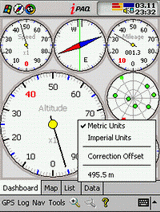
Many companies are in the process of developing executive dashboards, cockpits, consoles, portals or whatever you want to call them. To what degree have these been designed to be most effective? Designer Edward Tufte has addressed these issues in a number of 'ask ET' pieces at his web site. Worth a look, these discussions provide a number of designs and discussions by designers.
" ...Can you share any guiding principals or "best practices" in the presentation of Key Performance Indicators to the senior executives of a corporation? Discussion.
Executive Dashboard
I'm developing an executive dashboard, and I haven't been satisfied with the business graphics that are widely available (e.g. gauges, dials, stoplights). I decided to make a "Zen" version of a KPI status indicator, using as little color as possible, and incorporating E.T's innovative "Spark Line" metaphor for display of trends. The graphic below shows the proposed KPI display across the top of a browser screen with a descriptive example in the middle. Any feedback would be wonderful!
Discussion..."
Saturday, November 18, 2006
Journeys in Second Life

Above is a picture I recently took in one of my journeys in the virtual world Second Life. Well no, not exactly, its a picture I took on one of my frequent walks around Sharon Woods Park. That's an element of my first life. In my Second Life I have been doing some exploring as well. Inspired by a number of recent articles about businesses using Second Life (SL). I have taken a deeper dive.
Virtual worlds are not new. In the 90s we talked to a company called Blaxxun, which still exists. They tried to get us to advertise in their world and a number of well known companies did. But for a number of reasons, including underpowered computers and uncommon broadband, it did not succeed.
Now SL appears to be succeeding. A million members, over ten thousand online at any time. A half million US dollars being spent in every 24 hours. Just spend some time at orientation island and watch the folks arrive. So whats it about? A visual augmentation of chat, a way to collaborate, a way to shop in new ways. Edward Castronova recent explored the economics of virtual worlds. His take is that the economics is exploding.
What businesses exist in SL? Publicly IBM, Addidas, Nissan and Reuters are just some examples. And there are hundreds of other that largely deal only in virtual goods.
Dell just opened a space that consists of a number of islands. There you can design your own PC or laptop and have it delivered to your (physical) world. I visited it and spent some time looking at their wares. Like most Second Life spaces Dell is an austere world. Lots of sharp angles, no green space. Lots of vertical design that has you flying and bumping your head. Kiosks are all around that seek to interview you about your computing needs, a project with the University of Innsbruck. I thought that was interesting but the actual questioning was pretty cold, like the space itself. You can seek a map to see how many people are sharing the space with you. In the hour I was there there were only a handful at any one time, and most of them teleported away soon after arriving. I talked briefly to two people ... the lack of clues as to who people are ... young, old ... professional, tourist ... even male, female is unnerving to me, you have to do quite a bit of typing to establish any context. Almost too easy to disengage, no notion of investment or depth, just teleport away. No Dell reps that I could see, perhaps that would make sense to humanize the space. In fact I found emptyness to be common in commercial spaces. Even IBM's much touted Almaden space was empty when I arrived. A few spaces had signs warning that if someone said they represented a space, they were frauds.
You can zoom out in the map and see roughly how many people are in what island. Most of the ten thousand or so were in places where people could interact socially, in every sense of that word.
So what is my take? I am less skeptical than I was previously. It is yet another reason to sit on your butt for long periods. And we certainly have enough excuses for that now. Its not a game but a social experience addictive for some. My hard-boiled retailer wife took one look and shook her head. There is even recent unrest in the world. More commentary on that. Not for the socially squeamish. Many spaces are depressingly austere. Still worth understanding in some detail, My explorations continue.
Friday, November 17, 2006
Future of Enterprise Resource Planning
Good article on present and future of ERP and its vendors. Our Enterprise Resource Planning vendor is SAP. No mention of open source ERP, which I think is a good idea. Has anyone looked at this as yet?
Thursday, November 16, 2006
Mentos Geyser Revisited
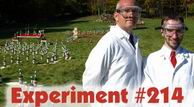
Everybody has by now seen the Mentos-in-the-Coke-geyser video. At the recent local AMA meeting Pete Healy, VP of Marketing for Mentos, talked about the experience and where it is going. The iconic consumer generated media has inspired over 9500 other videos. Mentos has moved a 'significant' amount of their marketing mix from TV to online. This summer Mentos ran a video contest which got about 200 entries, of which 150 are posted online. Mentos has a site highlighting the contest and related topics. They have connected with the Blue Man Group How to Be a Megastar tour to promote the candy with TV commercials that mimic the BMG's performance and some have started to air. No indication if sales have increased for Mentos.
The performers of the original phenomenon have a site, and a new performance called Experiment 214. It got over a millions views in the first five days of release. Its fun, like the first one, but not really distinctively new.
Mentos has certainly done an excellent job making much of CGM. Much better than ignoring the video. Despite some concern about experimenting leading to injury, there have been few problems. Early on they offered a co-marketing effort to some lesser-known soft drink manufacturers, with no luck. Coke now seems to be well-engaged with the effort. Linking this to new efforts like the blue man group may be harder to make work. As Healy suggested, you have to keep in mind that this is about marketing candy, and not curing cancer.
Wednesday, November 15, 2006
Space Visible Logo
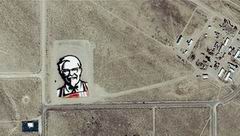
A colleague sends along a link to Michael Castellon's blog. As I responded, this is much less obnoxious than another proposed idea: launched logos and ads that can be seen from earth. At least its pull versus push. Assume this is not yet visible from Google Earth or Virtual Earth, though that may not be far away. Not as flexible as floating a billboard. It has also been pointed out that Target Logos are already visible from Google Earth.
"... KFC has the honor to be the first brand to be visible from outer-space. The 87,500 square feet logo was created by tiles placed in the Nevada desert, near the super secret Area 51. The stunt marks the revamp of the KFC logo, which now features a more streamlined image of Colonel Sanders ..."
Tuesday, November 14, 2006
John Seely Brown on Rethinking Learning
John Seely Brown is the former chief scientist of Xerox Labs, running it while it produced some of its greatest hits (desktops, for example). We had him in many times during the 90s, as a consultant and listener. Now he is a self-styled 'chief of confusion' with Annenberg at USC. Here is his blog. He is very big on education now. Dale Hunscher sends along powerpoints from a recent talk Seely Brown gave called "Rethinking Learning and the Community Library in the Networked Age". I am a library nut, digital or physical. The evolution will be interesting.
Google Blogoscoped
Great site for things Google by Philipp Lenssen which Paul Gillin uses in his forthcoming book: The New Influencers (Spring 07), as an example of strong influence in the blogosphere.
Sunday, November 12, 2006
Billboards in Virtual Earth
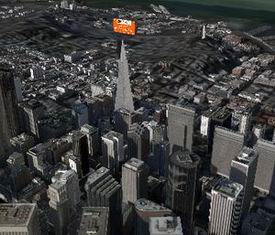
Microsoft has come out with a update to Virtual Earth that makes it look more like Google Earth. Most interesting is that this system shows true 3-D images of city landscapes, including the sides of buildings. Unlike Google Earth which shows buildings with blank grey sides. The result is a more realistic view of city scapes. Its incredible how much data would be required to paint a city. Mapped with low-flying airplanes?
AdAge points out that Microsoft can add floating billboards, and they have already sold space to several companies. There are several floating over San Francisco for ZipRealty (above). Its more of a fun thing to find rather than a easily seen ad. How different is this from billboards in Second Life? .... here it is aligned to a real geographical space. In the US VE uses identical satellite 2D image databases to GE. In Europe, VE appears to be using less detailed image databases, based on my small sample of locations. London shows its 'eye' impressively in 3D, but not much else.
They are still gathering data: "... The 3-D models will initially be available for 15 U.S. cities--San Francisco; San Jose, Calif.; Seattle; Boston; Philadelphia; Los Angeles; Las Vegas; Detroit; Phoenix; Houston; Baltimore; Atlanta; Denver; Dallas; and Fort Worth, Texas--and will be expanded at a rate of eight new cities a month until next spring, when that is ratcheted up even more...". Some of these city databases are glaringly incomplete, with skyscrapers missing. Compare it with Google Earth's 3D images. VE is entirely a web app, and is still a beta. Update: Its much slower than Google Earth too.
Data Mining
I was pointed to Matt Hurst's blog: Data Mining: Text Mining, Visualization and Social Media, all close interests of mine. Worth watching. Via Pete Blackshaw's Consumer Generated Media blog, also a must-read.
Google Geographical Heatmaps
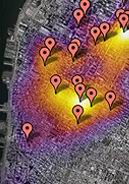
Anthony Townsend points us to a mashup from GeoIQ using Google Earth to create geographical heatmaps. Have now seen a number of examples of layering information in GE, this is a nice example. Here is another from Enterprise Horizons.
" ... GeoIQ is an open platform for building intuitive geographic analysis and visualization tools into web-based mapping applications. It gives people a simple and compelling way to filter, analyze and get value from geographic data without ever leaving their web browser ..."
Ghost Map
Steven Johnson's new book: Ghost Map: The Story of London's Most Terrifying Epidemic ..., re-tells the story of how the water-borne model of cholera epidemics replaced the miasma (bad smell) model in the 19th century and effectively led to the elimination of cholera in the developed world. Like many non-epidemiologists, I first heard of this story via Edward Tufte's 1983 book: The Visual Display of Quantitative Information. I was then more interested in the visual aspects of how the map of the epidemic made the case.
This book tells a more complete story, following the reasoning and collaboration of John Snow and Henry Whitehead which ultimately led to the change in understanding of cholera epidemics, which resulted in the re-engineering of city sewage and water systems.
It turns out that Tufte made a number of errors in his description of the epidemic in his first book, and largely corrected them in his followup book: Visual Explanations. Even there he misses some of the subtlety of the maps, for example their use of Voronoi diagrams to model the proximity of people to the source of infection. Tufte does an excellent job in understanding the effectiveness of visual representation, but less well with integrating computational methods that can aid human understanding.
Also notable is Johnson's hypothesis that this discovery was one of the first triumphs of amateurs. Snow was a physician, Whitehead was a local clergyman. It was their use of local information, painstakingly gathered, that ultimately made the case against a medical community entrenched in an incorrect model. Taking this further, the existence of the Web now makes it much easier to collaborate, gather data and drive to alternative solutions. Or does it confuse the matter through all the clutter?
The mapping itself today can be readily and cheaply done via approaches like Google Earth. The inclusion of such 'local information' as the proximity of pizza parlors can also be used to model complex visual epidemic data. Will this be the value of desktop visualization?
In the last chapter of the book Johnson examines the architecture of cities and the implications of how their scale effects such challenges as epidemics and nuclear terrorism. He is more speculative here, but the material is thought-provoking.
Excellent book for those interested in the history of this episode, the practical use of visualization and how difficult it is to change existing models.
This book tells a more complete story, following the reasoning and collaboration of John Snow and Henry Whitehead which ultimately led to the change in understanding of cholera epidemics, which resulted in the re-engineering of city sewage and water systems.
It turns out that Tufte made a number of errors in his description of the epidemic in his first book, and largely corrected them in his followup book: Visual Explanations. Even there he misses some of the subtlety of the maps, for example their use of Voronoi diagrams to model the proximity of people to the source of infection. Tufte does an excellent job in understanding the effectiveness of visual representation, but less well with integrating computational methods that can aid human understanding.
Also notable is Johnson's hypothesis that this discovery was one of the first triumphs of amateurs. Snow was a physician, Whitehead was a local clergyman. It was their use of local information, painstakingly gathered, that ultimately made the case against a medical community entrenched in an incorrect model. Taking this further, the existence of the Web now makes it much easier to collaborate, gather data and drive to alternative solutions. Or does it confuse the matter through all the clutter?
The mapping itself today can be readily and cheaply done via approaches like Google Earth. The inclusion of such 'local information' as the proximity of pizza parlors can also be used to model complex visual epidemic data. Will this be the value of desktop visualization?
In the last chapter of the book Johnson examines the architecture of cities and the implications of how their scale effects such challenges as epidemics and nuclear terrorism. He is more speculative here, but the material is thought-provoking.
Excellent book for those interested in the history of this episode, the practical use of visualization and how difficult it is to change existing models.
Friday, November 10, 2006
The Wiki Way
Socialtext is one of the best-known commercial wiki packages, have tested it here a number of times. Its a very good wiki implementation. Now Ross Mayfield has announced Socialpoint, or Socialtext running on Sharepoint. He positions this as useful, even though Sharepoint is coming out with its own wikis in 07. More commentary on the idea here. Not quite sure what this means, the Socialtext wiki claims to be the most successful commercial implementation out there. We have also experimented with some open source tools (Socialtext has also gone this way. My conversations with Ross indicates he is working with several companies to instill a wiki culture. Yet there are only a few real successes to talk. The wiki culture is not here or there as yet. Will there ever be, as Ross calls it, a wiki way?
Also in wiki news, Google acquired Jotspot, which we also tested a few summers ago, moderately surprising.
One experiment we talked is the construction of an analog of the Wikipedia within the corporation. Many companies, and certainly large ones have acronyms, terms, definitions, etc that are sometimes the same, and sometimes differ from public versions. He proposed setting up a 'CorporatePedia' that would organically grow as people added definitions.
One of the unsurprising experiences we have had with this is that its hard to get people to contribute. The same people with interest in blogs usually engage, but those who have the knowledge to contribute are hard to bring to the table. Of course the same thing happened in the early days of e-mail. Today there are no rewards for participating, and no 'editors' have yet emerged.
I am still excited about the prospect of managing knowledge by a broadly editable space and do my best to proselytize. Ideas and examples are welcome.
Also in wiki news, Google acquired Jotspot, which we also tested a few summers ago, moderately surprising.
One experiment we talked is the construction of an analog of the Wikipedia within the corporation. Many companies, and certainly large ones have acronyms, terms, definitions, etc that are sometimes the same, and sometimes differ from public versions. He proposed setting up a 'CorporatePedia' that would organically grow as people added definitions.
One of the unsurprising experiences we have had with this is that its hard to get people to contribute. The same people with interest in blogs usually engage, but those who have the knowledge to contribute are hard to bring to the table. Of course the same thing happened in the early days of e-mail. Today there are no rewards for participating, and no 'editors' have yet emerged.
I am still excited about the prospect of managing knowledge by a broadly editable space and do my best to proselytize. Ideas and examples are welcome.
Thursday, November 09, 2006
BMW Innovates

From the October 16 Business Week: Innovation at BMW. Note the emphasis on informal networks, which have worked quite well for them. The 'lunch exchange' idea reminds me of a method touted by the Santa Fe Institute, having folks from many disciplines interact informally over lunch. Saw this in operation during several visits, though it was unclear it could scale.
"The Secret of BMW's Success
BMW's reputation for innovation can be traced to its equally innovative lateral management techniques
At 4:00 p.m. on a Friday afternoon, when most German workers have long departed for the weekend, the mini-cafés sprinkled throughout BMW's sprawling R&D center in Munich are jammed with engineers, designers, and marketing managers deliberating so intently it's hard to hear above the din. Even the cappuccino machine is running on empty. It's an atmosphere far more Silicon Valley than Detroit.
"At lunch and breaks everyone is discussing ideas and projects all the time. It's somewhat manic. But it makes things move faster," says BMW chief designer Adrian van Hooydonk. The intense employee buzz at BMW is hot management theory in action. Top consultants and academics say the kind of informal networks that flourish at BMW and the noise and borderline chaos they engender in big organizations are vital for innovation--especially in companies where knowledge sits in the brains of tens of thousands of workers and not in a computer server. Melding that brain power, they say, is essential to unleashing the best ideas. .... "
Wednesday, November 08, 2006
New Influencers
Paul Gillin, who I met at a recent SNCR meeting, is coming out with a new book: The New Influencers, to be published in the spring of 07. He has some drafts of chapters you can read now, including profiles of his influencers. He also has an interesting blog on social media. In that blog he outlined some of a conversation we had a few weeks ago about internal blogging at P&G. The same post provides some useful other comments on internal corporate blogging. He is an insightful guy who is worth keeping track of.
Tuesday, November 07, 2006
Blog Restart
Welcome to the re-start of my personal blog. A couple of changes have occurred. Previously I was a guest blogger at IFTF's Future Now blog. Now I have moved from there to devote my spare time to posting on my personal blog.
Second, to finally provide full disclosure, I am an employee of the Procter & Gamble Company in Cincinnati, where I have worked for over 26 years. My background is in physics and mathematics. Professionally I have worked in analytical methods, retail technology, supply chain analysis, knowledge methods and social technologies. The web came along at the height of my technical career and I have been a avid observer of its evolution. Its been quite a ride, from when executives were deeply skeptical about the web to when they could not do without it.
I plan to blog some here about my experiences at P&G as they come to mind. Of course all of my opinions are my own, and I won't be divulging any secrets.
At P&G I have been running an internal technology blog since early 2003. Even before blogs I ran a technology mailing list since the early 1980s. My internal blog gets thousands of hits a month and is read by a very diverse set of our employees. Its still a social media experiment though. Some blog posts from my internal blog will be cross posted here. I have not opened comments, but will consider that. For now you can reach me at: franzdill AT gmail.com
This will be stream of consciousness. My interests are fairly broad, you can get an idea of them by scanning my posts.
Second, to finally provide full disclosure, I am an employee of the Procter & Gamble Company in Cincinnati, where I have worked for over 26 years. My background is in physics and mathematics. Professionally I have worked in analytical methods, retail technology, supply chain analysis, knowledge methods and social technologies. The web came along at the height of my technical career and I have been a avid observer of its evolution. Its been quite a ride, from when executives were deeply skeptical about the web to when they could not do without it.
I plan to blog some here about my experiences at P&G as they come to mind. Of course all of my opinions are my own, and I won't be divulging any secrets.
At P&G I have been running an internal technology blog since early 2003. Even before blogs I ran a technology mailing list since the early 1980s. My internal blog gets thousands of hits a month and is read by a very diverse set of our employees. Its still a social media experiment though. Some blog posts from my internal blog will be cross posted here. I have not opened comments, but will consider that. For now you can reach me at: franzdill AT gmail.com
This will be stream of consciousness. My interests are fairly broad, you can get an idea of them by scanning my posts.
iWoz
Just finished Steve Wozniak's memoir: iWoz. Wozniak was the co-founder with Steve Jobs of Apple in the late 1970s. In this book he seeks to set the record straight that he alone did the technical work for the Apple I&II, the first practical personal PCs. Jobs did most of the deal making, but never contributed to the wizardry that made the computer work and made them millionaires. The Apple II was not the first personal computer, but it was practical and dependable and the first to be usable at home and at work. In 1978 we brought in several (purchased as calculators) to do engineering analysis at Hillcrest technical center. Shortly afterward, with new spreadsheet software, finance started to use them.
I have followed Wozniak's post-Apple career (though he remains an Apple employee to this day) for some time, see previous posts on his work. He discusses probably his best known technical effort after Apple, a novel programmable remote that did not succeed. No mention of his low-power tracking system, last seen in 04. Besides some other mild digs at Jobs he is at his best writing about the power of engineering and how creativity comes from individuals not committees. The example of the latter being the Apple III. I did some contract development for that beast. Some of his work makes me think about the current push for creative design. What are engineers but scientifically grounded designers? Simplistic, very personal, sometimes too self indulgent style, readable, only descending into skimmable chip-speak a few times. Recommended if you have interest in the history of accessible computing and the power of engineering.
I have followed Wozniak's post-Apple career (though he remains an Apple employee to this day) for some time, see previous posts on his work. He discusses probably his best known technical effort after Apple, a novel programmable remote that did not succeed. No mention of his low-power tracking system, last seen in 04. Besides some other mild digs at Jobs he is at his best writing about the power of engineering and how creativity comes from individuals not committees. The example of the latter being the Apple III. I did some contract development for that beast. Some of his work makes me think about the current push for creative design. What are engineers but scientifically grounded designers? Simplistic, very personal, sometimes too self indulgent style, readable, only descending into skimmable chip-speak a few times. Recommended if you have interest in the history of accessible computing and the power of engineering.
Monday, November 06, 2006
Setting the Table
Finished fabled NYC restaurateur Danny Meyer's book: Setting the Table. Always had the dream of opening a restaurant and cooking. (yeah really). Meyer writes the story of his restaurant openings. Along the way he teaches us about how hospitality is as important as service. We don't sell much directly to consumers, but my wife Joy runs a retail business and it rang true to her. My favorite quote .... about Mary Kay Cosmetics ... ' ... Mary Kay would teach their salespeople that everyone goes through life with an invisible sign around their neck reading 'make me feel important' ... The most successful people in any business that depends on human relationships are the ones who know about that sign and have the ability to see how brightly it is flashing. And the the true champions know how best to embrace the human being wearing the sign ...'. Good book.
Sunday, May 22, 2005
The Infinite Library
Tech Review on The Infinite Library. I continue to be amazed by my personal use of the web ... I have links now to several libraries, and can quickly determine availability. If I could only get the full text and then also link to it as required. As in Nelson's Xanadu, the ultimate exercise in 'non sequential' writing. The infinite library still appears to have too many holes in it ...
Friday, May 20, 2005
Exploring Supermarket Paths
In the latest Knowledge@Wharton, an article on analyzing shopper paths in grocery by Peter Fader and Eric Bradlow. This provides an overview and study conclusions. I have taken a look at the complete technical paper on this, and its a novel use of statistical clustering techniques that could be quite important in this kind of analysis. This could result in some interesting changes in how a number of retail spaces are designed.
Monday, May 16, 2005
Gershenfeld's FAB
I finally finished Gershenfeld's FAB, enjoyed it, I have posted a longer overview and review over at Future Now.
Autistic Savant
I saw the Discovery program on Daniel Tammet this week A genius explains. Quite remarkable case, certainly an example of pattern recognition vastly different from the way we normally think of intelligence. A case for some sort of neural network as opposed to building rules .... Now if we could only tap this in some way, what we know so far is only maddeningly sketchy.
Saturday, May 14, 2005
Major IBM Blogging Initiative
An interesting item to follow IBM is preparing to launch a massive corporate wide blogging initiative as it seeks to extend its expertise online. This could influence other companies in their use of the technology.
Sunday, May 08, 2005
Don Tapscott
I am reading Don Tapscott's 2003 book The Naked Corporation in preparation for a meeting next week. Had previously read Growing Up Digital, which I found to be engaging. He has a related blog: Age of Transparency, which I also found to be useful.
Sunday, May 01, 2005
Camille Paglia's Break, Blow Burn
Just reading Paglia's book of selected poetry and commentary. I don't appreciate all of her selections, but even the ones I would not have chosen myself did stretch me a bit. I liked her analyses in general, but this is not really a book for the 'ordinary' reader, I doubt if anyone without a quite strong interest in poetry could deal with deal with it. That being said, her book is worth reading, including some familiar, some little known, and some very eclectic examples of poetry. I learned quite a bit from it.
Robots Working as a Team
This item on robot teamwork: Robot Teamwork brought to mind some work we had done on the teaming up of small groups of simple, cheap robotics to perform simple tasks. One suggested task was to take inventory of a warehouse with simple device that could travel about and sense location and stored items with RF tags. More specifically the idea of 'teaming' is more difficult, even the idea of giving a robot an 'agent' status is non-trivial, and adding the team aspect of reasoning takes it to another level.
Tuesday, April 26, 2005
Electric Universe
Read David Bodanis' Electric Universe, The Shocking True Story of Electricity .... which is a set of essays on the history of electricity. The are disjointed, hardly forming any sort of sort of coherently written view of the subject, which I was looking for. The longest essay is a popular history of radar in WWII, which though interesting, is out of place in this book. The individual topics are of interest, but scantly covered. Some of the writing too left me a bit puzzled. The author heavily overuses specific mental images, e.g. clouds of electrons for example. There are some emphatically negative reviews in Amazon, and I checked the references on a few, and the mistakes could be attributed to interpretation, but I would expect a book like this, to be read by non-scientists, to be more clear. This is another example where it is very hard to believe that the well-known reviewers on the back cover ever read the book. The Amazon reviews led me back to Robert Thompson's 1947 history of Telegraphy: Wiring a Continent. Still considered a classic.
Monday, April 25, 2005
Mathematicians and Tapestries
Interesting article Capturing the Unicorn A story of digital imagry, reconstruction and mathematics. Its also about stitching images. For some new work on this idea, for decidedly less complex sets of images, see here. An interesting, seemingly simple topic, with lots of complexity.
Sunday, April 24, 2005
Examining Playful Invention Company (PICO)
Saw a presentation by Elisabeth Sylvan on the Playful Invention Company (PICO) this past week. This has come out of the Lego supported work at the MIT Media Lab ... inspired by Froebel and Papert. This first inspired the Lego Mindstorm project, and now PICO plans to sell programmable bricks or crickets, which can be programmed and used to design systems. I am particularly intriqued by the tactile aspect of this, and its use to help engage collaborators on tough problems.
Monday, April 18, 2005
The Work Foundation - iSociety
The Work Foundation - iSociety: Useful article on Social Capital and Software ... full text, examining.
Sunday, April 17, 2005
Bobby Fischer Goes To War
Reading Bobby Fischer Goes To War: How The Soviets Lost the Most Extraordinary Chess Match of all Time. I followed this event closely when it was news. Now Fischer is back in the news due to the recent granting of Icelandic citizenship to him. An avid chess-player at the time, I had no idea what Fischer was doing outside of the moves of the game, it was my first introduction to the notion of gamesmanship, bizarre as his form of that was. Finally a writeup of what occured, and hopefully a full explanation of the motivations.
Update/Review: You really have to be very interested in this topic to want to read this. It did fill me in on some of the events, which I only barely remembered via NY press coverage at the time. It most made me wonder why Iceland wanted to take him back in. Reinforced my impression of Fischer as an embarassment ... Although it seemed like Fisher-Spassky progressed interest in chess at the time, it has progressed very little since then.
Update/Review: You really have to be very interested in this topic to want to read this. It did fill me in on some of the events, which I only barely remembered via NY press coverage at the time. It most made me wonder why Iceland wanted to take him back in. Reinforced my impression of Fischer as an embarassment ... Although it seemed like Fisher-Spassky progressed interest in chess at the time, it has progressed very little since then.
Wednesday, April 13, 2005
Gershenfeld's FAB
Have not read Gershenfeld's FAB book yet, but its on the list. His previous popular books were thought-provoking, and his modeling texts are well worth taking a look at.
Sunday, April 10, 2005
Shaping the Future - Robust Simulation
Brought to my attention by Steve King at Future Now an article: Scientific American.com: Shaping the Future -- On Robust modeling. Interesting view of the problem of robust modeling under uncertainty. I will comment there later this week. Brought to my attention: The Copenhagen Consensus and the fact that the poorly performing Club of Rome still exists. Here is a link to the PDF of the full RAND Pardee Center report.
Friday, April 08, 2005
Affective Computing example
Here Software Detects Unhappy Callers is an example of interacting with consumer emotions to classify calls. Note commercial example of work suggested by Rosalind Picard in her book: Affective Computing.
Wednesday, April 06, 2005
Beer Games and Engagement Models
Some work activities today made me re-visit the MIT Beer Game. I have some fond memories of participating in this game back in the 90s. Also recall some work being done on an agent-based advanced, multi-SKU version being developed by members of the Santa Fe Institute, have to look that one up. A good example of a simple game leading to complex behavior. This is required reading for folks new to supply chain. This brings to mind what I call 'engagement models', used to introduce folks to a domain, usually very visual, but which are not intended to be predictive. I have seen these to be quite valuable in industry. The Sim models are examples, but perhaps more complex than they need to be to represent this modeling approach.
Monday, April 04, 2005
Niklas Luhmann
Niklas Luhmann's Social Systems Theory . - In the latest issue of the Journal of Artificial Societies a post on the use of agent-based models to implement Luhmann's societal theories, which has led me to investigate them further. Further, these papers may be useful as examples of the use of simulation for agent based models and related techniques.
Physics of Society
Futurology gets a little more exact: Guardian article on Philip Ball's: Critical Mass: The Physics of Society. (Published under a different title in US ...: Critical mASS: How One Thing Leads to Another ) Covers issues of modeling people's group behavior, most recently suggested in agent-based technologies. Do not have the book as yet, but it looks to be interesting. Is it possible to model people in a way that is statisically meaningful? Yes thats been done fairly well,depending opon the measures you care about. Is predictive at some individual level? Not clear. Can provide true emergent behavior? In this too the jury is out ... I have not seen it as yet. This book appears to be non-technical, for a technical view of the complexity of models of people see: Journal of Artificial Societies ... See also Ball's article in PhysicsWeb.
Saturday, April 02, 2005
Chatter
Picked up Patrick Keefe's Chatter, recently, all about sigint surveillance, in particular the Echelon project. We have all heard about term 'chatter' by now, we have a feeling for what it means, but how is it measured? That question is never answered. I pose the more general question in a post at Future Now. I know a little about the subject and worked on Darpanet many years ago, have also looked at text mining approaches .. so I thought there would be some interesting detail here. Pretty early on Keefe makes it clear that he doen't know much about the topic, or technology in general. He provides uninteresting descriptions of his standing outside of facilities looking in through the fence, or interviewing other journalists with similarly limited knowledge. While visiting a purported, abandoned NSA site ... he is amazed that the computer room had a raised floor ... that there was a cable tunnel between two buildings on the site. He is in awe of the radomes that protect antenna complexes. He shows shock that an employee at a UK base is prosecuted when she steals classified material to support her own political agenda. He lost my respect fairly quickly, but I did slog on. He is further amazed that the NSA's public web site does not contain a full directory of their employees (no company does this today). He describes the criminal trashing of Admiral Poindexter and his neighbors to make a point. There was no faint suggestion of loss of privacy or potential data mis-use that he does not cover in depth, but there was not much mention of the potential value of these capabilities. His discussion of 'mining' in particular was weak; you got the impression it was just about finding words. The one part I did find interesting was some of the statistics regarding human intelligence ... but can I trust them? Find this at the library, but beware.
Wednesday, March 30, 2005
Blogs, Everyone? Weblogs Are Here to Stay, but Where Are They Headed?
From Knowledge@Wharton Blogs, Everyone? Weblogs Are Here to Stay, but Where Are They Headed? . Good overview article on blogging. Quotes marketing professor Peter Fader, who we have linked to several times.
Tivo Pops-Up ads

More details about the testing of the Tivo ads that pop-up during fast-forward. This was apparently part of the recently announced Comcast-Tivo deal. I previously posted on this, with some links to Tivo economic models. This brings to mind the book: The Big Picture: the New Logic of Money and Power in Hollywood by Edward Jay Epstein, which talks at considerable length about the evolution of content delivery economic models. This is just another example, perhaps the first interactive one. Slashdot post on Tivo's test. Via Richard L. James.
Monday, March 28, 2005
Chernoff Faces
I was reminded of the method of 'Chernoff Faces'; in Clifford Pickover's 1990 book: "Computers, Pattern, Chaos and Beauty" (p. 47-) .. I was led there by a pointer to some Java implementations of Chernoff faces. For those that have not seen this, its the use of cartoon faces, whose attributes (eyes, ears, mouth, hair, etc) are varied in their size and orientation based on some numerical measure. Specifically using a cartoon face is said to allow us to use our own facial pattern recognition ability to better understand complex multidimensional data. Can anyone point me to other implementations or examples of a similar idea ... linking numeric measures to the size of other aspects of an image in general? Is this idea used very often today?
Hortense Powdermaker
New to me, Hortense Powdermaker, anthropologist ... author of Hollywood, The Dream Factory ... famously quoted to have said ... that Hollywood was a " dream factory .. engaged in the mass production of prefabricated daydreams ...". Quoted in Edward Jay Epstein's recent book The Big Picture: The New logic of Money and Power in Hollywood, under review. Lots of interesting financial detail in this book, alternative economic models for dealing with content. Though fairly dry in style, not for everyone.
Saturday, March 26, 2005
V. S. Pritchett
Just reading VS Pritchett's London Perceived, a 1962 book about London supported by a number of excellent photographs by Evelyn Hofer. Its a 42 year old book, so you can't use it as a guide today, but Pritchett provides such a lyrical overview of his subject that this is still excellent reading. There are a few overlaps with the London I know, and it makes me want to re-examine those. It a guide to time and place when bomb-sites still existed, and the economy of London was very different. If you like the topic, well worth the read, its still in print. Likely in your local library. Also has inspired me to look into Pritchett as an author.
Friday, March 25, 2005
First look at Yahoo! 360
Charlene Li posts on First look at Yahoo! 360. Yahoo's new social networking and blogging service. Overall, based on the description, I am not impressed. I have experimented with a few of these social networking services, and they leave me cold.
Thursday, March 24, 2005
Numenta: Hawkins Brain Models for Intelligence
I reviewed Jeff Hawkin's book: On Intelligence last year. The founder of Palm Computing suggested a model using the architecture of the brain to build artificially intelligent systems. This is a novel approach, since most AI systems do not attempt to use the brain as structural model. His book was very good, but I suggested that he had considerable work to do to implement his ideas. Its another commendable attempt at the holy grail of machine intelligence.
Now an article in today's WSJ: Next Case for Palm Pilot Creators: The Brain and another in BusinessWeek: Jeff Hawkins' Bold Brainstorm, suggest that some progress has been made. He linked with Dileep George, who has started to implement some mathematics based on Hawkin's ideas, and formed a company called Numenta to work on practical applications. Both articles quote Intel scientist Gary Bradksi who says "Even if he's wrong, his theory is better than nothing. And it's 'attackable' -- and that's a good thing." Likely early applications are in machine vision and drug discovery. See also article in the NYTimes. Well worth tracking.
Now an article in today's WSJ: Next Case for Palm Pilot Creators: The Brain and another in BusinessWeek: Jeff Hawkins' Bold Brainstorm, suggest that some progress has been made. He linked with Dileep George, who has started to implement some mathematics based on Hawkin's ideas, and formed a company called Numenta to work on practical applications. Both articles quote Intel scientist Gary Bradksi who says "Even if he's wrong, his theory is better than nothing. And it's 'attackable' -- and that's a good thing." Likely early applications are in machine vision and drug discovery. See also article in the NYTimes. Well worth tracking.
Michael Faraday Bio
A Life of Discovery: Michael Faraday by James Hamilton is the first bio I have read of Faraday. Hamilton is an architect, and sometimes fits in pieces about London architecture into the work, I didn't mind that, since I enjoy London, but it can seem forced. Good descriptions of Faradays lectures and the amount of time and care he took to get them right. I doubt he would have used Powerpoint. The most amazing part is his description of Faraday's creation of the first simple electric motor, the rush of creativity, if it could only always be that way ... his own enthusiasm then got him into trouble as he rushed to get the word out. I also recall reading parts of his chemical history of a candle in chemistry class, a tour-de-force of observation. He was to follow with the invention of the transformer, the dynamos and electrolysis, plus a great deal of fundamental chemistry and physics. His correspondence with Ada, Lady Lovelace, is also intriguing. Good bio.
The Wikpedia entry on Michael Faraday is also worth a look.
The Wikpedia entry on Michael Faraday is also worth a look.
Wednesday, March 23, 2005
Dvorak on 1995
Short but interesting column by Dvorak, who I have been reading since then 1995: That Was the Year That Was. Although I had used the Darpanet back in the 70s, this was about the year I was first introduced to the Web and Internet. It took a few more years for the corporation to discover it. Shortly after this I remember giving a talk to management introducing the web, and their astonishment that their prime products were not showing up on search engines of the time. It is amazing how much has happened in the last 10 years. Nostalgia in just so few years.
Tuesday, March 22, 2005
Chance Discovery
I have just received the book Chance Discovery, by Yukio Ohsawa and Peter McBurney. I met Yukio at a recent meeting at the University of Illinois. Ohsawa is from the University of Tsukuba. The idea is intriguing and am looking forward to reviewing. I was introduced to the idea as part of a look at the DISCUS method of augmenting focus groups. See also his Chance Discovery site for an overview.
Saturday, March 19, 2005
Norbert Wiener The Father of Cybernetics
Itching to read Dark Hero Of The Information Age .... I read a few of Wiener's books, and the insight into our current age is amazing. Yet few people today, even those in the business, have heard if him. In the NYTimes review its mentioned that the Soviets thought highly of him, and I remember getting some English translations of Soviet work in 'Cybernetica' in the 80s that often mentioned his work. NYT suggests that ...information as a discrete concept did not widely exist before Wiener .. early Bell engineers referred to the signal traveling over telephone wires as 'the commodity to be transported by a telephone system' ... Intriguing, if true.
Understanding Comics: Scott McCloud
I read McCloud's Understanding Comics back in 1993, I was pointed back to it again by Christ Atkinson's book Beyond Bullets, now I am re-reading. Here is his site. Some very interesting things here ... See in particular the interface to the 'Morning Improv', something I would like to experiment with myself for instructional interaction.
In the early part of this book McCloud posits a fascinating distinction between realistic drawings of people and various levels of stylizing with a minimal number of pen-strokes. In real-life, whenever we talk to people we look at them directly and get a realistic view, but our pictoral view of ourselves in that interaction is stylized, since we cant see ourselves. So he suggests that by using a level of simplification in cartoons, it allows us to put ourselves in the position of the character. Thoughtful view.
In the early part of this book McCloud posits a fascinating distinction between realistic drawings of people and various levels of stylizing with a minimal number of pen-strokes. In real-life, whenever we talk to people we look at them directly and get a realistic view, but our pictoral view of ourselves in that interaction is stylized, since we cant see ourselves. So he suggests that by using a level of simplification in cartoons, it allows us to put ourselves in the position of the character. Thoughtful view.
Friday, March 18, 2005
Psychophysiology of Risk
Posted for potential workup into an article: MIT Laboratory for Financial Engineering: Psychophysiology of Risk
Communications Models
An interesting post on communications models at iaocblog. Steve King of IFTF provides some interesting thoughts about this. Particularly interesting , the stoller queen example. Though not a blog, this is an excellent example of consumers taking control of the marketing conversation.
Wednesday, March 16, 2005
Sign Language
Fascinating pointer Sign Language on work underway about using gestural interfaces to control geospatial interfaces. Apparently designed to be used in high stress situations, such as the emergency management centers, to help partipants collaborate and interact with geospatial data. I have worked on some relatively primitive GIS systems, this would have been useful. Can we ultimately just wave our hands at out data?
Tuesday, March 15, 2005
Spring comes to AI winter: Hecht-Nielsen's Confabulations
This article Spring comes to AI winter Mentions neural net commercialization pioneer Robert Hecht-Nielsen and his confabulation idea. Its also described in a Physorg post. Some pretty bold predictions of the generality of the approach. I have not looked at the technical article as yet. Is it available online anywhere? We worked with Hecht-Nielsen's HNC Software back in the 90s to develop neural nets for corporate pattern recognition problems. They were acquired by FairIsaac.
MemCheck Memory News from Cognitive Labs
Consumer Marketing taking hints from neuroscientists. Another example of neuromarketing ideas.
Sunday, March 13, 2005
Why Stock Markets Crash
Inspired by an article in MIT's Tech Review on using Physics models to predict book sales (No longer online, you would think MIT Tech Review would know better?) I just read: Why Stock Markets Crash: Critical Events in Complex Financial Systems, by Didier Sornette. Here is UCLA's press release on the work. The book is a well-done overview of complexity work as it relates to financial markets. Though technical, the book spends much time in setting up coherent descriptions of how models link to financial problems. Leading to an 'autopsy' of major crashes. I can't speak to the validity of the conclusions in detail, since finance is not my world. Many, many useful references here to related work, and good thumbnail descriptions of advanced modeling work in finance. Obvious overlap with Benoit Mandelbrot's The Misbehavior of Markets. The last chapter addresses the question of if we are in for a end of growth by 2050. Optimistic overall. Here is chapter 1, though its the least technical.
IFTF's Future of Marketing
I am blogging now at IFTF's Future of Marketing specifically for marketing related emergent technology ideas. Some of those posts will start to be initially outlined here, with sometimes a request for information I can fold up to that blog. Not sure how many people are reading this, but always welcome additional information, credit and links will be given to those that contribute.
Saturday, March 12, 2005
Strange Angel
Completed Strange Angel, by George Pendle, bio of rocket fuel pioneer John Whiteside Parsons. Early history of JPL and rocketry in the US. Also, Parsons connection to cult leader Aleister Crowley. Sometimes uneven , but interesting view of that time.
Beyond Bullet Points
I completed my review of Cliff Atkinson's Beyond Bullet Points and posted it in Future Now. Good book, I found a number of its ideas useful and plan to use them in upcoming presentations. Also interesting, some of the pointers in it to research on effectiveness of multimedia presentations.
Friday, March 11, 2005
Gallups New Poll on Blogs
Gallups new poll on blogging is worth noting: Blogs Not Yet in the Media Big Leagues As bloggers we do lots of introspection about this emerging idea, around since only 1997 ... As has been pointed out to me, we have been doing things like blogs for some time, but only in these last few years have we seen its explosion. The study makes the case that three quarters of US public uses the internet, but only one in four is even somewhat familiar with blogs ... just slightly more than half of the US public has no knowledge at all of them. There is considerable room room yet for the expansion of this idea. Well worth reading in its entirety.
Wednesday, March 09, 2005
Understanding Comics
I was referenced to this book: Understanding Comics. Via Cliff Atkinson's Beyond Bullet Points. See also his excellent Beyond Bullets site.
Stay-in-car shopping : Autocart
Stay-in-car shopping | www.azstarnet.com �
I found this during some research on the drive-through superstore concept, note it mentions IFTF.
I found this during some research on the drive-through superstore concept, note it mentions IFTF.
Tuesday, March 08, 2005
AutoCart revs up drive-through supercenter
I wrote about this before in Future Now ... AutoCart revs up drive-through supercenter. Still looking for more details, would appreciate anything people can send along.
Monday, March 07, 2005
On Demand Blogosphere
Jon Udell introduced me to bookmarklets, and although I am mostly an ad-hoc programmer, used to constructing things to solve problems, rather than a professional programmer, his simple examples helped me collaborate with the local library to construct a simple interaction between web pages and the library reservation system. That resulted in something I use daily now.
Since then I have been following his work, Now he is working on another problem of note, how do you make your RSS feeds more useful, how do you find out who is talking about a topic you want additional commentary on. In his recent post he provides a short screencast that describes how he is working towards the goal of constructing tighter networks between bloggers and their networks of information.
Since then I have been following his work, Now he is working on another problem of note, how do you make your RSS feeds more useful, how do you find out who is talking about a topic you want additional commentary on. In his recent post he provides a short screencast that describes how he is working towards the goal of constructing tighter networks between bloggers and their networks of information.
Augmented Marketing Focus Groups: Discus
Here is a blog post I wrote about our recent visit to Professor David Goldberg's GA lab at the University of Illinois to observe the first test of their Discus augmented focus group idea.
Charles Stross' Singularity Sky
Just completed Charles Stross' SF novel Singularity Sky. Very nicely done, a wild compendium of technology touched upon, less on the side of character development. Still a very good, readable story, recommended.Here is his blog. Just starting to peruse.
Envisioning a Leapfrogged World
Envisioning a Leapfrogged World
Saw this noted in Rajesh Jain's Emergic blog ... Thoughtful piece on the subject of technology leapfrogging ... in particular how the process of leapfrogging is also likely to change over time as some of the development capabilities are also leapfrogged. (Note the recent Businessweek article on product development in China) Will become an increasingly important issue for the west.
Saw this noted in Rajesh Jain's Emergic blog ... Thoughtful piece on the subject of technology leapfrogging ... in particular how the process of leapfrogging is also likely to change over time as some of the development capabilities are also leapfrogged. (Note the recent Businessweek article on product development in China) Will become an increasingly important issue for the west.
Sunday, March 06, 2005
Professionalization of Blogs
The Professionalization of Blogs
Good article by Steve King addressing the professionalism of blogs, and the apparent movement from amateur to professional.
Good article by Steve King addressing the professionalism of blogs, and the apparent movement from amateur to professional.
Friday, March 04, 2005
HP Blog Epidemic Analyzer
I was reminded of this research on blog academics by a recent link, out of HP's Information Dynamics Lab. See their demonstration, and their related FAQ. The research and data is a couple of years old now, but its an intriguing piece of work.
Thursday, March 03, 2005
GPS and Google Maps
Jon Udell: Walking tour of Keene: followup
Here is another clever thing from Jon Udell. Last summer I played with his library lookup capability, and with just a little help from the local library folks, was able to set up searches based on ISBN, author, title and subject. This introduced me to bookmarklets, and now I use these lookup capabilities most every day. Very nice for a biblio junkie. I continue to try to get other folks to use them ... a very nice capability.
This new example makes use of Google Maps, which I have played with a bit as well, and although still Beta, boasts a very nice interface. Udell has worked on setting up a GPS-based tour of a set of locations, based on Google maps. He points to a live example, and outlines how to do this.
See also pointers to Google Maps Hacking Wiki, which I am also starting to explore.
Here is another clever thing from Jon Udell. Last summer I played with his library lookup capability, and with just a little help from the local library folks, was able to set up searches based on ISBN, author, title and subject. This introduced me to bookmarklets, and now I use these lookup capabilities most every day. Very nice for a biblio junkie. I continue to try to get other folks to use them ... a very nice capability.
This new example makes use of Google Maps, which I have played with a bit as well, and although still Beta, boasts a very nice interface. Udell has worked on setting up a GPS-based tour of a set of locations, based on Google maps. He points to a live example, and outlines how to do this.
See also pointers to Google Maps Hacking Wiki, which I am also starting to explore.
Wednesday, March 02, 2005
RiverGlass Real-Time Analytics
RiverGlassInc.com
RiverGlass develops software that merges multiple data streams from disparate sources and applies powerful, real-time data analysis and modeling techniques that help customers manage risks, solve critical problems, and make informed decisions.
I am starting to look at this provider of data mining capabilities. Especially with regard to the real-time aspects of its capabilities. Will update this post as I progress.
RiverGlass develops software that merges multiple data streams from disparate sources and applies powerful, real-time data analysis and modeling techniques that help customers manage risks, solve critical problems, and make informed decisions.
I am starting to look at this provider of data mining capabilities. Especially with regard to the real-time aspects of its capabilities. Will update this post as I progress.
Subscribe to:
Posts (Atom)