


Tuesday, March 13, 2007
Retail Blog
Spoke to Evan Schuman, who publishes StoreFrontTalkBack, one of the few blogs that cover retail technology. I have found it to be very useful, since I cover similar ground internally. I connected with him to discuss some of his articles. Much of what he publishes are original articles, based on interviews and connections with retailers and vendors. What struck me was the difference between his work and many tech blogs, which often just comment on other writings. Evan also publishes a newsletter which I have subscribed to, which provides more detail regarding his blog entries. If you know of other blogs that cover retail tech, would appreciate knowing about them.

Monday, March 12, 2007
Making Business a Game
An article in Strategy+Business : The Game Maven of New Haven, article about Yale prof Barry Nalebuff and some of his game theory applications. Notably Nalebuff was the author of the book Co-opetition. I was led to the article by the mention of P&G, but the article itself contains only a brief mention of our spinbrush acquisition, and not much else. Still worth a look:
" ... Barry Nalebuff, chairman of Honest Tea and an economics professor at Yale, has applied complex game theory and innovation principles to his business. One major thrust of his work is companies can grow the "game" by welcoming competitors and still grow their own business. Companies from Procter & Gamble to Dunkin' Donuts have effectively used the strategies, he said .... "
Sunday, March 11, 2007
Ray Buse
Pete Blackshaw comments on Ray Buse's recognition as PR Professional of the Year. Buse is a Cincinnati PR celebrity. The article provides some local venture history.
Saturday, March 10, 2007
Semantic Web Application Freebase
The semantic Web, aka Web 3.0, leads to an application called Freebase via AI and hardware luminary Danny Hillis. Free, open structured data, with intelligent meta-tag links. Carr describes it:
" ... Artificial intelligence guru Danny Hillis has launched an early version of the first major Web 3.0 application. It's called Freebase, and its grandiose epistemological mission is right up there with those of Google and Wikipedia."We're trying," Hillis tells John Markoff of the New York Times, "to create the world's database, with all of the world's information." Alpha user Tim O'Reilly says that Freebase "appears to be a bastard child of wikipedia and the Open Directory Project" but that it's really "like a system for building the synapses for the global brain." ..."
Wednesday, March 07, 2007
Seeking the Nature of the Blog
Nicholas Carr writes In Praise of the Parasitic Blogger, thoughtful piece which he ends describing his blog as ... a parasite, a bacterium, a scavenger of bones and turds and the occasional piece of pretty cloth. And I, for one, couldn't be happier ... He takes his metaphor from Steven Johnson's Ghost Map, the excellent description of nineteenth century London's battle with disease. I agree that blogs are a new form of journalism, born of a cheap universal medium and a very simple recording mechanism. So it permits most anyone and everyone to digest today's news. Here news is not what I can find in a newspaper today, but also the track of an individual in an increasingly information-rich environment.
That's a useful outward view of the blog. What is the view to the individual? Some conversations we had recently bring up that idea. Should an employee be able to write about their professional experiences, when that might reveal the activities of their employer? I said yes, as long as the affiliation is clear. I described a blog as a sort of 'floating resume'. Today some employers may look at a candidates online writing. In the future they may require the submission of a blog name to show the evolution of a person's writing, thinking and interests.
That's a useful outward view of the blog. What is the view to the individual? Some conversations we had recently bring up that idea. Should an employee be able to write about their professional experiences, when that might reveal the activities of their employer? I said yes, as long as the affiliation is clear. I described a blog as a sort of 'floating resume'. Today some employers may look at a candidates online writing. In the future they may require the submission of a blog name to show the evolution of a person's writing, thinking and interests.
Tuesday, March 06, 2007
Is Business Ready for Virtual Worlds?
In CIO Insight: Is Business Ready for Virtual Worlds? Good overview with some technical perspectives. They mention the positives and some of the negatives I have observed now with a few months of 'in-world' experience. Its has lots of intriguing possibilities, but it has a number of slips in actual execution.
Monday, March 05, 2007
Qwaq for Multi-Dimensional Model Collaboration
 Qwaq is an interlinked set of multidimensional croquet spaces. Advised by such people as Alan Kay, the company aims to aid in the collaboration of geographically distributed groups. I saw a short demo, and the graphics are a bit primitive, but are much more stable than virtual worlds. It links together applications with knowledge assets in 3D space. More on the open source Croquet platform, which Qwaq is based on. At the right, a Croquet implemented 3D spreadsheet. First I had seen this idea, worth a look. I would be curious to see if this could be linked into virtual worlds in some way. Examining.
Sunday, March 04, 2007
The PC Must be Revamped
Alan Kay, some say the inventor of the modern workstation, writes in CIOInsight : Alan Kay: The PC Must Be Revamped-- Now. Very good piece, while the personal computer greatly expands the computing and textual capabilities of the individual, its interface deserves a serious review. Its only been about thirty years since computing became widely available. How can we we do better? Though his work on the Children's Machine (also known as the One Laptop Per Child and $100 Laptop) is mostly about hardware availability, rather than improved interface, at least for now.
" ... Kay believes the limitations of the PC are due as much to lack of imagination and curiosity on the part of computer scientists, the unwillingness of users to invest effort into using computers, and the deadening impact of popular culture, as they are to technical constraints. He says the push to make PCs easy to use has also made them less useful; their popularity has stunted their potential. Executive Editor Allan Alter spoke with Kay about the future of the PC. The following is an edited version of their talk ... "His Viewpoints Research Institute..
Saturday, March 03, 2007
Psychology of Security
Security Guru Bruce Schneier has a draft of an essay on The Psychology of Security that is worth reading. Lots of useful discussion about how people look at risk and how that relates to security choices. Also recommend his books.
Friday, March 02, 2007
Future Value Chain
Quoting Alan Kay's famous line "The Best Way to Predict the Future is to Create it" ... From the Global Commerce Initiative (GCI) , Intel and Cap Gemini, a 46-page paper published in October 2006: The 2016 Value Chain, with a forword by P&G's AG Lafley and Jose Luis Duran of Carrefour and a number of manufacturing and retail contributors. A good, but general overview of the how the next 10 years will evolve our view of value chains. Nothing tremendously new here, but lays out what we should be thinking about. Includes mention of virtual reality, quantum computing and 'Wikipedia style collaboration' as means of delivering aspects of this new value chain view. Minimal mention of analytical methods. Also just a few mentions of RFID. Well worth a read, provides a basic grounding in the value chain world.
Thursday, March 01, 2007
Jingles for Pringles
A new consumer media creation site, Jingles for Pringles. With prizes. Upload your own video. Good example of consumer generated media (CGM).
HP Labs : Imaging the Antikythera Mechanism

When I was a student of archaeology back on the 70s we were shown a picture of a corrosion encrusted device that contained some interlocked bronze gears. It had been found in a 2000 year-old Mediterranean wreck a hundred years earlier and labeled the Antikythera Mechanism. We did not have a clue as to what it was. It was clear that there were barely discern-able inscriptions on the device. Only a few years ago, Thomas Malzbender, an imaging scientist at HP Labs, developed an technique using multiple images of a surface, such as the mechanism, to build an enhanced image of the writing detail. The text turned out to be instructions for using the device for predicting eclipses. This idea, called reflectance imaging, has the potential of revolutionizing aspects of archaeology. More here on this from HP labs.
So what has this to do with corporate Information technology? Is IT planning Indiana Jones type efforts? Doubt it. But imaging is a powerful concept that helps companies get a better understanding of materials and their function. Computing and digital photography have advanced to the point that this can all be done in increasingly powerful ways.
Wednesday, February 28, 2007
Voice to Come to Second Life
Voice will soon be an option in Second Life. If you have done any extensive text chat there you would think that its an obvious positive. The debate is more complex than I had thought.
New Views of Synthetic Worlds
In a recent post I mentioned a symposium I attended sponsored by Cisco and The Santa Fe Institute. All about synthetic worlds. Second Life and games like World of Warcraft are now well publicized examples of these ideas. Interfaces, really, with a new capability to expand interface into a third dimension .... plus another dimension ... a fourth synthetic and social dimension, allowing new kinds of interaction with people, especially in groups.
This is all not new. Back in the 90s we connected with a company called Blaxxun that wanted to do some of the same kinds of things. Bandwidth was still uncommon outside of universities. We were asked to advertise there, but there was little social component, and we passed. Even before then, back to the 70s. the military was building 3D worlds to help trainees interact with battle environments.
Edward Castronova of Indiana, author of Synthetic Worlds: The Business and Culture of Online Games, gave a talk, perhaps too tongue-in-cheek, about how the Second Life currency of Lindens was becoming more real to many than dollars. Well, OK, but then it has not been taxed yet. Still Castronova made the point that alternative currencies are making people take notice. They are being used on E-Bay, exchanged for actual labor. Economists know what that means. Cisco's Christian Renaud talked about their new space in Second Life and how they were seeking to use it as an engagement space for clients. MillionsofUs CEO Reuben Steiger gave a pep talk about where all of this is going and what we should expect, and not expect. Byron Reeves of Stanford gave a talk on some extensions of work he had reported on in his book The Media Equation. That work had inspired us to do early work on having advertising avatars talk to consumers. A good meeting, with lots of interesting ideas being posed.
The meeting turned out to also be a revealing view into how easy (and not-so-easy) it was to use SL as a collaboration space. The talks were delivered in real and second life, and then transmitted to both. There were some problems, created by lag, that occurred along the way, making it unclear who had seen what, except for the people in Real Life, who could nod in acknowledgement.
From an engineer's perspective we have worked with synthetic worlds for a long time. Simulations (sims) have been used since before computing became personal to model proposed worlds to test them before construction. Synthetic Worlds are places where a very general purpose interface has been constructed, mostly with social interactions in mind. Its still not easy to do complex specific things there. As Steiger suggested, its still a place where you can do mostly chaotic, unplanned things, not precisely scripted or planned actions. Sure you can build, construct 'scripts' of object interaction, and text chat all you want. But the interface is still mostly limiting, as opposed to enabling. I have seen things there that are breathtaking, but they are mostly about art as opposed to about engineering and science.
I remain optimistic about where all of this is going. In its current form its really not completely ready for business, but I can see how its evolving in that direction. The enterprise needs some help in making this work. Even better interfaces, stability and interaction. It may not happen in this go around. Looking forward to it.
Tuesday, February 27, 2007
Google Apps Re-Examined
Check out Google Apps Grow Up. The introduction of a set of premiere application for the enterprise. I was an early user of Gmail, which though it did not do everything the 'enterprise' email applications did, had some advantages in sheer retentiveness and simplicity. When I first took a look at Google Spreadsheets and docs I was not impressed. In the early days I took several fairly simple spreadsheets in my collection and sought to convert them, with not a great deal of success.
Now things are changing, and some notable large companies are looking at the possibilities of using Google applications. First because their cost is far less than the cost for full featured packages. Feature creep has led us to the point where we use a small percentage of a packages capabilities. The average user, even at a large company, rarely uses these capabilities, and may be better off not introducing the complexity they allow.
They won't do everything, they won't serve all needs, but as long as there is upward compatibility between basic user needs and the advanced applications, your can segment the needs of your users. And the basic segment of users can be very large. Certainly the needs of the home and small business are often addressed by these basic ideas. The apps are worth another look for businesses large and small.
Monday, February 26, 2007
Tapscott Now BusinessWeek Columnist
Don Tapscott is now a BW columnist, His recent book Wikinomics, which has lots of references to P&G, is a good overview of collaborative and group models at large companies. Here is hi first column, about open source models at large companies. Few new revelations here for people who have tracked this. But a great introduction.
Sunday, February 25, 2007
Made to Stick Call
I mentioned the book Made to Stick : Why Some Ideas Survive and Others Die. Have not read it yet. Jerry Michalski is having a conference call with co-author Dan Heath on Monday, February 26, 1:30 EST, 1-800-615-2900 or 1-661-705-2005 access code: 778778 .
Saturday, February 24, 2007
Group Brains

Paul Saffo sends along a note about Harvard's Group Brain project:
" ...The Group Brain Project
Our project is focused on developing a model of how analysis and problem-solving occurs in groups of professionals, and how the complementarities of cognitive processes among team members can affect team performance. A lot of the existing work in the psychology of problem-solving focuses on the cognitions of *individuals*; however, what is less well understood is what takes place when the "analysts" need to confer with one another, share information, and come to a consensus on what the answer is.Brains work effectively only when the various specialized areas operate in concert. And groups work effectively only when they are structured and led in ways that enable them to exploit the complementarities of their members. Given that we can now assess the kinds of cognitive and emotional activities for which different individuals are especially adept, might it be possible to adapt such assessment devices for use in composing teams that perform analytic work? And might it further be possible to identify the specific conditions that would increase the chances that such teams would be able to draw upon the full complement of member talents in the interest of excellent collective performance?
Friday, February 23, 2007
TV Remote Inventor Dies
Max Kalehoff writes an insightful obituary of the inventor of the TV Remote control, Dr. Robert Adler. Perhaps our first example of personal remote interaction. What were the implications of this idea? Update: The Wikipedia says his remote was the not the first, but a vast improvement ...
Tuesday, February 20, 2007
Synthetic Environments and the Enterprise
Atty Mullins of the Santa Fe Institute sends along a link detailing the February 20 SFI sponsored Synthetic Environments and the Enterprise meeting. Much of the symposium will also be presented in Second Life in Cisco Corporation's theater. Details in the link.
" ... There’s a lot going on right now in a place that doesn’t really exist. Millions of people are spending part of every day engaged with others in intense collaboration, competition and exploration in virtual online worlds. Some are playing massive multiplayer online games like World of Warcraft™ and others are meeting people via their computer-generated avatars in a virtual world known as Second Life™. Entertainment applications are driving technology — as always for cutting edge media — but serious people are asking more and more thoughtful questions about how these new ways of connecting people and problems can be harnessed for real-world challenges. This meeting is a chance to see what business can learn from the rich tapestry of human behavior now playing out in synthetic environments. We will look at initial corporate efforts to meet customers in these worlds and attempts to address the challenge of managing collaborations across large scales of time and geography. We will explore how old models of leadership hold up in these brave new worlds and which of the successful game design principles can be integrated into enterprise workflow today. Invited participants will have a chance to place their own bets on the pace of innovation in enterprise application of game-like technology ...
Monday, February 19, 2007
Human-Future Interaction
Jason Tester of IFTF has a good piece in IFTF's Future Now blog on the case for human-future interaction.
Sunday, February 18, 2007
Visualization as a Problem Solving Tool
SF writer and Transparent Society author David Brin writes about a talk he gave at Google. Video of talk here.
" ... In October, Google invited me to fly up and give one of their company-wide Tech Talks on "Visualization as a Problem-Solving Tool in the 21st Century." For this topic, I asked to bring along one of the most ingenious "visualizers," Professor Sheldon Brown, my colleague in the Exorarium Project. The Google talk (hosted by my friend, the appropriately named Larry Brilliant) stretched 90 minutes, but for those who are interested in the evolution of online tools, it should offer a few new perspectives. We also met with Sims creator Will Wright, whose new game "Spore" will knock you out of this world ... "
Wednesday, February 14, 2007
Silence is Deadly
Robert Scott in Computerworld: Silence is Deadly: Five key conversations can mean the difference between success and failure in IT projects. (note that the actual 5 conversations are found in a link in a sidebar to the right of the article.)
" ... These days, however, less than 30% of corporate initiatives come in on time, on budget and on spec. The rest either fail outright or are significantly disappointing. So while much has been done to improve new processes, tools, techniques and governance concepts in the past 20 years, there is surprisingly little progress to show for it.
This point was dramatically emphasized recently by a major study called "Silence Fails: The Five Crucial Conversations for Flawless Execution." "Silence Fails" was conducted by The Concours Group and VitalSmarts LC to identify the causes of IT project failure. This worldwide study involved more than 1,000 executives and project management professionals representing a cross-section of major corporations. It included analysis of more than 2,200 projects. The Procter & Gamble Co. was one of 40 companies participating. Our goal was to determine how we could take our project management competency to the next level. ... "
Monday, February 12, 2007
Baby Journeys Goes Live

A new Procter & Gamble external blog, Baby Journeys has gone live. Includes 7 bloggers, representing 5 stages of baby development. Looks to be a very good start.
Sunday, February 11, 2007
Global Digital Natives Call
Another one of Jerry Michalski's conference calls that I thought would be of interest:
" ... We've talked about different generations' uses of technology and attitudes in general. This time we'll address today's youth, those Digital Natives, the kids who never bought an LP or stood in line to get cash at a bank. With Jennifer Corriero, founder of TakingITGlobal, let's discuss:
What do Digital Natives think about global-scale change?
How do they prefer to be involved?
Is climate change a priority? How are they tackling it?
What practices help connect and catalyze their actions? ...
Date: Monday, February 12, 2007
Time: 10:30 PDT, 1:30 EST
Primary Dial-in Number: 1-800-615-2900 (Toll Free in USA and Canada)
1-661-705-2005 (for callers outside the USA and Canada)
Participant Access Code: 778778 ..."
Friday, February 09, 2007
Japanese Subway Ads
 A colleague sends along this link to top Japanese subway ads. Some impressive examples, including one that effectively uses the movement of the subway itself like a old time movie zoetrope, like these Dasani ads done on the NYC subway. To the right, two Pringles in a soup bowl. A 3D effect in a normally very 2D space, a Trompe L'oeil effect. Also, examples of making whole spaces, like a subway car, transform into a single message. Not sure how much actual subway advertising we do, the Pringles example here aside, but the effects are inspirational.
Wednesday, February 07, 2007
A Tagging Video
RFIDupdate points to a video that shows how easy it can be to find tags in your environment with a small amount of money. The author, Chris Paget, finds passport tags in the city and says that RFID is particularly unsuitable for tagging people.
Monday, February 05, 2007
WorldMapper
 WorldMapper is a visualization project brought to my attention by the Santa Fe Institute Newsletter:
" ... developed by the University of Sheffield and Mark Newman (SFI Faculty Member and Associate Professor, University of Michigan). Worldmapper turns "all sorts of obscure statistical information into vivid pictures," and is based in part on a 2004 paper by Newman and Michael Gastner (SFI Postdoctoral Fellow) entitled "Diffusion-Based Method for Producing Density Equalizing Maps."... Worldmapper is a collection of world maps, where territories are re-sized on each map according to the subject of interest. 366 maps and PDF posters will be finished by February 2007. ...
Sunday, February 04, 2007
To Blog or Not to Blog
From Knowledge@Wharton a fascinating view of how the blogosphere is being used to provide value. As I blog internally and externally I have changing impressions. When people provide feedback I feel that value is being provided, at other times its hard to tell.
" ...Kevin Werbach, Wharton professor of legal studies and business ethics, is a dedicated blogger, especially when it comes to technology news and innovation. He sifts through 300 to 400 blogs using NetNewsWire for the Mac, a blog management tool that allows him to quickly scan new posts. "I look for blogs that tell me something I don't already know, including in areas where I am an expert," he says. Knowledge@Wharton asked several faculty members and technology experts to comment on the appeal and usefulness -- or lack thereof -- of blogs..."
Friday, February 02, 2007
EDS on Workflow Processes
Correspondent Charlie Bess of EDS on Workflow/Process Management. He makes some excellent points about workflow.
Generative Social Science
Just received a copy of Joshua M. Epstein's new book: Generative Social Science: Studies in Agent-Based Computational Modeling. While the worlds of engineering have used simulation methods for a long time to do analysis, research using simulation in the social sciences has always seemed less useful. People are by their nature less predictable and thus the results of such models have always been less useful by industry. Social models I have seen to date still treat people with an engineering mentality. Scanning his first chapters, Epstein covers some foundational assumptions of his methods. I look forward to better understanding this view.
Thursday, February 01, 2007
BMW in Second Life
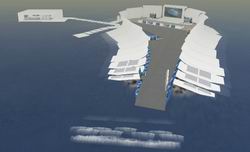 An article in the Second Life Herald talks about BMW's relatively recent build in Second Life called BMW New World. At the right is an aerial view. The article complains that most corporate sites are usually empty. I agree, whenever I visit SL, I make a point of quickly scanning several of the corporate spaces. The much vaunted Dell site, with multiple islands and some clever 'AI Agent' ideas, rarely has any visitors, and I have yet to see an actual Dell employee there. Artificial agents can be clever, but you need the intelligence of real people to make the experience noteworthy.
The exception is IBM, who appears to have taken a very different approach. At any one time there are dozens of their employees 'in world' in their dozen plus sites. Some of their employees are performing tasks, meeting with clients and many of them are willing to engage in conversations. The most recent activity was the build of a Lotus Sphere area that mirrored some meetings in the physical Lotus conference. While IBM's build investment, compared to their TV ads, has to be insignificant, the investment of researchers time is considerable. I have met several researchers I knew from the real world in their Second Life Almaden site.
New IBM employees (based on their 'born' date) appear to be arriving every day, learning and experimenting. I witnessed a number of small group training exercises of IBM users and their clients. Its a great way to speak to researchers off-the-record. Its possible that this works well because the experience is novel, and that may wane. Clearly there is some corporate direction to do this.
Wednesday, January 31, 2007
Age Your Management
Ad Age Digital writes about a viral site that allows you to age your management based on a current photo. Their article features a P&G exec with strange results. The site, age-o-matic, is a nearly 'pure' viral play with careerbuilders.com.
Tuesday, January 30, 2007
YouTube Revenue Model Examined

Pete Blackshaw has some intriguing comments on YouTube's new revenue-sharing model. He has a very good point, but I think the direction is largely inevitable given the money involved. Traffic here does appear to equal content.
" ... YouTube this weekend announced it would eventually move to a revenue sharing model with content creators...not unlike Revver, which splits ad-revenue 50/50 with consumers who post video. This is a big deal, and could have massive implications on the creation and consumption of consumer-generated media (CGM). Up until now, YouTube has anchored its model more to "attention gratification" than financial compensation, which to many sounds like a raw deal against a backdrop of YouTube selling to Google for $1.5 billion. .... "
Monday, January 29, 2007
Is our Digital Destiny Brandwashing?
 I am reading Digital Destiny: New Media and the Future of Democracy, by Jeff Chester. Also well covered in a recent AdAge Digital article: The Dark Side of Interactive Marketing: How New Media Is Causing the Brandwashing of America. This is basically a book that is strongly anti-corporate. He quickly dismisses the benefits that corporations can provide by spending for the infrastructure itself. Consumers benefit from this spending, both in jobs and new capabilities. Accuses a number of large companies of using -
" ... increasingly sophisticated, but largely invisible, technologies that will "sense" or "know" our interests, dislikes, and habits. Information about our travels -- in cyber and real space -- will be collected and stored, most often without our awareness. Our personal data will be the basis of computerized profiles that quickly generate commercial pitches honed to precisely fit our psychology and behavior.Though without a great deal of specific evidence. I found useful the outline of legal issues in communications, but could have done without some of the rant.
A ubiquitous system of micropersusaion is emerging, where the potent forces of new media are being unleashed to influence our individual behavior. From the ad industry's initiatives to better perfect measures such as "engagement," to the MI4 research effort (Measurement Initiative for Advertising, Agencies, Media and Researchers) to harness the power of the unconscious mind, to the rapid evolution of "rich media" virtual applications, a marketing technological "arms race" is underway that will further permeate advertising and marketing in our daily lives ... "
Sunday, January 28, 2007
Meez Identity Generator
 An odd little site that allows you to create your own digital identity. An avatar you can then use to identify yourself and use in a number of venues. This has become hot among the myspace crowd. Some are calling it the year of the avatar. Here is an example.
Saturday, January 27, 2007
IBM Many Eyes

A colleague points us to IBM's Many Eyes. An IBM alpha site for shared visualization and discovery. Some nice examples of viz. Wim says you can upload some of your own data. (To use it I had to upload a new version of the Java Plugin, not sure if this usual). From IBM's Visual Communications Lab.
" ... Many Eyes is a bet on the power of human visual intelligence to find patterns. Our goal is to "democratize" visualization and to enable a new social kind of data analysis. Jump right to our visualizations now, take a tour, or read on for a leisurely explanation of the project. ... All of us at the Visual Communication Lab are passionate about the potential of data visualization to spark insight. It is that magical moment we live for: an unwieldy, unyielding data set is transformed into an image on the screen, and suddenly the user can perceive an unexpected pattern. As visualization designers we have witnessed and experienced many of those wondrous sparks. But in recent years, we have become acutely aware that the visualizations and the sparks they generate, take on new value in a social setting. Visualization is a catalyst for discussion and collective insight about data ... "
Friday, January 26, 2007
Myth of Market Share?
 We have mentioned and interacted with Wharton Prof J. Scott Armstrong here a number of times. A new article of his is in Knowledge@Wharton: The 'Myth of Market Share': Can Focusing Too Much on the Competition Harm Profitability?
" ... It is a common practice of many companies to focus their attention on grabbing market share from their competitors. But such efforts can actually be detrimental to the firm's profitability, according to Wharton marketing professor J. Scott Armstrong. For years, Armstrong has been conducting research showing that competitor-oriented objectives, such as setting market-share targets, are counterproductive. After co-authoring a paper in 1996 that reached this conclusion, he and a different co-author, Kesten C. Green of Monash University in Australia, have written another paper summarizing 12 new studies that add additional weight to the original conclusion. Their study is titled, "Competitor-oriented Objectives: The Myth of Market Share." ...
Thursday, January 25, 2007
Unilever Outsourcing Moves
Unilever has signed a seven-year IT outsourcing deal with IBM. Also an HR outsourcing deal with Accenture. And has engaged HP to conduct due diligence for enterprise computing.
Wednesday, January 24, 2007
A Logic of Diversity
 I met Scott Page at the Santa Fe Institute a few years ago. He is a prof at the University of Michigan and has just authored a book: The Difference: How the Power of Diversity Creates Better Groups, Firms, Schools and Societies. I have read a pre-release copy. He has a notably different, quantitative and welcome view of the subject. This is a book about predictive sociology, and it shows some physics envy along the way. Non-technical, few equations, and those mathematical relationships that are used are accompanied by easy numerical examples. (Full technical papers pointed to in his home page, above) So its an easy read. Makes the obvious comparisons to 'smart mobs', 'wisdom of crowds' and related ideas of recent years. Provides some useful conditions for the application of diversity to problems.
Even in the introduction, though, Page makes the point that the theory of relativity was not outlined by a diverse crowd, but by a single patent examiner with a penchant for thought experiments. Perhaps the deepest quandary I have with this book is its definition and positioning of the term diversity itself. He gives lots of useful examples of diversity of problem solving methods and cognitive approaches. He then uses business interest in diversity to support his tabletop models, stretching his definition of diversity. His arguments, when they address the gorilla-on-the-table world of identity diversity vs cognitive diversity include too many statements starting 'If we believe that ...' to convince me. Despite that, this is a thought-provoking and well-written book that makes you think about the problem, and the first time I have seen an attempt at using logic to address this issue.
Monday, January 22, 2007
Geothermal in Our Future
Always thought there was much benefit in the use of geothermal energy. Pointers to a recent MIT report on the topic. Viable in the west at a depth of 5,000 feet. The full report. Can we use abandoned oil wells? The report shows an optimistic view.
Citizendium

The Citizendium wiki is an alternative to the Wikipedia developed by one of its founders, Larry Sanger, his blog. It specifically addresses some of the criticisms of the wikipedia, namely that many WP entries are mediocre and sometimes wrong or agenda-driven. The citizendium is an expert edited wiki, which attempts to remove some of the WPs inaccuracies. Originally they planned to 'fork' the WP, in other words start with its entries, and then have experts edit them. Now they have decided this is not the way to go and they are starting from scratch. Is this because editing does not have the same appeal as creating? Will this new form of hive intelligence work better than the WP? The WP also has a very big head-start with a crtical mass Citizendium does not have. Impressed by the attempt. It still requires a login and is subject indexed rather than search friendly. What are the implications for other intelligence-aggregating social technologies? And, about Citizendium in Wikipedia.
Sunday, January 21, 2007
ZoomAlbum on QVC
ZoomAlbum is a way to create albums from digital pictures. Simple, clever idea. I like it because it converts a digital problem back to an analog solutuion. In a digital world, its outside the box! Doug Rowan of Zoomalbum tells me that QVC will be featuring their product on January 24 and 25th. Loook for the times on QVC.
Saturday, January 20, 2007
Marvin Minsky Interview

Marvin Minsky interviewed in Discovery. Minsky has been one of the leading thinkers in the world artificial intelligence for years. His book Society of Mind was instrumental in scoping out a deisgn outline of intelligence. His new book, the Emotion Machine, is another great read in this area addressing the issue of how systems can include emotions. He has influenced both fiction and technology over the last thirty years.
Wednesday, January 17, 2007
Jungle Jim's Entertainment
ABC News covered local grocer Jungle Jim's in a short article as differentiating themselves with entertainment, includes a short video. " ... Hosting more than 50,000 shoppers a week, it's a world tour of food fantasy from the Fabled Sherwood Forrest to Gilligan's Island. Displays include dancing animatronic animals, an authentic shrimp boat, aquariums, wine cellars and even a fire truck suspended over 1,000 different hot sauces ... " I go to JJ's at least twice a month, to me and most adults the attraction is not the entertainment, which is mostly kiddie oriented, but the wide selection of foods. A unique 'foodie' grocery experience, which is carving out its niche against the Wal-Marts.
Monday, January 15, 2007
Cloning Your Passport
If you lose your passport, you soon know its lost. A BBC article shows how the new ePassports, which contain an RFID chip, can be cloned in 5 minutes. You won't know it has been cloned. Consider the security implications. From Bruce Schneier's newsletter and weblog. Have now read several of his books, such as his most recent book: Beyond Fear. All of his works are insightful and sometimes contentious, always informative.
Friday, January 12, 2007
BPM Whitepaper
Business Process Management (BPM) is a term that's much talked about these days, but there is confusion about what it really is and its implications for IT's relationship with business process. Here is a good overview paper on the subject: KMWorld White Paper, Best Practices in Business Process Management. A useful look at the topic.
Thursday, January 11, 2007
Social Media Invades the Inc 500
Roland Piquepaille has a blog that examines corporate blogging, in a recent post he mentions a study on corporate social media: ' ... I introduced you to the research work of Nora Ganim Barnes, Director of the Center for Marketing Research at the University of Massachusetts Dartmouth. Now, with her colleague Eric Mattson, she has just completed a study of the Inc. 500 and their use of social media. Their report is aptly named "The Hype is Real: Social Media Invades the Inc. 500." ...'. - Here is a link to the full pdf of the study.
Wednesday, January 10, 2007
IRobot Create

Of interest from CES, the IRobot Create, an open source robot chassis based on the IRobot Roomba. Inspired by all the hacking that had been done on the Roomba and its offspring. Costs from $130 to $999. I like the idea of a robust platform robot system that can be used to test sensors, control and design. More here from IRobot. Completely assembled, operational and tailorable.
IPhone to all People
Read about Steve Job's keynote at MacWorld 2007 today. Makes a lot of sense to have all that functionality in one place. Its an all touch device that combines a phone, internet access and Ipod music access. The engadget transcript link above shows the presentation very nicely. Its still not a complete computational device, and although my Blackberry does include internet access, its very incomplete in that regard. It does the basic searches OK, but hardly allows for me to deal with a complex web application. The Apple device also brings to mind the swiss-army-knife argument. Will a device that tries to include many functions do them all as well as specialist devices? I recall juggling a phone and PDA for a while, and eventually went for a less than ideal phone with the Blackberry. Earlier experiences with PDAs also showed that if you did any amount of text entry, a non-keyboard device was not going to work, though I had seen some impressive texting performances. Maybe primarily for non business applications. Based on the presentation, the way it does graphics is very impressive. The Apple device is not for sale yet, and they are linking with Cingular for the internet and phone services. Perhaps whether the IPhone is successful will, as most such devices do, depend on its ultimate execution. Pete Blackshaw looks at the related buzz.
Tuesday, January 09, 2007
Wikipedia to Make Computers Smarter?
Wikipedia Used to Maker Computers Smarter
Fascinating note of work at the Technion. The idea of background or common-sense knowledge is an inportant one in artificial intelligence. Since a Wikis knowledge is potentially ever-changing, and we know the WP has led to much debate over the correctness of its knowledge, how would such an approach work?
Fascinating note of work at the Technion. The idea of background or common-sense knowledge is an inportant one in artificial intelligence. Since a Wikis knowledge is potentially ever-changing, and we know the WP has led to much debate over the correctness of its knowledge, how would such an approach work?
" ... The program created by the research team uses a concept database, constructed from Wikipedia, to understand single words and phrases. The type of "background knowledge" that the researchers want computers to utilize is a vital part of human problem solving ability, "but we [previously] didn't know how to have computers access such knowledge," says Technion Faculty of Computer Science researcher Shaul Markovitch. Whereas current programs simply treat documents as a group of words, the new system aims to understand the meaning of the words it encounters..."
Monday, January 08, 2007
Perils of Too Much Information
Intriguing piece by Malcolm Gladwell in the current New Yorker. Enron, intelligence, and the perils of too much information. He positions mysteries versus puzzles. Is a mystery just a puzzle with missing information, or missing understanding of a model? Simplistic in its conclusions, but thought provoking. Via Alex Pang, of the Institute for the Future, who comments on this as it might relate to the business of future forecasting.
Sunday, January 07, 2007
P&G Boosts Social-Networking Efforts
In todays WSJ: P&G Boosts Social-Networking Efforts (May require registration) " ... Procter & Gamble, in its biggest foray into the hot Web phenomenon of social networking, is launching two Web sites aimed at creating online communities where the consumer-products titan can learn more about its customers and market to them .... "
Friday, January 05, 2007
Treating Avatars Like People
Nicholas Carr reports on the recent experiments that showed that people treated avatars (virtual, often cartoon-like representations of people) much like they treat real people in a repeat of the infamous Milgram experiments of the 1960s. This also relates to the broader findings of Stanford Prof Byron Reeves in his book 'The Media Equation'. The finding there was that people treat computers more like people than one would expect, even when they absolutely know its an artificial entity. Some of our reactions are wired in quite illogical ways. We attempted to use this effect with the talking Mr Clean. Always thought this would have implications for marketing, but nothing impressive so far.
Thursday, January 04, 2007
Wal-Mart Environmental Concept Stores
 In 2005 Wal-Mart set up experimental stores in Colorado and Texas to address environmental and sustainability issues, they are now starting to publish data from this experiment. Any further information?
" ... In order to learn more about how Wal-Mart, and the entire industry, can improve in the area of environmental sustainability, this store and one in McKinney, Texas will experiment with materials, technology and processes which will reduce the amounts of energy and natural resources required to operate and maintain the store, reduce the amount of raw materials needed to construct the facility and substitute, when appropriate, the amount of renewable materials used to construct and maintain the facility ... "
Wednesday, January 03, 2007
Ove Arup
 Know who Ove Arup is? I didn't until very recently. He and his company are one of the leading design and engineering firms of the twentieth century. A bio by Peter Jones, was sent to me by Chris Luebkamen of Arup. Civil Engineers practice a unique blend of science, technology, art and function. Sydney Opera House, one of Arup's iconic designs and implementations at the right. Worth seeing how this evolved in the life of Arup.
Tuesday, January 02, 2007
New Year's Transition
Its a new year, and I know that there are a few readers out there. This blog, as I have mentioned a few times, is a weak mirror of my internal corporate blog, which is widely read there. Internally I can provide much more detail and link to efforts underway. This year will be a very big transition for me. I will be moving from a corporate world to being an independent entity. I plan to continue to run this blog as long as I find it interesting myself. If you are interested in talking to me about any of my areas of expertise, for fun or collaboration, contact me at the email address at the right.
Monday, January 01, 2007
Minitel Closes Doors
Richard James informs us that the France/UK videotex service Minitel officially closed its doors on January 1. The Minitel was a predecessor to the Web, launched in France in 1982. It did very well at first, and attempted to link to to the Web after its emergence. I saw a demo in the late 80s and it was impressive for the time. Is there a place where we can learn about some of the learnings from the Minitel experience? It is surprising to me that it lasted as long as it did after the Web achieved more universal critical mass, but was likely buoyed by governmental support. From Minitel, where they are establishing a new service which is business oriented, but apparently web based.
Sunday, December 31, 2006
Consumers and CPG Search
Short article with stats about how consumers use search for Consumer Package Goods (CPG) products. Package goods like those found in a grocery store, are smaller investments, and thus considered less likely to be the subject of internet search. This piece suggests that search is still important for CPG choices.
Thursday, December 28, 2006
Mobile Persuasion
 Stanford correspondent B.J. Fogg writes:
"Mobile phones will soon become the #1 platform for changing people's behaviors., That's why my Stanford Lab is hosting the premier event on mobile technology designed to motivate and persuade people. I'm excited about what we'll learn, and I invite you to join us., "Mobile Persuasion" -- Stanford University -- Friday, February 2, 2007. Register. "
Is Web 2.0 Simply Narcissism?
Dawdy at Furious Seasons makes some clever points about the real nature of Web 2.0.
Metaverse Media
Another thing I have been doing to better understand the texture of virtual worlds is to read some of their media. Notable is the Second Life Herald, a blog journal of things ongoing in Second Life (SL). I would not recommend it if you have not experienced the virtual world itself, since it uses terms and descriptions that are at least mysterious if have not have not experienced it yourself. Other media examples, a weekly, the Metaverse Messenger and New World Notes.
Particularly interesting are descriptions of happenings that may be unclear to those experiencing them. For example, 'griefers', or participants who periodically harass residents and disrupt social activities. Also, scripts, or programs can be written to make objects seem intelligent in SL, they can also be used to harass or at least perplex visitors. I experienced both griefers and harassing scripts during my first month in SL. In fact I posted a complaint about one, and based on the serial number I was given, SL gets about 500 such complaints a day.
SL's infrastructure also continues to be shaky, the world slows down and does perplexing things. For example sometimes it does not replicate clothing and leaves characters grey and naked. This will have to be solved before it is business ready.
Wednesday, December 27, 2006
IBM and Circuit City in a Virtual World
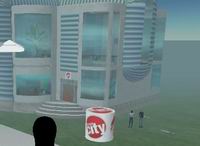 I have been exploring Second Life and had the rare experience of watching IBM and some of its contractors set up their virtual Circuit City store in Second Life. Watching a half dozen avatars 'construct', tune and correct the experience is a revelation. It has been formally opened now. Since the opening I have returned a number of times, its usually not very crowded, have had some interesting conversations with others in the location. Its their first experiment in linking the store experience to the home experience. IBM plans to set up a number of virtual development centers. Have had a number of interesting encounters there. Search for location 'IBM 10'. Below is their text introducing the location:
" ... We've partnered with Circuit City to explore and experiment with how we can apply virtual worlds to their business -- from doing business inside of virtual worlds to connecting the virtual world with the real world to create a richer, more immersive Web environment.There is still much to do here, they are attempting to mimic a real-world retail experience in a virtual world that does not effectively support that illusion. Will continue to track.
This early build of a virtual Circuit City store is an area where we are experimenting with how to enrich a user experience by using virtual worlds to augment both the Web experience and the real world experience. For example, instead of browsing through a catalogue on a website, people can use their avatars to walk the aisles of a virtual Circuit City store, and pick up and examine products in a way that is closer to real life.
They can also easily link to an order form to shop in these virtual worlds in a way similar to ordering on the Web.
In addition, this build demonstrate a really powerful advantage that virtual worlds have over the Web... in the area of customer service, instead of simply talking someone through technical issues or how to use certain products, they can actually show the user their product in 3-dimensional virtual worlds and explain exactly how and where to fix or examine the product to find the problem and get it resolved.
Other immersive features that IBM and Circuit City are experimenting with include an interactive home theater, where customers can easily recreate their own home environment to do things like setting up a home theater -- users can easily move a couch at the proper distance from where they want to put a new TV, and it automatically tells them the optimal size TV to purchase for their room dimensions, and eventually will add other features like where to place speakers for a surround sound system
This is in the early experimentation phase, and we are eager for feedback from consumers and other businesses on how we can make it better ...."
Tuesday, December 26, 2006
Tim Berners-Lee Blogging Again
Richard James points out that web inventor Tim Berners-Lee is blogging again, followed him for a short while, but stopped due to lack of traffic. Hmm, he does one good thing and then slacks off :) One of his latest projects is the Tabulator, a proposed semantic web browser that is worth a look.
Monday, December 25, 2006
Incessant Barking
From a 2006 New Yorker Cartoon, pretty much on point:
Two dogs are facing each other, one speaks:
"I had my own blog for a while, but I decided to go back to just pointless, incessant barking".
Friday, December 22, 2006
Saffo on Intelligent Enslavement

" ... Fear of enslavement by our creation is an old fear, and a literary tritism. But I fear something worse and much more likely -- that sometime after 2020 our machines will become intelligent, evolve rapidly and end up treating us as pets. We can at least take comfort that there is one worse fate -- becoming food -- that is mercifully highly unlikely ..."Paul Saffo, director of the Institute for the Future, on the evolution of smart machines in the 12/06 Communications of the ACM.
Paul, who we have connected with since the late 70s, as a practitioner, I disagree here. I don't think the type of intelligence he suggests will be here sometime shortly after 2020, if ever. There are still very fundamental problems with cracking the problem of intelligence. Its not about faster machines, or more memory, or more connected networks .. but about understanding how to make things smart. Its not about knocking down straw men like playing chess, but its about very deep forms of pattern recognition that allow us to abstractly understand our world. The most common computing intelligence we use today is still simple search. I think the old question of whether a dog could make a machine smarter than itself has still not been shown to not apply to us as well.
Thursday, December 21, 2006
Corporations and Web Services
The Economist on how Consumer technologies are invading corporate computing. Mostly about Google and Web services. Carr with some related comments.
Wednesday, December 20, 2006
Swiss Army IT Model
 This has seen lots of press. The largest swiss army knife, reviewed in the Guardian. Lots of demand, most likely as a conversation piece as opposed to a practical solution. Brought to mind many of the things we do in IT today. Is it a model for Google? Is it SAP for the large enterprise? My knife has a couple of blades and a corkscrew, quite sufficient.
Tuesday, December 19, 2006
NY Times and Consumer Generated Media
Pete Blackshaw, longtime colleague, writes in his always lively consumer generated media blog about an article in the NY Times on consumer generated media: " ... the writer, Keith Schneider, using Nielsen BuzzMetrics as his backdrop, asks all the right questions about whether CGM, and in particular CGM analysis and text-mining, is destabilizing the typical "go to market" strategy for most brands ...". Fascinating view of where all this is going, where measurement is ultimately the driving force. Quote from the NY Times article:
" ... the branding game has changed radically, largely because of the myriad choices the Internet provides consumers and because of the economic influence of widespread Web pontificating, known as the blogosphere, which barely existed as a popular force until about four years ago...As consumers eagerly post word-of-mouth commentary in online communities, message boards and Web logs, a straightforward question confronts brandmeisters: Who wins and who loses as time-tested practices of mass production and mass marketing are undermined by the informed and often cranky voices of the knowledge age?... "
Monday, December 18, 2006
Google Patents
A colleague writes to remind me of Google's patent searches: Patents site, which searches full text on all US patents, this search, returns only about 740 patents assigned to IBM, far fewer than there are, from a database of about 7 million. So appears to be far less inclusive than that of the USPTO office. I like the simple search, though. Its also not well known that you can search for US patents in a normal Google search by entering the word 'patents:' in front of the number, e.g. 'patent:4288291'. One odd thing, I used to often use Google's UPC code search by typing in just a 10-digit UPC/Bar code to ID a grocery item and also get some sample prices. Now when you do that I note that it sends you to a UPC search site.
Sunday, December 17, 2006
IBM's Dogear
From IBM Think Research Magazine: Fetch!. An article on their Dogear social bookmarking research. IBM's Think Research is a development journal I have followed for years. IBM positions Dogear as the first social bookmarking method that is usable by organizations. They are planning to announce offerings that deliver some of their internal social technology work:


" ...Social bookmarking services have dramatically changed the way we find information on the Internet. Popularized by a service named del.icio.us, these Web-based applications provide a centralized place to store, organize and share Internet bookmarks. There are two distinguishing characteristics of social bookmarking systems. The first is the use of keywords, or tags, that a user enters to describe the links he or she saves. These tags allow users to organize and display their collection with labels that are meaningful to them. Furthermore, multiple tags allow bookmarks to belong to more than one category, a limitation of the traditional hierarchically organized folders found in most Web browsers. The second significant characteristic of these social bookmark applications is the social nature of their use. While bookmark collections are personally created and maintained, they are typically also visible to others. As a result, users benefit by getting pointers to new information from others while at the same time getting a general sense of what other people's interests are ...."
Saturday, December 16, 2006
Dove Solicits Ads
Unilever's Dove is the latest brand to solicit consumer generated ads for a TV spot. Details here.
Friday, December 15, 2006
Is this the Way to Run a Meeting?
I have spent some time in the last month getting up to speed in the Second Life (SL) virtual world. I worked with similar things, notably Blaxxun, back in the 90s. Always have been interested in highly visual interfaces, so this is a great example that I awaited with anticipation. It also has received much interest from the business world.
I received an invitation from IBM to attend a tour of their new virtual islands today. This was the first time I attended a formal meeting in SL. There were about 50 or so avatar participants and maybe 10 IBM speakers, tour guides and helpers there. Not all of the participants (including me) were highly skilled at controlling their character, so there was lots of bumping, colliding and fidgeting before getting people in their seats. The interface does not lend itself to precise control. Some seated avatars were so large and strangely adorned that I wanted to yell 'down in front'! But it did not actually matter since there was little to see down in front.
Like most SL presentations this consists of words typed in a chat box and supporting visuals. The visuals, though, require some adeptness with zooming in to a screen, also something more of an advanced technique. As a result the visuals were mostly just repetitions of the chat text. While the presentation goes on, you can IM other people in the crowd to create a back conversation, but that too can become confusing, and if you type in the wrong box, your acid comment becomes part of the public presentation!
Once the short presentation was over, we were invited to group teleport to a number of venues that IBM and their clients had developed. Teleporting groups is also something that the interface does not do well, so with each teleport some folks were left behind. You could also fly there, if you knew the way.
One of the venues I was most interested in was the Circuit City store. Last night I had watched as the IBM architects spent some last minute time fixing it up, and that process, done by avatars in virtual space, was fascinating to watch. That worked well, at least in my perception, because there were only a few folks, and they were very focused on a task.
The building of the Circuit City store (In SL search for 'IBM 10') and all of the store venues along a virtual street in SL are very well done. Much effort has been expended to get these looking architecturally good. Inside the store, however, things are different. I have interacted with some real-world store designs, and the CC world is strange indeed, very large aisles and too small products. Once you get more than a few shoppers things become chaotic. Its another case of precision control of your avatar, and a relatively small space, that makes it hard to do anything like they envision. Also, what they are trying to do is create a old style 'a pick and choose store' in a virtual space. People are now used to click- picking things from a screen to do online shopping, they don't need the illusion of aisles. Most stores in SL use click able pictures on the wall to sell their goods.
Once outside of the store you can fly and explore at will, you don't need the precision required in a narrow space. Leaving, I felt that breath of relief when you get out of a too-enclosed space.
What was amazing is the amount of effort that IBM has put into this effort. Dozens of staff and those that I talked to were very enthusiastic about the idea. The SL space also allowed an openness that I had not seen before. On the steps of the virtual Almaden Virtual labs (the real one is in San Jose) I got into some great conversations about virtual space, navigation and data interaction. Made some great connections. That would have been hard to set up otherwise.
I chatted with a colleague about this and his reaction was that IBM is investing in this not for the now, but in the belief that this will become something in the not too distant future. A very good point. Sure the SL interface is klunky and imprecise, but that problem will be solved, perhaps by some other vendor.
So congratulations to IBM to get this work started for us. There is lots to do. Its worth exploring on a not too crowded day. We need to understand how real companies can sell real things in a virtual world. And along the way, just how to have a simple meeting there.
Thursday, December 14, 2006
Second Life Guide
 Making my way through Second Life: The Official Guide, by Michael Rymaszewski et al. This is a good introduction to the idea of SL, but its not a substitute for at least a demonstration of the real thing. The book does not build a case for SL, assumes you have some enthusiasm already. Its a good skim after experiencing SL, because it will alert you to a number of things you had probably not understood. Good jump start in virtual worlds.
Graphically well done, as should be the case with a visual world. A useful appendix, but no index. Does not give you an alert to the fact that all is not running smoothly in SL of late, with slowdowns and odd behaviors. Mild cautions, but no dirt here. The advanced section on building and scripting is not a manual, but an introduction, the book points to online resources. There is an attached CD with code samples I have not examined as yet. Finally a lot of emphasis on avatar appearance, which I can find distracting.
Wednesday, December 13, 2006
Made to Stick
Scott Underwood, correspondent at IDEO, sends along his view of the forthcoming Made to Stick: Why Some Ideas Die and Others Survive , by Chip Heath and Dan Heath. The question is a useful one:
" ... Why do some ideas thrive while others die? And how do we improve the chances of worthy ideas? In Made to Stick, accomplished educators and idea collectors Chip and Dan Heath tackle head-on these vexing questions. Inside, the brothers Heath reveal the anatomy of ideas that "stick" and explain sure-fire methods for making ideas stickier, such as violating schemas, using the Velcro Theory of Memory, and creating "curiosity gaps." ..."Made to Stick website (with a lengthy excerpt).
Tuesday, December 12, 2006
Google Research Video Picks
I recently discovered the videos that Google Research puts together from speakers on their campus. Some very interesting topics about technology, research and directions. They just put together a 'top twenty' thats worth scanning for gems. Example: How to Survive a Robot Uprising.
Monday, December 11, 2006
Coke Teams with YouTube
About Coke's Wishcast effort:
Coke Taps YouTube For Video Card CampaignHere former P&G I-Marketing manager Tim Kopp of Coke invites you with a (rather wooden) video. Will follow this to see if it takes off.
" ... COCA-COLA IS TEAMING UP WITH YouTube for a new joint marketing effort--one that doesn't involve Mentos or exploding Diet Coke bottles. Instead, Coke is sponsoring a page on YouTube that enables users to select or create their own holiday video "cards" to send to friends and family ..."
Sunday, December 10, 2006
Grace Hopper's 100th Birthday
 I see that this past Friday was Grace Hopper's 100th birthday. Here is a personal reminiscense from my first professional IT experience:
In 1975 I was freshly graduated from the University of Pennsylvania with a degree in astrophysics. There were few opportunities for someone with an undergraduate degree in that field, so I took the civil service exam, and ended up taking the train from Philadelphia to Washington for the first time. I had hired on as an analyst for the national Military Command Systems Support Center at the Pentagon. We were some number of floors below the ground, responsible for keeping several military computers running. We were managed by the Navy, so even though we were far below dry earth, when a new officer arrived they were 'piped on board' in shipboard fashion.
Just around the corner from my cubicle was the very humble office of then Captain Grace Hopper. Having always been interested in the history of technology I recognized the name mainly due to her involvement in the development of compilers for the computer language Cobol. She gave a talk a few months after my arrival and I was impressed by her vision. Her talks gave a nod to computer history, which she had been a key part of, but even more so she was sincerely interested in the future of computing. In her talks then and for many years afterward she always carried a length of wire with her as a prop, this wire, she would declare, is a nanosecond ... equating time and computing power. She then would talk about where she thought computing was going. Her views were mainly about numerical rather than symbolic computing, but even in this realm she understood computers were stretching far beyond just numbers.
She was very rarely in her office, even then acting as an ambassador for military computing. I made it a point to stop by one day when she was there and introduced myself, a slightly longhaired young computer neophyte. She was gracious and invited me in. We hit it off because most of my work in school had been about solving differential equations, which had been an interest of hers. I was particularly interested in the pre-compiler world of the computer, when developing code was more like wiring a machine than writing logic. She also spoke about her involvement with Eckert and Mauchly, early pioneers of computer hardware. Looking back I should have had far more questions, but our chat ended far too soon. It was our only meeting, I moved on soon afterward, though we said hi a few more times in the hall.
She was appointed to admiral in 1985 and died in 1992, just as the Web had been developed. What might she have thought about that development? Many millions of non-technical people using 'Hypertext Transfer Protocol' to communicate? Her development of the compiler was a first step from numerical computing to using computers to manipulate text and communicate thoughts freely between ordinary people. She showed the way in the very early years and helped make it happen.
Good short overview of her life and achievements.
FA Dill June, 2004
Saturday, December 09, 2006
Volvo Designed by Women
At a recent futurists meeting (more on that later) Volvo Brand presented about a car designed entirely by, but not necessarily just for women.
" ... When Volvo Cars' all-women team developed the YCC (Your Concept Car), they had a thesis: if you meet the expectations of women you exceed the expectations of men..."
Its a concept car, and as you know, concept cars don't usually go directly to the market, if they are ever sold at all. Ideas in the cars do evolve and are typically integrated into new models. Here is more with lots of pictures.
Thursday, December 07, 2006
Operating Theaters of the Future

Recently attended a local meeting on RFID tagging. One presentation at that meeting was by Jim Milkovitch and Jim Waldron of Johnson & Johnson's Ethicon division. They currently have over 150 people and 35 projects working in the area of RFID tagging. One particular area of interest is their work with hospitals to created what they are calling 'operating theaters' of the future. In such an environment anything that enters the room is tagged. Patients, doctors and nurses will wear active (battery powered) tags which will be read at entrance portals. Instruments will carry passive tags. The inventory, movement and use of every object in the room will be micro tracked to determine its use. The use of objects in the theater will be compared to lists of procedures and processes to check for errors. Costs will be automatically determined. This will allow J&J to give value-added capabilities to their instruments and surgical goods. Whats useful here is the linking of sensors to procedure and location. Areas that require very precise manipulation, risk and cost, certainly like surgery, are where we will see early useful of these capabilities.
Power of Your Data
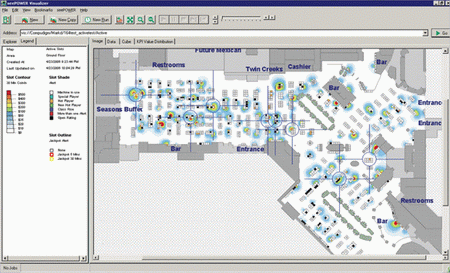 Who deals better with data than the casinos? The Las Vegas company Compudigm here a number of times, in the recent copy of Teradata Magazine (Good mag that I have neglected for too long) , an article by Craig Mullins about advanced analytics, especially consumer behavior. Since most casino customers use loyalty cards and most purchases are made at the point of choice, they can be tracked and analyzed in ways just dreamed of by retail. We met with them a few years ago, and they had just started to work with retail data. Good example of visual abstractions overlayed on location data.
" ... Traditional business intelligence (BI) enables companies to understand the "here" and "now," and even some of the "why," of a given business situation. Advanced analytics goes deeper into the "why." Employing a business-focused approach, it comprises techniques that help build models and simulations to create scenarios, understand realities, improve decision making and determine forecasts. These techniques include--but are not limited to--data mining, predictive analytics, applied analytics, data visualization and statistics ..."
Wednesday, December 06, 2006
Blacksmith's Gift
Former colleague Dan T. Davis has become an independent author of children's books. " ... The Blacksmith's Gift was awarded the 2005 Benjamin Franklin Award for the 'best independently published juvenile/young adult fiction of the year' ...". Congratulations, Dan. Check out the site.
Monday, December 04, 2006
Big Brands and Brain Waves
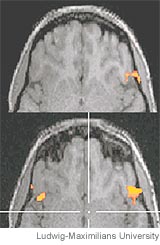 In a recent WSJ article: Biology of Brand Identity, another article on what has come to be called neuromarketing. The images at the right describe the findings that a big brand requires less brain work, top image, than a weaker brand, bottom. This idea has reaped considerable controversy in implying that it could result in a 'buy switch' that could be activated by the right kind of marketing message. This is new research that specifically looks at the strength of brands, and tried to determine how that aspect effects the brain. I believe that this and and related ideas will ultimately become important if they can be validated. . "... use of MRI to gauge consumer response eliminates the risk of dishonest or incomplete answers in market surveys. In an informal experiment, she says she asked a student to name his favorite brand of sneakers, and he said Adidas. But under MRI, the Puma brand evoked a more positive response, and the student admitted that his favorite shoe was a Puma model that was out of his price range ...". Some of my other posts discuss this further and compare it to other biological sensor models.
Shortfuze Machinima
 New correspondent Juhi Shareef of Arup's futures group sends along this link to Shortfuze's Moviestorm, a machinima moviemaking package. We have been experimenting with Reallusion's Iclone. What can businesses do with machinima? It can be used to link prerecorded audio to animated avatars. It can also be used to place prerecorded video into virtual worlds. Or easily set up creative storyboards. Other ideas are welcome.
Sunday, December 03, 2006
Home Robots in Retreat?
PC Mags Lance Ulanoff in his Holiday Robot Buying Guide, writes about the status of home robotics that aim to do real work. Following this for some time, I get a similar read. Though I did see the Roomba prominently displayed at the local Costco. No things we could really use; robot butler, or home maid or laundry helper yet on the horizon.
" ... Wow Wee's Robosapien and Roboraptor and iRobot's Roomba should have been the sparks that ignited the industry. Instead, the lit fuse has been snuffed out. Wow Wee's newest Roboreptile is entertaining, but it has done little to move the industry forward. Meanwhile, the excitement surrounding iRobot's Roomba has dimmed, and the Scooba floor mop has not been a Roomba-like hit. Worse yet, instead of more companies flooding into the consumer robot space, there seem to be fewer. Sony dismantled its consumer robots division and killed off the AIBO and the Qrio, and Radio Shack dumped the Vex robot kit ..."
Friday, December 01, 2006
Expert Systems on Handheld Devices
More Expert Systems Migrate To Handheld Devices
Exsys ports its Corvid expert systems software to run on Hewlett-Packard's iPaq pocket PCs and 40 other handheld devices. Exsys was one of the expert systems companies we worked with in the 90s. The article uses the term 'inference engine' ... let me explain. Almost all computer code today, like that running the browser you are reading this on, is operating in a step by step order determined by the code itself. This process is fundamentally not much different from the coding that was done in the 50's.
If you use an inference engine, the program logically proceeds to a desired business conclusion we were attempting to resolve. This sounds more like the way our thought process works (if we really were that logical!) so its considered a part of artificial intelligence. Its also much easier to understand the code used, making maintenance easier. Back in the late 80s, we thought that by now all computer coding would be done with 'inference engines', but it turned out to be more difficult than we thought.
" ... You may soon be carrying expert systems in your pocket or briefcase. More companies are adapting their software to run on handheld devices that use inference engines rather than hard coding, and customers should have more choices in the coming months and years.
The latest evidence is from software vendor Exsys, which this month ported its Corvid expert systems software to run on Hewlett-Packard's iPaq pocket PCs. The software also can run on about 40 other handhelds that rely on the Document Type Definition subset of IBM WebSphere's Java Virtual Machine. The ability to arm knowledge workers with expert systems loaded onto handheld devices makes expert knowledge much more accessible. This could be especially useful to sales reps, technicians, or field repair workers.
The National Park Service is looking at using the handheld version of Corvid to evaluate areas that experienced environmental damage, Exsys CEO Dustin Huntington says. With the software, the Park Service could hire people with limited environmental background to go to a site and evaluate the situation as if they were environmental engineers conducting the survey. The expert system, in the form of a questionnaire, would guide the surveyors down the right path, prompting them to seek specific new information based on the response to the last question they entered. "By having that knowledge there," Huntington says, "they're able to put the logic of the decision maker out there in the field." ...
Short Persuasive Videos
Professor BJ Fogg of the Captology Lab at Stanford, who we have worked with a number of times asks for our help:
" ... My Stanford students have created short videos (averaging 2 minutes) that show how Web 2.0 services persuade people and change their behaviors. The videos are interesting -- and sometimes funny. I'm inviting you to help evaluate some of these videos before December 4th. You can rate one video or twenty. The choice is yours. To watch and rate the videos. The videos with the highest rating will be featured in the Captology Film Festival on December 7th at Stanford. You're invited to join us at that event. For more info ..."The Captology Lab is worth taking a look at. It addresses the problem of how to use computers to persuade, beyond just the advertising level.
Thursday, November 30, 2006
The Traveling Shopper Problem

Our correspondent at Wharton, Peter S. Fader, writes in Knowledge@Wharton about how shoppers travel in stores. The Traveling Salesman problem is a classic operations research model where someone must find a best path to visit pre-designated locations in minimal time. For example, a shopper seeking to find all the items on a list. Fader mines his large database of real shopper travel data to find out what shoppers really do, and what kind of challenges this raises for retailers when designing or reformatting their stores. Some lessons for us as well. Link to the full paper.
Wednesday, November 29, 2006
Backseat Virtual Reality
From Newscientist a game that uses passing scenery to provide a base for a game. A nice idea of borrowing or augmenting reality to provide richness for a game experience:
" ... Researchers at the Interactive Institute in Stockholm, Sweden, are testing an in-car gaming system that allows passengers to play an interactive game based on the buildings, forests, and rivers passed along a route while driving. The Backseat Playground uses such landmarks encountered during a trip to build a story, complete with in-game characters and events. The game matches sights for events in an adventure that might involve a murder mystery or a werewolf thriller, and makes use of a GPS receiver to provide geographical data, a handheld computer for player interaction as the story builds, and headphones for players to listen to phone calls and walkie-talkie messages from in-game characters. A laptop in the trunk, which correctly positions the car in the virtual world, connects the GPS receiver, handheld computer, and headphones. "We are trying to suggest spaces and places and events and have the user fill in the gaps to build a narrative," explains John Bichard, who developed the interactive game with colleagues Liselott Brunnberg and Oskar Juhlin. The computer scientists are considering integrating voice recognition into the game, which would allow players to talk directly to the characters. Rob Aspin, with the Center for Virtual Environments at Britain's University of Salford is intrigued by the way in which content is delivered for the game. "It can create a high sense of presence and interaction while hiding most of the technology from the user," says Aspin ..."
Sunday, November 26, 2006
Lincoln's T-Mails
Here visiting Georgia Tech and getting some reading time in. Part of the way through Tom Wheeler's: Mr. Lincoln's T-Mails: The Untold Story of How Abraham Lincoln Used the Telegraph to Win the Civil War. I guess its important to have such an extensive subtitle today, the book browser has to have no reason to misunderstand the topic of the book. Like it so far, I was intrigued by the thumbnail history of telegraphy. It is fashionable to credit Samuel Morse with nothing more than self-promotion today. I compared this history with the Wikipedia entry on telegraphy, and that entry filled in some of the non-US details. Wheeler attributes the development of the actual code to Morse's assistant Alfred Vail, though Vail's WP article says otherwise. Tom Standage's The Victorian Internet, links the telegraph to the internet and is a good related book.
Good book. Lincoln (the only US president granted a patent to date) became increasing enamored with the ability to directly communicate with his people in the field. In some cases the military did not know what to make of these communications. Wheeler makes much of saying that Jefferson Davis, who had a military background, meddled with his military, causing some confusion. Lincoln, who had no military background, he suggests communicated without meddling. Not sure I buy that, in hindsight Lincoln won, so for whatever ultimate cause, his communication was not meddling.
If you have interest in the history of technology or the military a good read.
Saturday, November 25, 2006
Journal of New Communications Research

New Communications Research (SNCR) has published the first issue of their new Journal. SNCR is
" ... A global nonprofit think tank dedicated to the advanced study of new communications tools, technologies and emerging modes of communication, and their effect on media, professional communications, business and society.."Their wiki in Socialtext. Online preview, with contents. I am loosely affiliated with this nonprofit as a research fellow. A good initial selection of readable papers about social technologies, oriented to a degree in their use for external relations. Still reading and will report on useful learnings. Order here.
Friday, November 24, 2006
Will Wikis Help with Knowledge?
Nicholas Carr, who I make sure to read , talks about whether " ... Web 2.0 tools like wikis will help automate the management of knowledge in companies. Also featured in the podcast is a debate on whether IT matters strategically..." Podcast here in the Financial Times.
Subscribe to:
Posts (Atom)