

Tuesday, May 27, 2008
Tineye Image Search Engine
Tineye a search engine that finds similar images: " ... TinEye is an image search engine built by Idée currently in private beta. Give it an image and it will tell you where the image appears on the web ... " . For more about what they are about, see their blog.

Emergent Tagging Trends
I reviewed Gene Smith's recent book about Tagging. Here are the slides he used at Webvision for a talk on emergent tagging trends.
Unilever CEO Wants Wow
Piece on Unilever innovation 'wow', interesting and somewhat contrasting read just after finishing P&G CEO's book:
Unilever chairman wants more "wow"
Michael Treschow, chairman of Unilever, says the company needs a greater focus on developing innovative product lines. "The single most important thing is that we speed up our innovation machine, which means that we bring more highly appreciated products to the consumer so that they say, 'Wow, this is really something I would like to have,' " he says ... '
Treemaps
 Have been exploring the Treemap data visualization format. It's a means of visualizing relative hierarchical quant values in a fixed space. Well known examples are the Map of the Market and the Newsmap. The Hive Group licenses software to implement the capability. It's also covered in designer Ben Fry's recent Visualizing Data book, with usable code. The U of MD has a test version and some overview papers. Also, IBM's ManyEyes has treemap tools, and a good simple explanation of the method. Surprised that this form is not more widely used for ease of use in dashboard type applications. Does anyone know of additional distinctive examples? ... UPDATE a commenter writes: My company, Lab Escape, has several examples of using treemaps for different uses in our Learning Center on our web site ... Trevor Lohrbeer
Monday, May 26, 2008
Smart Packaging for Consumer Goods
Of interest: Smart Packaging Technologies for Fast Moving Consumer Goods. One of our innovation center coverage areas. Has an Amazon 'search inside'. Quite pricey ($180) so I doubt I will review unassisted. Send me a copy and I will be glad to review in a knowledgeable context and broadly distribute.
Sunday, May 25, 2008
David Sibbet and Grove
I regret I have not been reading David Sibbet's blog. He recently mentioned my insider post on P&G's innovation work. See also his TED big Viz work. David has worked with us for a very long time, since the late 70s, even trying to teach us graphic visualization. Never turned me into an artist, but did make me think about things visually in critical new ways. I fondly remember sessions we had at the Presidio in San Francisco with his company, The Grove. Thanks David, you are on my feed now.
Beyond Blogs
Business Week has updated its much-read 2005 'Blogs Will Change Your Business' article with a new post: Beyond Blogs. Apparently the old post was still getting top exposure three years later. The bottom line: They don't believe the blog bubble will burst, but different kinds of social technologies, that are less publishing and more conversation are taking over. So Facebook, Myspace, LinkedIN and Twitter are getting most of the buzz these days. I am still skeptical that the new resume can be '140 characters long', referring to the Twitter message length limit.
Companies, IBM and BT get good mentions, are seeing the value of linking into both internal and external networks in new ways. I started my internal company blog in 2003, and though it and dozens of others were widely read, they did not start broad conversations. Now it remains to be seen if social networking capabilities will start these profitable conversations both in and through the firewalls of (non technology) companies. The BW article is a good overview and update for this domain.
Companies, IBM and BT get good mentions, are seeing the value of linking into both internal and external networks in new ways. I started my internal company blog in 2003, and though it and dozens of others were widely read, they did not start broad conversations. Now it remains to be seen if social networking capabilities will start these profitable conversations both in and through the firewalls of (non technology) companies. The BW article is a good overview and update for this domain.
Saturday, May 24, 2008
Bionic Eyes
Report on some new work on the bionic eye. Still lots to do and learn. Reminds me of Carver Mead's Silicon retina work, not sure closely these examples are related.
Friday, May 23, 2008
A Future of Self Checkout
Evan Schuman paints an alarmist picture of the future of self-checkout. Sure there are dangers, but this does not mean we should return to a dataless barter system.
Tag Galaxy
 Tag Galaxy: A novel interface for interacting with tagged Flickr images. By Steven Wood of Nuremberg. Choose a tag, click on a planet within a taxonomy neighborhood and explore the images.
Thursday, May 22, 2008
P&G's Beckett Ridge Innovation Center
 It's in public print now. I am making my way through P&G CEO's A G. Lafley's and Ram Charan's book: Game-Changer: How you can Drive Revenue and Profit Growth with Innovation. Good book so far.
As might be expected there is a short mention of Procter & Gamble's Beckett Ridge Innovation Center, of which I was one of the founders. The space started with a mostly skunkworks operation in about 2000. I ran the retail store operation until 2005, hosting hundreds of executives, retailers, vendors and employees through the center. A few interesting details of the center's operation are included in the book:
" ... One of the star features at the Beckett Ridge Innovation Center is the Virtual Wall. This is an eight by sixteen foot wall on which images from twenty four projectors can be displayed. P&G adapted the idea after a visit to DreamWorks; it wanted to do something with digital imagery, but that was of course, hardly its expertise. Working with the University of Aachen - connect and develop again - P&G ended up with something akin to what oil companies use for seismic imagery. What had to be done with it was project packaging - from shelves to categories to the whole store.
There is video that can be connected to remote tech centers around the world, so that people can call in questions. At a few touches of a button, the shelves can be re-aligned. The P&G Team can run shoppers through many more iterations than if they had to drive from store to store, assuming they could even find what they wanted. Fifteen minutes on the wall can replace months of dithering. Failed ideas get nuked much faster, good ones get accelerated.
Once P&G brought in execs from Iams, the pet food division, to evaluate some packaging. The team did the usual - projecting pet food aisles from different stores, and bringing in shoppers to make their picks. It didn't take long for the Iams folks to realize their concept was not working: shoppers kept choosing the competition. That kind of understanding would have been very expensive if the team had launched and waited for the product to fail ...
P&G's Envision Center takes the Virtual World to another dimension. It's a paneled wall eight feet high and thirty feet long. The panels can be moved to create a three walled cave. Through this, P&G can project the top ten stores of its top retailers. With goggles, gloves and a virtual reality device, it's possible to navigate through the aisles (or above them), testing new concepts and store environments, flipping through the wrong ideas on the way to finding the eight one ... " (p. 201)
Good, though idealized description of what went on at BRIC. Sometimes it's not just the push of a button, lots of work needs to be finished in preparation for the performance. It also isn't all virtual, often it's useful to link the tangible with the virtual to get full engagement from the participants. It's not all that goes on either, but all the secrets cannot be told. I worked with many un-mentioned people at BRIC who worked long hours to get it established and working. I fondly remember the effort.
Similar things afoot at Kimberly Clark.
Wednesday, May 21, 2008
Microsoft Pushes Mobile Ads
MS and mobile ads:
" ... Bidding to grab an early share of the rapidly growing mobile advertising market, Microsoft on Tuesday announced a broad initiative to drive both display and search ads on mobile devices ... "
UK Retailer Tests Cell Phone Tracking
From StoreFronBacktTalk: A UK retailer is using cell phones to track consumers. Or at least their statistical movements. The vendor says that they are not tracking individuals, but they are using cell phone specific IMEI numbers. Which could lead to misuse. The vendor is Path Intelligence. Some similar goals to the Prism idea, but Prism is not gathering personally identifiable data.
Modiv Media Hand Held
 At the recent FMI show we got to see some of the offerings of Modiv Media. Have had a fairly long technical relationship with the idea of consumer-driven handheld scanners in grocery. Tested the design and usage of these devices with real consumers in 2001 when Symbol was making a device that eventually was merged into Motorola.
Modiv Media, formerly MobileLime, picked up the delivery of these devices, in Stop & Shops in New England. They also purchased cart-display maker Cuesol, which we had also tested in realistic environments. They have also formed a strategic alliance with Fujitsu, which has also been looking at related offerings.
I had looked at previous tests, and much of the interest by shoppers was the ability to do pre-checkout in the aisle, minimizing waiting in line. The new version has more screen detail and color with a simple keyboard. Marketers would like to be able to communicate with the consumer and cross and up sell items in the aisle. This latter goal has not been universally proven, though many are still trying. Consumers have to be convinced this is of value to them. Compare also to previous post on Modstream.
Request: Would also love to hear from people who have experienced Modiv in a real store. Send me an e-mail (Franzdill the-atsign gmail.com) and I will publish your experiences here. Or I can set up an interview.
ScanLife and Other Camera Scanning
 Earlier this year we took at look at ScanLife, a down loadable program for camera phones that lets them be used as scanners. Unfortunately it does not allow the camera to scan the common 1D product bar codes, or even regular 2D bar codes, but only a proprietary 2D code called an EZcode. You aim your camera at the code and it interprets it, beeps, then takes some action, say sending an e-mail, or bringing up a web page. Worked well during the test. Unlike other attempts at this ScanLife has thought it through commercially. Applications like free samples, price comparisons and extended information are obvious. At the right is an (incompatible) 2D QR Code.
It won't work with all providers or cellphones, visit the site above to see which. We tested with Verizon and HP. I was reminded of the test by some rumors that it was now available on the IPhone. Don't believe everything you read, because it's not available yet.
Some have cynically compared the idea to the much ridiculed Cuecat, which we also tested. It depends much on the critical mass of enough codes being out there to entice the phone user to download the software, or ultimately to have it automatically loaded on phones.
There is much value to having a scanner capability on a cellphone. Though it should have the ability of interpreting multiple kinds of codes, 1D, 2D and others and preferably those that meet open standards. It may be the only way to achieve a critical mass common enough to get the attention of the consumer.
There is more activity now in this area, see the iMatrix platform and Neoreader.
Tuesday, May 20, 2008
Tesco Self-Checkout Results
Evan Schuman writes about Tesco's good results in their all self-checkout store experiment. As I previously mentioned, self checkout is popular at our local Kroger, we also pump our own gas.
Google Health
 The Google personal health data offering has been in the works for some time, now it's upon us. There are still lots of skeptics about having Google be responsible for yet another form of public information. Will there be sufficient privacy for both the information and searches that are made by participants? What does it meant to integrate information from other Google services and the new health site? If we assume that it will be pharmas that will do much advertising, to what degree will that be regulated? I recall that this was one of the things that Web MD was originally designed to do. The Google site says:
" ... Google Health puts you in charge of your health information. It's safe, secure, and free.
Organize your health information all in one place
Gather your medical records from doctors, hospitals, and pharmacies
Keep your doctors up to date about your health
Be more informed about important health issues ... "
Febreze
 Good local article on P&G's Febreze brand. It's moving towards having a billion dollars in annual sales. Useful background. Febreze's Wikipedia article is odd, read the talk section to get varying comments on the tone of the article. Despite the WP article including a negative rumor, one commenter thought it was written like an ad! Some people are very suspicious of commercial success.
Brain Reactions to Social Approval
A colleague sends along a link to this article in Neuroscience Marketing that I had missed: Money, Social Status Similar in Brain
"Why do people do things that will gain them social approval? It turns out that the same parts of the brain are activated for a positive social outcome as for a monetary reward. In other words, the same reward circuitry is turned on both by social and monetary gains. Corporate marketers as well as non-profit fundraisers have always known that most individuals crave social approval, but these new findings show how our brains process these social rewards and how they relate to money..."What implications might there be for understanding brain responses? Or is this simply a generalized positive pleasure reaction?
Retail and Web 2.0
Online shoppers will return to socialize, survey finds: "More retailers have been adding Web 2.0 social features to their e-commerce sites. A new study finds that may be a shrewd investment for merchants who want shoppers to return ... "
Monday, May 19, 2008
P&G Digital in Canada
An AdAge aricle speculates that P&G is putting more emphasis on digital advertising, and is using Canada as a testing ground.
Sunday, May 18, 2008
Gartner on Business in Virtual Worlds
Gartner reports that most business-launched virtual worlds fail. They suggest a 90% failure rate. Not so dissimilar from new cpg product failure rates. The reason they cite is that most try virtual worlds for the cool tech factor, rather than the people dimension. Not surprising.
Nature of Mathematics
Is mathematics discovered or invented? And how does this influence patents? A slashdot piece pointed me to a Science News article:
" ... Think too hard about it, and mathematics starts to seem like a mighty queer business. For example, are new mathematical truths discovered or invented? Seems like a simple enough question, but for millennia, it has provided fodder for arguments among mathematicians and philosophers.
Those who espouse discovery note that mathematical statements are true or false regardless of personal beliefs, suggesting that they have some external reality. But this leads to some odd notions. Where, exactly, do these mathematical truths exist? Can a mathematical truth really exist before anyone has ever imagined it? ... "
Saturday, May 17, 2008
Open Wetware
Open WetWare, a example of a wiki sponsored by MIT being used for Biology and Bioengineering. " ... OpenWetWare is an effort to promote the sharing of information, know-how, and wisdom among researchers and groups who are working in biology & biological engineering..." Includes courseware and blogs and contributions from global labs. About sharing science, one does wonder about the IP implications.
Friday, May 16, 2008
DARPA at 50
It's DARPA's 50th anniversary. One of their most amazing developments was the ARPAnet, which I used at the Pentagon in the 70s. No one knew then that it was anything special, just a somewhat useful networking capability with vendors. Then it became the Internet.
Carr on Gwap
I see that Nicholas Carr has commented on Von Ahn's GWAP site, which I reported on earlier this week. I was a bit surprised by his almost positive take. Or perhaps it should have been seen as self-evident that his sometimes cynical view was that machines are taking over our knowledge through the 'fun' in games. The Las Vegas of computation.
Wikinomics II
 Don Tapscott and Anthony Williams have a new expanded edition of Wikinomics: How Mass Collaboration Changes Everything out. The book uses P&G heavily as an example of collaborative innovation, though they did not cover internal uses of Web 2.0, likely because of corporate unwillingness to talk about it. I have posted about some of the Wikinomics related work here, but somehow my internal review did not make it to this blog, will fix that when I look at the new book. I see that this book has a 'search inside' on Amazon, so you can preview it there. See also their web site.
Thursday, May 15, 2008
P&G Ponders Spending
P&G considers the relationship of promotion spending and consumer spending. This links to only part of the article.
Science in Second Life
 Some interesting examples of science being done in Second Life. It's fine to use a virtual world as a social environment, but how can we construct virtual 3D labs to use for collaborative science? The only examples I have seen live is IBM's virtualization of proteins, and a visualization of starts in 3D. mainly useful for instruction, rather than experimentation. I think there is still some possibilities for exploring other kinds of 3D visualization. If the manipulation of point-of-view could be made more natural. At the right, an avatar explores a virtual 3D portion of the stellar neighborhood. Below, IBM's protein display at Almaden labs.

Update (from the comments): Chemistry in Second Life.
Wednesday, May 14, 2008
Games With a Purpose
 I have been looking at a number of online 'games with a purpose' aka 'serious games' , especially how they can be related to more elaborate simulations ... Here is something new and related:
" ... Luis von Ahn and his team at Carnegie Mellon University have launched GWAP, a new web site for 'Games With A Purpose.' By playing these online games, humans help provide data for problems that are hard for computers to solve, such as computer vision and sound classification. Slashdot has previously covered other human computation projects by Dr. von Ahn, including the ESP Game and reCAPTCHA. The new web site contains a re-vamping of the ESP Game as well as four completely new games." ...Mentioned in the BBC. Note this is about getting data from people, somewhat different from playing complex games to achieve process solutions, but there is a useful connection.
Unilever and Interactive TV
In the WSJ (subscription required) ... Unilever is pairing with Comcast and DirecTV to start interactive-TV ads for some of its brands, including Degree deodorant and Bertolli. A Unilever director and an interactive-TV ad expert discuss the medium.
Brand Tags
A collective experiment in brand perception. A good, simple idea. You are shown a brand or logo. You answer with a word or phrase you associate with that brand. The system aggregates the perceptions and shows them in a 'tag cloud' format. Thought I had seen something like this before, but online it is genius. More on the concept.
Tuesday, May 13, 2008
Google Reader for the Iphone
A simplified Google news reader for the Iphone and other phones with advanced browsers. Nicely done.
VisualRank
A short time ago I posted about work that Google was doing on image analysis and ranking. The official Google Research blog has more details about the status and practicality of it's use. Bottom line is that the results are not live. See also related work such as ALIPR at Penn State and work at Google on Youtube datamining. Lots of useful pieces being provided for later assembly.
Are Games Changing Our Brains?
From a colleague, quite a strong hypothesis. At a gut level I do feel there are changes going on, but I would like to see more evidence:
" ... Electronic devices and pharmaceutical drugs all have an impact on the micro- cellular structure and complex biochemistry of our brains. And that, in turn, affects our personality, our behaviour and our characteristics. In short, the modern world could well be altering our human identity ... "
Monday, May 12, 2008
Safeway Builds Private Label
 Retailers make much more profit on private label goods, but they have historically relied on big CPG to do their marketing and to leverage the knowledge for a category. Now, word of Safeway bringing out an 80-item line of baby goods, and backing it with merchandising knowledge. This has been done in small scale before, but this case is bold and revolutionary. More to come? Nothing on their site as yet.
Games Honing Tomorrow's Leaders
Byron Reeves, who we have worked with on scoping the influence of games in business, has an article in this month's Harvard Business Review on the influence of games on leadership. You can read the HBR article online. A Computerworld article prints an interview with Reeves that overview's his study. He says that smart companies should be playing. I am convinced that if we saw these games as kinds of corporate simulation, they would be more widely used.Previously about Reeves. His company Seriosity.
Sunday, May 11, 2008
Self-Checkout Psych
 Evan Schuman saw, as I did, the increasing emphasis on self-checkout in retail tech at the recent FMI conference. For example, Fujitsu included a bluetooth device that allows the consumer to scan a large or heavy item without removing it from their cart. I have seen the use of self-checkout increase dramatically at our local Kroger. I have seen lines even when the store is not overly crowded. Which leads to his essay about if the consumer and retailer will continue to be honest about the process. He also relates an incident about the danger of using a self-checkout for getting consumer feedback.
New Directions in Bayesian AI
A colleague points me a May 3 NYT article: Pursuing the Next Level of Artificial Intelligence, which describes some of the work of Daphne Koller at Stanford. Specifically Bayesian techniques that introduce more quantification and uncertainty in artificial intelligence models. The only thing I disagree with in the article is it's saying that in the original AI methods used in the 80s practitioners avoided quantification. This is not true, methods we used did address both quantification and uncertainty. They were often hung on a base of logical constructs. Now the reverse seems to be more popular. I like to see that the article says there is a revival occurring in AI, though I have not seen much of it in industry. The work being done by Koller and others should improve the tool set available to solve problems. Here is more on her research.
Carousel Widgets
Allan Cox demonstrates the new Amazon Carousel widget on his Inner CEO blog. A way to display multiple book picks. Too commercial? Write him with you opinion.
Saturday, May 10, 2008
Making Electronic Coupons Easier
 Larry Loper sends along a Mercury News Article : Hoping that Digital Coupons Will Cut it. This is about breakthrough work by Cupertino company Ecrio. The article is not about their Mobeam technology, which allows you to transmit electronic coupons from cellphones to standard supermarket scanners, but rather about the research process and it's sometimes odd turns. Describing their newest piece of work:
" ... the gadget translates coupon bar codes loaded from the Web into quick light bursts that trick supermarket scanners into thinking they are reading the coupons themselves. Point the so-called ClipPod at a scanner, press a button and bingo, the coupon savings is deducted from the grocery total ... "
This technology was at FMI and demonstrated at our innovation center because it showed how commonly installed existing technology, such as supermarket checkout scanners, can be used to create new value. It's this kind of piggybacking research that can leapfrog the costs and complexity involved.
Friday, May 09, 2008
Big Ideas to Deliver
New Yorker article: In the Air: Who says big ideas are rare?, by Malcolm Gladwell. A view of Nathan Myhrvold's Intellectual Ventures company. " ... built on the belief that combining capitalism and invention will benefit the world with more and better inventions as well as create financial rewards for investors .... " . Nice article in the New Yorker's 'wordy narrative' tradition about the vagaries of invention, and how to make a business of it. Also, a mention of the Gray-Bell patent primacy book I recently reviewed.
Thursday, May 08, 2008
Protein Folding Game
I was introduced to some of the basic science behind protein folding a number of years ago. It's one of those very tough problems that is very difficult to solve directly with analytical techniques. We thought about some AI techniques that addressed the problem. Solving the problem would be a big coup. Now there is a protein folding site that allows you to game solutions. From Slashdot. Another example of linking machine intelligence to humans, and an example of a potentially very useful game.
Giant Food Stores Shopping Network
Giant Food Stores seeks to improve it's online shopping capabilities. Some details of the vendors involved in this short article that concentrates on the supply chain details. Giant does online shopping and delivery through online grocery pioneer Peapod, which now only works through Giant and US Stop&Shop in limited areas.
Conversation about Conversations
Via Eric Grant Will Richardson writes:
" ... is the conversation moving from more centralized platforms to a decentralized pseudo-realtime mode? are we losing the quality of thought that goes into a paper or a blog post in favor of less contextual snippets and links? .... ".I have started to see much more Twitter activity and 'list blogs' of late. Are we changing to a medium with less thought and more fire from the hip spontaneity. No stopping to think or analyze? Is this the web implementation of 'Blink'? Is there room for both kinds of communications? Help us.
Wednesday, May 07, 2008
Martin Lindstrom on Brands at FMI
 We saw Martin Lindstrom author of the book BrandSense speak at FMI. Have read this book, but this is the first time I had heard him speak. He is quite dynamic, moving through the audience and up and down from the stage. That can be fun, but also a bit distracting, making you swivel your neck just a few times too often. He uses lots of slides, but fairly few words on them. Lindstrom also has a useful site. which has videos on brand building and you can sign up for a newsletter.
Lindstrom's pitch is all about how all the senses are important to brands. I have been exposed to lots of research about using all the senses in retail environments, so I very much like his proposition. All senses are important, but some are harder to control than others. Sight, for example is something we use often, and we can readily manipulate brand images using vision. Many of Lindstrom's examples use aspects of color and form.
He also suggests that we often have 'Proustian' episodes where the smell of environments profoundly influences us, modified by age and perhaps when and where we grew up. I have seen where the smells of environments have been used to establish convincing contexts. Still, this kind of control is very different, the way broad emotional state is different from making calculated decisions. I would suggest it's often barely controllable at all. While we have learned how to control sounds in three dimensions, smell is often at the mercy of air conditioning systems.

Lindstrom shows many brand examples, and how aspects of smell, taste, sound and vision (but not often touch) are increasingly being used to define a brand. And also how the most successful brands are defined by multiple senses. Lindstrom has also developed a simple graphical means to show the contribution of each of the senses. In some of his site videos he mentions some of the neuromarketing analysis being done with fmri brain scans, but that was not mentioned in the talk. He did not include any background about the statistics he references, such as how .. smell effects us up to 75% more than any other sense ... .
I think there is much to be done in utilizing all the senses in the definition of brands, and also in how brands are linked to marketing and merchandising. Lindstrom show lots of examples, and constructs a means to broadly analyze the influence of the senses. I did not come away with much understanding of what to really do to fully utilize all the senses. There is still much to do to get that place, it does not appear the problem has been solved beyond finding intriguing examples.
Intelligent Sticky Notes
Have followed MIT's notion of ambient intelligence for some time, during demonstrations this always impressed people. Intelligence can be ambient, reactive and collaborative rather than attempting to solve deep problems we request. Yet there were relatively few examples that would ultimately be useful. This one combines 'old' tech convenience with new tech details. Or is this overkill?
" ... Bringing one of the most famous inventions of the 20th century into the digital age, scientists of the "Ambient Intelligence Group" at the Massachusetts Institute of Technology have developed the "intelligent stickies". These are essentially Post-its with a twist - the notes written on them can be managed by a PC that will be able to remind users of any information stored on the small paper notes at the appropriate time, via a variety of digital devices. In a project that combines artificial intelligence, RFID, and ink recognition technologies, the MIT team says they have managed to make the popular sticky notes much more useful ... "
WordNet
A number of years ago when looking at language Taxonomies I had cause to look at Princeton's WordNet, " ... a large lexical database of English, developed under the direction of George A. Miller. Nouns, verbs, adjectives and adverbs are grouped into sets of cognitive synonyms (synsets), each expressing a distinct concept. Synsets are interlinked by means of conceptual-semantic and lexical relations. The resulting network of meaningfully related words and concepts can be navigated with the browser.... " . Just started to look at it again for a project. It can be used as a means to establishing the basis for a taxonomy of language. It seems it is no longer being updated.
Tuesday, May 06, 2008
Tagging
 I just read Tagging: People-Powered Metadata for the Social Web, by Gene Smith. This is a short and easy to read book that defines and elaborates the idea of tagging. Tagging is the informal metadata that many systems allow you to add to the web. The result of tagging is a useful categorization of Web resources. The book is completely non-technical until the final chapters, when coding examples are provided. Also useful are a number of detailed case-studies, such as one of Del.icio.us, one of the first systems to permit useful tagging. Also good descriptions of flicker and LibraryThing, which is being used by some library systems to improve their classification systems. All of these systems are basically about how to classify resources via tagging, but are also different in their approach.
The book is largely non-academic, but does point to some useful survey papers that have been written about the use and statistics of tagging. The book also covers the topic of taxonomies, or the arrangement of tagging data. I could have used some more detail there. Also covers the topic of how rich media, such as images, are being tagged, despite their often lacking text. Perhaps surprisingly MS Vista's Photo Gallery is given some praise as a simple kind of hierarchical taxonomy. I plan to explore.
This book is an excellent introduction to the topic of tagging. I recommend it to anyone who wants to explore related topics. Like all books about tech, its examples may fade, but it is a useful start.
Monday, May 05, 2008
Map of the Future in the Making
 Have been a reader of IFTF reports for a long time, making some of their work public appears to be a good idea.
"We are pleased to present our map of the Future of Making! This is our first Creative Commons–licensed map and we plan to share and distribute it at Maker Faire this weekend. We're excited to use it as a way to tie the innovation and general awesomeness of Maker Faire to our research on the future of making .... "
Sunday, May 04, 2008
FMI: Marketechniques
 I am off to the FMI (Food Marketing Institutes) Marketechniques conference in Vegas tomorrow. Although I have been at FMI many times before, this is the first time I have attended as a solo participant. This conference often provides a hint into how retail technology is progressing. Sometimes methods that were featured a few years ago are absent, and others have taken their place. I reported on these and their potential application in the past, but now I can take a broader and more objective look at their application. If anyone out there would like to meet and discuss what they are up to, would be glad to talk and comment. My blog is still read in and outside relevant companies. I will comment here on what I hear and see.
Hypnotism and Brainstorming
The May 12 Business Week reports on the increased use of hypnotism to enhance creative brainstorming in focus group sessions. It works by making " ... people ultra relaxed - through breathing, meditation and visualization. In that state people are less inhibited .. and may offer their craziest ideas, which are sometimes the best ... ".
Building Language
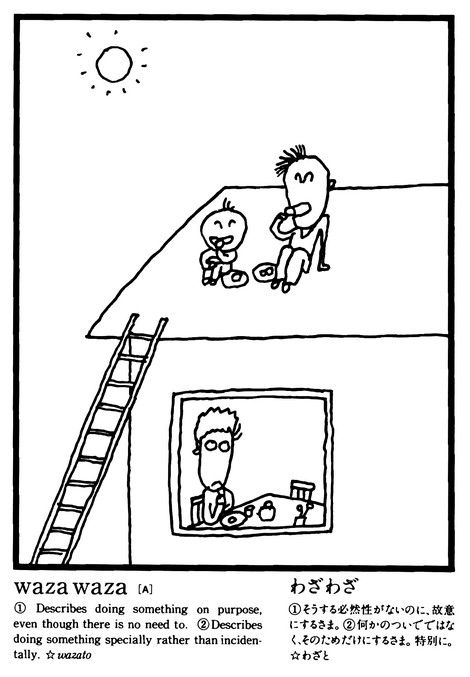
The Language Log looks at, and playfully illustrates Japanese words for complex concepts, such as uja uja, a term for lots of small things moving together. A commenter points out that using such terms loses the efficiency of using combinations of words. Right, but still delightful. Via Ann Althouse.
Saturday, May 03, 2008
To Cork or Not to Cork
 You have probably been part of the little script that takes place in a restaurant when ordering a bottle of wine. The waiter opens the bottle and presents you the cork. I was taught that you politely smell the cork, or perhaps just acknowledge it's existence, before going on to a taste. I have never smelled something tainted in this process, but more and more consumers have, and the realization that more apparently good wine was 'corked' and undrinkable has led to the educated consumer rejecting wine and has become an economic problem for retailers and vintners.
You have probably also noticed that more good wine now is sold with 'screw-cap' closures, replacing cork. Although that's still only about 3% of US sales. It is a much higher percentage in Europe and New Zealand and Australia.
Corks too have changed, some of them are now made of plastic or agglomerated cork material. Corks also have a strong marketing component. Consumers expect good wines to have corks, and there is much less romance in a restaurants sommelier simply screwing off the cap, than there is in them pulling a cork with a satisfying pop.
The value of the natural cork was sold as it's ability to last for decades, until a wine is re-corked with the proper ceremony. The trouble is that most wine in markets like the US is consumed within 48 hours of purchase. No need for complexities in storage. It turns out though that there is not just one solution for this problem, some wines should be enclosed with cork, others could economically use screw-caps, once the consumer has been convinced that it can still be good wine.
George M Taber's 2007 book: To Cork or not to Cork Tradition, Romance, Science and the Battle for the Wine Bottle. covers this in considerable detail. Sometimes too much detail, except for the vintner, chemist, retailer, or very interested consumer. Just reading the last couple of chapters can be illuminating, but if you like details it is worth a complete read.
I was struck by how this change in thinking is an interesting mix of technology, process, innovation, marketing and economics. The standards of a thousand years have now been changing in the last few decades to better overall solutions. It's a good case study of how things can change in a short time.
Friday, May 02, 2008
Wegman's Site to Introduce New Store
In Supermarket News a perhaps obvious approach, innovative retailer Wegman's is using a web site to introduce consumers to new stores. The site is here. To generate buzz about the store, I would imagine, but a quick look shows relatively little that will pull people there except a few give-aways. I was most interested in the store layout, but not much new there, and the layout map itself could have been designed for better understanding of value for the consumer.
Optimistic for AI
Patrick Henry Winston, MIT AI Prof, is optimistic about the discovery of the computational foundations of intelligence within the next ten years. The essay is interesting, but undated. More on his web site. His book: Artificial Intelligence is one we used to get acquainted with the field in the 80s, he still teaches AI at MIT See also, Kurzweil's view on this.
Thursday, May 01, 2008
Parc on the Future
 BBC views the future at Parc, some nice examples, but not comprehensive. In our early days of AI we visited them many times. As is well known, smart people, but not good at delivery to the business.
Surveying the Software Landscape
Carr outlines findings from a just out McKinsey report on the changing software landscape. The full report is here.
Virtual Christian
 I just now see that Christian Renaud, responsible for new tech at Cisco, has a blog where he posts about virtual worlds and other edgy topics. There he recently writes about the history and maturing of the virtual worlds industry. I have followed some of these same changes and they mark a direction for the industry that is worth understanding. Cisco also has a virtual worlds blog that he contributes to. Above, an image from collaborative work being done between Google and Multiverse Network to build virtual worlds linked with the kinds of geographic data found in Google Earth. Progress continues.
Wednesday, April 30, 2008
Public Web is 15 Years Old Today
BBC article talks to Berners-Lee, Web still in it's infancy. I am still amazed it's only been around that long.
Better Living Through Taxonomies
In the Digital Web Mag, a good introductory article: Better Living Through Taxonomies, by Heather Hedden.
Consumers as Media Planners
From Ad Age: P&G Lets Consumers Act as Media Planners. Well, not exactly, but they can complain about media decisions. How that translates into non PC decisions remains to be seen.
" ... Last week, Procter & Gamble set up an option on its main consumer toll-free line (800 331 3774) in response to a drive from a coalition, dubbed Enough Is Enough, that was urging the company to stop sponsoring hip-hop programs on MTV and BET laced with profanity, liberal doses of the "N word," and scenes the group believes degrade and objectify women.
This week, P&G set up a second toll-free option asking callers to register support or criticism of the "story line" on "As the World Turns," from P&G Productions, which featured fairly passionate kisses between daytime TV's only gay couple .... "
Tuesday, April 29, 2008
Flowcasting the Retail Supply Chain
 I had reason to take another look at this book, which I had reviewed last year. I was involved in a test of the method, with very good results. Here is a recent Extended Retail Systems article that explains the method ...
... the Retail Systems Alert Group (RSAG) recommended Flowcasting from Factory2Shelf as a methodology. I have seen this tested and it's useful for its sheer simplicity. Flowcasting should not be seen as a means of future forecasting, but rather as a capability designed to eliminate the need for most forecasting by using demand data such as point-of-sale information. The companion site contains a good overview and the first few chapters of the book. provided here. Worth taking a look at.
Emerging Trends in Tagging
Gene Smith posts his slides for Five Emergent Trends in Tagging talk. He is the author of a new book on tagging I just received.
Monday, April 28, 2008
Robo Mowers Recalled
Not as bad as the headline seems to indicate. Robots with spinning blades should be paid attention to. Home tasks are hard to generally automate.
Kauffman, Science and Religion
I see that Stuart Kauffman, now with the University of Calgary, will soon have a new book out: Reinventing the Sacred: A New View of Science, Reason, and Religion. Look forward to it. We read a number of his early books when we developed complexity inspired models of supply chains. Surprising, since his models were mostly about simplifications of biology. An executive we worked with had read his 'At Home in the Universe ... ' several times, which led to lots of pressure to look at biologically inspired models of trucks. Inspirational from a philosophical point of view. Still waiting for the big modeling win.
Image Search Improvement
I have posted on the general problem of categorizing and finding images. Google and GA Tech just presented a paper about new ways to improve image search, written up in general terms in the NYT. Also, here is the technical paper, presented last week in Beijing. I am reviewing now. From the NYTimes article:
" ... Despite decades of effort, image analysis remains a largely unsolved problem in computer science, the researchers said. For example, while progress has been made in automatic face detection in images, finding other objects such as mountains or tea pots, which are instantly recognizable to humans, has lagged.
“We wanted to incorporate all of the stuff that is happening in computer vision and put it in a Web framework,” said Shumeet Baluja, a senior staff researcher at Google, who made the presentation with Yushi Jing, another Google researcher. The company’s expertise in creating vast graphs that weigh “nodes,” or Web pages, based on their “authority” can be applied to images that are the most representative of a particular query, he said ...
Sunday, April 27, 2008
Captchas and Ann Hathaway in Encyclopedias
I mentioned the term Captcha in a recent post. The term refers to the distorted letters you are asked to interpret when you sign up for a new web service. The object of this is to detect that there is a human asking for the service, as opposed to a spam-spewing robot. The term is defined in a detailed article in the Wikipedia. It is not to be found at all in the premium version of the Britannica. Yes, I know this comparison may be unfair, the term is a somewhat obscure, fairly new (coined in 2000 the article says) technical term, and the WP excels at this sort of thing.
Then there followed another, non technology, example. Britannica just sent out a set of topic articles, constructed from BT entries. One was about Ann Hathaway, Shakespeare's wife. Exactly 303 words long. I am a Shakespeare buff, and know there is relatively little known about her except her family ties. No technology here. Then I looked Hathaway up in the WP. Much longer article there, lots of links to recent related books and articles, including Germaine Greer's 2007 book: Shakespeare's Wife. By my non-historian analysis, a similar level of credibility about the few known and and some inferred facts. Nothing controversial I could see, writing clarity good. So there too, the WP won in overall value to someone that wants a credible but detailed overview.
Once more, though, I don't want a winner, I want competing resources.
Virtual Waiter at Pizza Hut
 Evan Schuman reports on Pizza Hut's Virtual Waiter Program. They say this takes data from millions of online orders and suggests add-ons to your order like Amazon does. Beyond the usual data, it also uses location from zip codes. What complex pizza ordering patterns exist in these orders remains to be seen. At the very least it exposes some of your other offerings to your customers, as effectual as a waiter saying 'would you also like an order of garlic sticks'? A common up-sell at restaurants. It's not like books ... to what extent does the fact that others order something with pizza influence you? They should soon have that data.
Saturday, April 26, 2008
Gems of Marketing Science
 Byron Sharp sends along some interesting articles from the Marketing Science blog of the Ehrenberg-Bass Institute for Marketing Science. Worth looking at, includes:
"- How to measure brand salience
- Differentiation vs distinctiveness
- Reasons not to buy
- Engagement and time spent with the ad
- Do 9 out of 10 new product launches fail ?
- Is recognition a better advertising metric ? ... "
Business Intelligence View
I am a long time practitioner of business intelligence methods. In this week's Information Week a fairly good overview of the big players (SAP, MS, Oracle and SAP) in BI. The expense and sometimes narrow views of the big players is outlined. Its important to note that just because you have an ERP vendor buying a BI vendor, it does not mean you have the best way to deliver valuable BI. SAP comes to mind. Yes, data integration is important, but also valuable is to be able to deliver useful solutions, initially solutions that are fundamentally convincing, that can then be continually leveraged to more value. Business intelligence comes from first understanding an industry, then understanding the application of the simplest possible methods to improve it.
Friday, April 25, 2008
New Scientist and Spam's 30th Anniversary
The problem is still not solved. I do remember spam-like things on the Darpanet before 78. It took some time for Spam to show up in corporations.
Captchas and ALIPR
 I wrote recently about the hacker cracking of Captchas, those distorted letter problems you see when you sign up for new online services.
This is very serious since it has allowed the release of millions of spam messages from bots posing as people. I have also been looking at methods for identifying things in arbitrary images and using them to tag pictures with identifying descriptors.
One of the most interesting approaches to this latter problem was developed at Penn State and is called ALIPR (Automatic Linguistic Indexing of Pictures) It's a fascinating mathematical programming method that can assign sets of tags to images. It turns out that this problem is one of the most difficult immediately practical AI problems known. It is also the case that the ALIPR approach to tagging photos is not perfect, where any particular tagging of a photo includes wrong tags. A recent Cyber Cynic blog post describes how the ALIPR method is being reapplied to the now broken Captcha method, with links to demonstrations of the method. For those with the math background, this paper gives a perceptive view of the ALIPR method.
Thursday, April 24, 2008
BrewBlog
A Brewing industry Blog. Such industry covering blogs are useful to get a category introduction. Not sure it will generate any controversy.
Choice Demotivating?
An overview of the problem of choice. Research appears to show that having too many choices can cause you not to purchase at all. Seems like a simplistic view, but this added to the cost of managing too many choices can lead management to reconsider complicating the shelf.
Evolving Answers
A good online newsletter SIGevolution: Newsletter of the ACM Special interest Group on Genetic and Evolutionary Computation. Moderately technical view of applications in the field.
Wednesday, April 23, 2008
State and Future of the Smart Home
 A number of CG companies are getting together to understand how the future 'smart' home will influence their markets. Includes a positioning quote from Orly Cocco, P&G's future home innovation manager.
" ... The 2008 State of the Connected Home Market Study is being conducted under the auspices of the Internet Home Alliance Research Council, which is part of CABA, a not-for-profit industry association that promotes advanced technologies for the automation of homes and buildings in North America.The concept of the smart home is always very impressive to people, and much can be done with todays tech. Yet few people would want to pay the required current cost for what many see as frills. To what degree these capabilities will be embedded in the typical home remains to be seen. Eldercare applications, such as those being developed in Japan, seem more likely in the short-term. Also applications that will result in significant energy savings.
The results of the study, which will conclude on May 30, 2008, are expected to be released to the public in January 2009. The study is being conducted by Zanthus, a market research-based consulting firm that serves high-tech companies ..."
A Great UnBundling
In the Britannica blog: The Great Unbundling, by Nick Carr. Insightful pieces, newspapers and mags are getting thinner and different. He does a good job in exploring the difference between on and offline. Economic models. A week long forum will be providing responses to the article. Is the newspaper dead? More ephemeral than the printed book, which I think will be here for a while yet.
Curse of Granularity
Insightful post about the ever expanding information firehose. Brought to my attention by the atomiq blog. The author of that blog, Gene Smith, has a new book out called Tagging:People-powered Metadata for the Social Web , which I have on order. Have been looking at the tagging issue, and in the resources I have looked at, people don't tag things. I see that in MS's image manipulating programs there are explicit places for tags. On Amazon's Mechanical Turk there is a 'human intelligence task' that asks you to provide ten tags for arbitrary images. They will pay you $0.01 per image for the bother. Not a way to make a lot of money.
Tuesday, April 22, 2008
Going After Connectors
 Mediapost article about how P&G is using experence from their Tremor effort to understand social networks: Steve Knox of P&G on finding advocates for your products:
" ... Tremor goes after a group called "connectors." "They are people who have social networks five to six times larger than normal people." What the agency does, among other things, is to tap into a network of several thousand connectors to find out what they think.
"What we have learned in eight years is that there is a message the consumer wants to hear, and really doesn't mind [being subjected to] advertising as long as it's relevant," he says. But, he adds, in terms of campaigns intended to generate buzz, marketers are shooting themselves in the foot. "There is a message the consumer wants to share with friends, and it is always different than the advertising message."
Knox said that two factors--advocacy and amplification--are intrinsic to the success or failure of campaigns meant to generate conversation among consumers. "The issues, for consumers, are 'why do I care? And if I do care how do I share?' There are brands that are amplified but nobody talks about them." Crest Strips, he says, are a good example. They have a lot of awareness, but nobody will want to say "Look at my teeth! Crest Strips did it!" ... "
IT Boomer Brain Drain
Working on a project based on this premise:
What brain drain?
Baby boomers are retiring and taking their knowledge with them. Why do so few in IT seem to care? ..."
Monday, April 21, 2008
Consumer Goods Technology Re-Launched

I see that the CGT web site has been re-launched. A good source of consumer goods tech news and background pieces.
Simpler Digital Cart
 The idea of putting some sort of display on a shopping cart has been around for some time. As part of my role running innovation centers I have seen a number of them demonstrated. The aim is to be able to talk to shoppers directly, with just the right message at just the right time. The problem is that most shoppers are not interested in lengthy interactions in front of the shelf. Retailers are not interested in complex devices that are costly to maintain and load with ads. Of all the devices I have seen, the Modstream idea, pictured here and mentioned below, is the most compelling. Not because it can show 60 second video ads on a screen, it cannot, but because it gives simple messages to shoppers, alerting them to what's happening in the store of value to them. It's also cheap to maintain, and can be managed remotely. It's good to keep it simple.
From GDR Creative Intelligence:
"Digital shopping trolley ...
Retailers in the US using this new type of shopping cart, which displays text ads on a small screen on the handle, have reported a 35% increase in sales of featured products. Co-ordinated promotional messages can be set to run on trolleys across an entire chain of stores, and can easily be altered to review new products or offer discount alerts. Manufacturer: Modstream (www.modstream.com) ... "
Sunday, April 20, 2008
Britannica Becomes Free for Some, For Now
 TechCrunch reports that web publishers can apply for a free one year subscription to Britannica online. I used to be a BT subscriber, but let it lapse. I want alternative (hard to believe I am saying this about the Britannica) encyclopedias to survive. More recent evidence that a less formally edited encyclopedia like the WP is also selectively less objective makes me want this even more. Am I willing to pay even a token amount? As a publisher I want to be able to read it and link to it. Otherwise it's not a universal source.
Update: I have taken advantage of this offer. Whenever I do a search on the WP, I will also do a search on the Britannica. I will report on my impressions. First example, the WP has a substantial article on Edward N. Lorenz, Chaos Theory pioneer, the Britannica has a brief paragraph on him, with no indication of his recent death.
Chaos Theory Pioneer Dies

Edward N. Lorenz, A founder of Chaos theory, died this past week, his MIT obituary. I attended his lectures in the 70s and was very impressed by their implications. Methods in these areas have not yet seen as broad a practical application as expected then, but give us some insightful hints into how the physical world may be ordered, and how difficult it may be to predict precisely.
American Airlines Crisis Bog
Shel Holtz on American Airlines launch of a crisis blog. Paul Gillin calls it the World's Worst Corporate Blog. It does show how hard it is to blog about a tough corporate situation and bad news in general. Holtz argues against establishing a blog in a crisis and attempting to communicate with consumers that you have not already established trust with.
GPS Cameras
Some high end digital cameras exist that have included GPS, this is apparently the first example of a consumer level camera with an integrated GPS and geotagging capability. You can use this to organize your photos on Google Earth and Maps and with Flickr. It can also allow you to put a 'pin' in any earth location by simply taking a picture there, leading to some useful nomadic application possibilities.
Saturday, April 19, 2008
Why Good Data Can be Hard to Find
In the WSJ Numbers Guy Blog, Good short piece, though I think its more often, despite the huge amounts of data that companies gather, the right data, gathered under the right circumstances that is hard to find. Think about the quality of data you need before you start gathering it.
Friday, April 18, 2008
Game Changer Interview
Time Magazine interviews P&G's A G Lafley's about The Game Changer book and innovation.
" ... We find a characteristic, high correlation in people who are naturally curious: the more things you're curious about, the more likely you're going to be an agile innovator or a contributing member of an agile innovation team. And then the last one is courage. I mean, there's a lot of uncertainty. Look at my industry, everyday household and personal-care products: 80% to 85% of the new ones fail ... ".Previously with book excerpt.
Credit Card Complexity
Retail tech pundit Evan Schuman and I had a discussion about some examples he has come up with about the complexity of credit card transactions. These relate to who is responsible for different kinds of failures and frauds. The law has not caught up with the technology. Evan poses three instructive problems with the credit card system.
" ... If there's one thing that the last year of credit card catastrophes have made undeniable is that mixing credit cards, retailers, banks and card brands is unpredictable and a lot more complex than anyone wants to believe ... "
Thursday, April 17, 2008
Wikipedia in the Hands of the Zealots
This is what I was afraid was happening. I really would like to see an objective, balanced view of controversial scientific topics. If the editors don't want to assure that, who can?
Gadgets, Networks Bridge Home and Work
I noticed recently how many of my former colleagues were joining professional social networking groups. Unlike in the recent past it is now possible to link with people inside companies easily. Its becoming one big professional network. I have read several job descriptions that gave me views of what people were doing inside companies. It's a new blurring between home and business. More from Knowledge@Wharton: Gadgets at Work: The Blurring Boundary between Consumer and Corporate Technologies. In part its about the physical gadgets, but more importantly its about software and networks that fluidly and actively fill the gaps.
Subscribe to:
Posts (Atom)