


Wednesday, November 22, 2006
Risks of Public Mentions
An August 3 talk by Google intern Dan Frankowski. Good view of privacy issues. Via Roughtalk, where Carr raises a flag about the implications for Web 3.0 / Semantic Web.
Tuesday, November 21, 2006
Human Computation: Useful Games

This is a bit of old news, but taking another look at it. There are things that computers can do. There are also things that humans can do that computers cannot, for example recognizing things in an image. But humans are relatively costly to engage. How can I get humans to engage with problems that are tough for computers to do? Engage them with a game!! Luis von Ahn of Carnegie Mellon gives a lecture on the idea. Its about using games that produce a purposeful result. His best known example is the ESP Game. Could this kind of thing be applied in design, marketing, branding? I think there are some gems there. More from Ahn's research outline. A colleague points out something similar done by Amazon, their Mechanical Turk. No broad application that I have seen as yet, though the potential is enticing.
Monday, November 20, 2006
Mastering Languages

From IBM Think Research Magazine -> MASTORing Languages.. This article struck a strong chord. I saw part of the demonstration mentioned below at the 64 NY Worlds Fair. They also demonstrated simple database lookup, all done with punchcards. This was before displays were common. We have a come a long way, this article talks about progress in processing natural languages, both recognizing and translating:
" ... IBM's history with speech recognition technology goes back over 40 years - to its first demonstration of an early discrete translation system at the 1964 New York World's Fair. At the time, the "shoebox recognizer" could identify the spoken digits zero through nine - for a total of ten words.
Speech recognition has made great strides from those humble beginnings, but travel and the Internet are helping to flatten the world, so more robust and comprehensive tools are needed. Going through airports or getting sick in a foreign country and not being able to understand or communicate can be, at best, inconvenient and, at worst, dangerous. ..."
Sunday, November 19, 2006
Executive Dashboard Designs
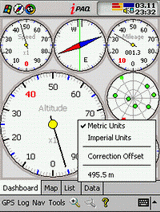
Many companies are in the process of developing executive dashboards, cockpits, consoles, portals or whatever you want to call them. To what degree have these been designed to be most effective? Designer Edward Tufte has addressed these issues in a number of 'ask ET' pieces at his web site. Worth a look, these discussions provide a number of designs and discussions by designers.
" ...Can you share any guiding principals or "best practices" in the presentation of Key Performance Indicators to the senior executives of a corporation? Discussion.
Executive Dashboard
I'm developing an executive dashboard, and I haven't been satisfied with the business graphics that are widely available (e.g. gauges, dials, stoplights). I decided to make a "Zen" version of a KPI status indicator, using as little color as possible, and incorporating E.T's innovative "Spark Line" metaphor for display of trends. The graphic below shows the proposed KPI display across the top of a browser screen with a descriptive example in the middle. Any feedback would be wonderful!
Discussion..."
Saturday, November 18, 2006
Journeys in Second Life

Above is a picture I recently took in one of my journeys in the virtual world Second Life. Well no, not exactly, its a picture I took on one of my frequent walks around Sharon Woods Park. That's an element of my first life. In my Second Life I have been doing some exploring as well. Inspired by a number of recent articles about businesses using Second Life (SL). I have taken a deeper dive.
Virtual worlds are not new. In the 90s we talked to a company called Blaxxun, which still exists. They tried to get us to advertise in their world and a number of well known companies did. But for a number of reasons, including underpowered computers and uncommon broadband, it did not succeed.
Now SL appears to be succeeding. A million members, over ten thousand online at any time. A half million US dollars being spent in every 24 hours. Just spend some time at orientation island and watch the folks arrive. So whats it about? A visual augmentation of chat, a way to collaborate, a way to shop in new ways. Edward Castronova recent explored the economics of virtual worlds. His take is that the economics is exploding.
What businesses exist in SL? Publicly IBM, Addidas, Nissan and Reuters are just some examples. And there are hundreds of other that largely deal only in virtual goods.
Dell just opened a space that consists of a number of islands. There you can design your own PC or laptop and have it delivered to your (physical) world. I visited it and spent some time looking at their wares. Like most Second Life spaces Dell is an austere world. Lots of sharp angles, no green space. Lots of vertical design that has you flying and bumping your head. Kiosks are all around that seek to interview you about your computing needs, a project with the University of Innsbruck. I thought that was interesting but the actual questioning was pretty cold, like the space itself. You can seek a map to see how many people are sharing the space with you. In the hour I was there there were only a handful at any one time, and most of them teleported away soon after arriving. I talked briefly to two people ... the lack of clues as to who people are ... young, old ... professional, tourist ... even male, female is unnerving to me, you have to do quite a bit of typing to establish any context. Almost too easy to disengage, no notion of investment or depth, just teleport away. No Dell reps that I could see, perhaps that would make sense to humanize the space. In fact I found emptyness to be common in commercial spaces. Even IBM's much touted Almaden space was empty when I arrived. A few spaces had signs warning that if someone said they represented a space, they were frauds.
You can zoom out in the map and see roughly how many people are in what island. Most of the ten thousand or so were in places where people could interact socially, in every sense of that word.
So what is my take? I am less skeptical than I was previously. It is yet another reason to sit on your butt for long periods. And we certainly have enough excuses for that now. Its not a game but a social experience addictive for some. My hard-boiled retailer wife took one look and shook her head. There is even recent unrest in the world. More commentary on that. Not for the socially squeamish. Many spaces are depressingly austere. Still worth understanding in some detail, My explorations continue.
Friday, November 17, 2006
Future of Enterprise Resource Planning
Good article on present and future of ERP and its vendors. Our Enterprise Resource Planning vendor is SAP. No mention of open source ERP, which I think is a good idea. Has anyone looked at this as yet?
Thursday, November 16, 2006
Mentos Geyser Revisited
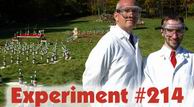
Everybody has by now seen the Mentos-in-the-Coke-geyser video. At the recent local AMA meeting Pete Healy, VP of Marketing for Mentos, talked about the experience and where it is going. The iconic consumer generated media has inspired over 9500 other videos. Mentos has moved a 'significant' amount of their marketing mix from TV to online. This summer Mentos ran a video contest which got about 200 entries, of which 150 are posted online. Mentos has a site highlighting the contest and related topics. They have connected with the Blue Man Group How to Be a Megastar tour to promote the candy with TV commercials that mimic the BMG's performance and some have started to air. No indication if sales have increased for Mentos.
The performers of the original phenomenon have a site, and a new performance called Experiment 214. It got over a millions views in the first five days of release. Its fun, like the first one, but not really distinctively new.
Mentos has certainly done an excellent job making much of CGM. Much better than ignoring the video. Despite some concern about experimenting leading to injury, there have been few problems. Early on they offered a co-marketing effort to some lesser-known soft drink manufacturers, with no luck. Coke now seems to be well-engaged with the effort. Linking this to new efforts like the blue man group may be harder to make work. As Healy suggested, you have to keep in mind that this is about marketing candy, and not curing cancer.
Wednesday, November 15, 2006
Space Visible Logo
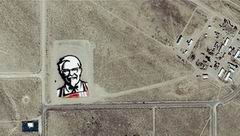
A colleague sends along a link to Michael Castellon's blog. As I responded, this is much less obnoxious than another proposed idea: launched logos and ads that can be seen from earth. At least its pull versus push. Assume this is not yet visible from Google Earth or Virtual Earth, though that may not be far away. Not as flexible as floating a billboard. It has also been pointed out that Target Logos are already visible from Google Earth.
"... KFC has the honor to be the first brand to be visible from outer-space. The 87,500 square feet logo was created by tiles placed in the Nevada desert, near the super secret Area 51. The stunt marks the revamp of the KFC logo, which now features a more streamlined image of Colonel Sanders ..."
Tuesday, November 14, 2006
John Seely Brown on Rethinking Learning
John Seely Brown is the former chief scientist of Xerox Labs, running it while it produced some of its greatest hits (desktops, for example). We had him in many times during the 90s, as a consultant and listener. Now he is a self-styled 'chief of confusion' with Annenberg at USC. Here is his blog. He is very big on education now. Dale Hunscher sends along powerpoints from a recent talk Seely Brown gave called "Rethinking Learning and the Community Library in the Networked Age". I am a library nut, digital or physical. The evolution will be interesting.
Google Blogoscoped
Great site for things Google by Philipp Lenssen which Paul Gillin uses in his forthcoming book: The New Influencers (Spring 07), as an example of strong influence in the blogosphere.
Sunday, November 12, 2006
Billboards in Virtual Earth
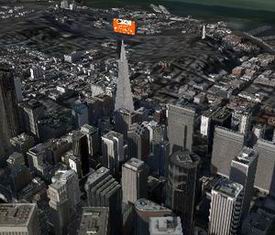
Microsoft has come out with a update to Virtual Earth that makes it look more like Google Earth. Most interesting is that this system shows true 3-D images of city landscapes, including the sides of buildings. Unlike Google Earth which shows buildings with blank grey sides. The result is a more realistic view of city scapes. Its incredible how much data would be required to paint a city. Mapped with low-flying airplanes?
AdAge points out that Microsoft can add floating billboards, and they have already sold space to several companies. There are several floating over San Francisco for ZipRealty (above). Its more of a fun thing to find rather than a easily seen ad. How different is this from billboards in Second Life? .... here it is aligned to a real geographical space. In the US VE uses identical satellite 2D image databases to GE. In Europe, VE appears to be using less detailed image databases, based on my small sample of locations. London shows its 'eye' impressively in 3D, but not much else.
They are still gathering data: "... The 3-D models will initially be available for 15 U.S. cities--San Francisco; San Jose, Calif.; Seattle; Boston; Philadelphia; Los Angeles; Las Vegas; Detroit; Phoenix; Houston; Baltimore; Atlanta; Denver; Dallas; and Fort Worth, Texas--and will be expanded at a rate of eight new cities a month until next spring, when that is ratcheted up even more...". Some of these city databases are glaringly incomplete, with skyscrapers missing. Compare it with Google Earth's 3D images. VE is entirely a web app, and is still a beta. Update: Its much slower than Google Earth too.
Data Mining
I was pointed to Matt Hurst's blog: Data Mining: Text Mining, Visualization and Social Media, all close interests of mine. Worth watching. Via Pete Blackshaw's Consumer Generated Media blog, also a must-read.
Google Geographical Heatmaps
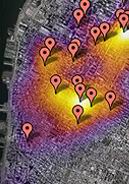
Anthony Townsend points us to a mashup from GeoIQ using Google Earth to create geographical heatmaps. Have now seen a number of examples of layering information in GE, this is a nice example. Here is another from Enterprise Horizons.
" ... GeoIQ is an open platform for building intuitive geographic analysis and visualization tools into web-based mapping applications. It gives people a simple and compelling way to filter, analyze and get value from geographic data without ever leaving their web browser ..."
Ghost Map
Steven Johnson's new book: Ghost Map: The Story of London's Most Terrifying Epidemic ..., re-tells the story of how the water-borne model of cholera epidemics replaced the miasma (bad smell) model in the 19th century and effectively led to the elimination of cholera in the developed world. Like many non-epidemiologists, I first heard of this story via Edward Tufte's 1983 book: The Visual Display of Quantitative Information. I was then more interested in the visual aspects of how the map of the epidemic made the case.
This book tells a more complete story, following the reasoning and collaboration of John Snow and Henry Whitehead which ultimately led to the change in understanding of cholera epidemics, which resulted in the re-engineering of city sewage and water systems.
It turns out that Tufte made a number of errors in his description of the epidemic in his first book, and largely corrected them in his followup book: Visual Explanations. Even there he misses some of the subtlety of the maps, for example their use of Voronoi diagrams to model the proximity of people to the source of infection. Tufte does an excellent job in understanding the effectiveness of visual representation, but less well with integrating computational methods that can aid human understanding.
Also notable is Johnson's hypothesis that this discovery was one of the first triumphs of amateurs. Snow was a physician, Whitehead was a local clergyman. It was their use of local information, painstakingly gathered, that ultimately made the case against a medical community entrenched in an incorrect model. Taking this further, the existence of the Web now makes it much easier to collaborate, gather data and drive to alternative solutions. Or does it confuse the matter through all the clutter?
The mapping itself today can be readily and cheaply done via approaches like Google Earth. The inclusion of such 'local information' as the proximity of pizza parlors can also be used to model complex visual epidemic data. Will this be the value of desktop visualization?
In the last chapter of the book Johnson examines the architecture of cities and the implications of how their scale effects such challenges as epidemics and nuclear terrorism. He is more speculative here, but the material is thought-provoking.
Excellent book for those interested in the history of this episode, the practical use of visualization and how difficult it is to change existing models.
Friday, November 10, 2006
The Wiki Way
Socialtext is one of the best-known commercial wiki packages, have tested it here a number of times. Its a very good wiki implementation. Now Ross Mayfield has announced Socialpoint, or Socialtext running on Sharepoint. He positions this as useful, even though Sharepoint is coming out with its own wikis in 07. More commentary on the idea here. Not quite sure what this means, the Socialtext wiki claims to be the most successful commercial implementation out there. We have also experimented with some open source tools (Socialtext has also gone this way. My conversations with Ross indicates he is working with several companies to instill a wiki culture. Yet there are only a few real successes to talk. The wiki culture is not here or there as yet. Will there ever be, as Ross calls it, a wiki way?
Also in wiki news, Google acquired Jotspot, which we also tested a few summers ago, moderately surprising.
One experiment we talked is the construction of an analog of the Wikipedia within the corporation. Many companies, and certainly large ones have acronyms, terms, definitions, etc that are sometimes the same, and sometimes differ from public versions. He proposed setting up a 'CorporatePedia' that would organically grow as people added definitions.
One of the unsurprising experiences we have had with this is that its hard to get people to contribute. The same people with interest in blogs usually engage, but those who have the knowledge to contribute are hard to bring to the table. Of course the same thing happened in the early days of e-mail. Today there are no rewards for participating, and no 'editors' have yet emerged.
I am still excited about the prospect of managing knowledge by a broadly editable space and do my best to proselytize. Ideas and examples are welcome.
Thursday, November 09, 2006
BMW Innovates

From the October 16 Business Week: Innovation at BMW. Note the emphasis on informal networks, which have worked quite well for them. The 'lunch exchange' idea reminds me of a method touted by the Santa Fe Institute, having folks from many disciplines interact informally over lunch. Saw this in operation during several visits, though it was unclear it could scale.
"The Secret of BMW's Success
BMW's reputation for innovation can be traced to its equally innovative lateral management techniques
At 4:00 p.m. on a Friday afternoon, when most German workers have long departed for the weekend, the mini-cafés sprinkled throughout BMW's sprawling R&D center in Munich are jammed with engineers, designers, and marketing managers deliberating so intently it's hard to hear above the din. Even the cappuccino machine is running on empty. It's an atmosphere far more Silicon Valley than Detroit.
"At lunch and breaks everyone is discussing ideas and projects all the time. It's somewhat manic. But it makes things move faster," says BMW chief designer Adrian van Hooydonk. The intense employee buzz at BMW is hot management theory in action. Top consultants and academics say the kind of informal networks that flourish at BMW and the noise and borderline chaos they engender in big organizations are vital for innovation--especially in companies where knowledge sits in the brains of tens of thousands of workers and not in a computer server. Melding that brain power, they say, is essential to unleashing the best ideas. .... "
Wednesday, November 08, 2006
New Influencers
Paul Gillin, who I met at a recent SNCR meeting, is coming out with a new book: The New Influencers, to be published in the spring of 07. He has some drafts of chapters you can read now, including profiles of his influencers. He also has an interesting blog on social media. In that blog he outlined some of a conversation we had a few weeks ago about internal blogging at P&G. The same post provides some useful other comments on internal corporate blogging. He is an insightful guy who is worth keeping track of.
Tuesday, November 07, 2006
Blog Restart
Welcome to the re-start of my personal blog. A couple of changes have occurred. Previously I was a guest blogger at IFTF's Future Now blog. Now I have moved from there to devote my spare time to posting on my personal blog.
Second, to finally provide full disclosure, I am an employee of the Procter & Gamble Company in Cincinnati, where I have worked for over 26 years. My background is in physics and mathematics. Professionally I have worked in analytical methods, retail technology, supply chain analysis, knowledge methods and social technologies. The web came along at the height of my technical career and I have been a avid observer of its evolution. Its been quite a ride, from when executives were deeply skeptical about the web to when they could not do without it.
I plan to blog some here about my experiences at P&G as they come to mind. Of course all of my opinions are my own, and I won't be divulging any secrets.
At P&G I have been running an internal technology blog since early 2003. Even before blogs I ran a technology mailing list since the early 1980s. My internal blog gets thousands of hits a month and is read by a very diverse set of our employees. Its still a social media experiment though. Some blog posts from my internal blog will be cross posted here. I have not opened comments, but will consider that. For now you can reach me at: franzdill AT gmail.com
This will be stream of consciousness. My interests are fairly broad, you can get an idea of them by scanning my posts.
iWoz
Just finished Steve Wozniak's memoir: iWoz. Wozniak was the co-founder with Steve Jobs of Apple in the late 1970s. In this book he seeks to set the record straight that he alone did the technical work for the Apple I&II, the first practical personal PCs. Jobs did most of the deal making, but never contributed to the wizardry that made the computer work and made them millionaires. The Apple II was not the first personal computer, but it was practical and dependable and the first to be usable at home and at work. In 1978 we brought in several (purchased as calculators) to do engineering analysis at Hillcrest technical center. Shortly afterward, with new spreadsheet software, finance started to use them.
I have followed Wozniak's post-Apple career (though he remains an Apple employee to this day) for some time, see previous posts on his work. He discusses probably his best known technical effort after Apple, a novel programmable remote that did not succeed. No mention of his low-power tracking system, last seen in 04. Besides some other mild digs at Jobs he is at his best writing about the power of engineering and how creativity comes from individuals not committees. The example of the latter being the Apple III. I did some contract development for that beast. Some of his work makes me think about the current push for creative design. What are engineers but scientifically grounded designers? Simplistic, very personal, sometimes too self indulgent style, readable, only descending into skimmable chip-speak a few times. Recommended if you have interest in the history of accessible computing and the power of engineering.
I have followed Wozniak's post-Apple career (though he remains an Apple employee to this day) for some time, see previous posts on his work. He discusses probably his best known technical effort after Apple, a novel programmable remote that did not succeed. No mention of his low-power tracking system, last seen in 04. Besides some other mild digs at Jobs he is at his best writing about the power of engineering and how creativity comes from individuals not committees. The example of the latter being the Apple III. I did some contract development for that beast. Some of his work makes me think about the current push for creative design. What are engineers but scientifically grounded designers? Simplistic, very personal, sometimes too self indulgent style, readable, only descending into skimmable chip-speak a few times. Recommended if you have interest in the history of accessible computing and the power of engineering.
Monday, November 06, 2006
Setting the Table
Finished fabled NYC restaurateur Danny Meyer's book: Setting the Table. Always had the dream of opening a restaurant and cooking. (yeah really). Meyer writes the story of his restaurant openings. Along the way he teaches us about how hospitality is as important as service. We don't sell much directly to consumers, but my wife Joy runs a retail business and it rang true to her. My favorite quote .... about Mary Kay Cosmetics ... ' ... Mary Kay would teach their salespeople that everyone goes through life with an invisible sign around their neck reading 'make me feel important' ... The most successful people in any business that depends on human relationships are the ones who know about that sign and have the ability to see how brightly it is flashing. And the the true champions know how best to embrace the human being wearing the sign ...'. Good book.
Sunday, May 22, 2005
The Infinite Library
Tech Review on The Infinite Library. I continue to be amazed by my personal use of the web ... I have links now to several libraries, and can quickly determine availability. If I could only get the full text and then also link to it as required. As in Nelson's Xanadu, the ultimate exercise in 'non sequential' writing. The infinite library still appears to have too many holes in it ...
Friday, May 20, 2005
Exploring Supermarket Paths
In the latest Knowledge@Wharton, an article on analyzing shopper paths in grocery by Peter Fader and Eric Bradlow. This provides an overview and study conclusions. I have taken a look at the complete technical paper on this, and its a novel use of statistical clustering techniques that could be quite important in this kind of analysis. This could result in some interesting changes in how a number of retail spaces are designed.
Monday, May 16, 2005
Gershenfeld's FAB
I finally finished Gershenfeld's FAB, enjoyed it, I have posted a longer overview and review over at Future Now.
Autistic Savant
I saw the Discovery program on Daniel Tammet this week A genius explains. Quite remarkable case, certainly an example of pattern recognition vastly different from the way we normally think of intelligence. A case for some sort of neural network as opposed to building rules .... Now if we could only tap this in some way, what we know so far is only maddeningly sketchy.
Saturday, May 14, 2005
Major IBM Blogging Initiative
An interesting item to follow IBM is preparing to launch a massive corporate wide blogging initiative as it seeks to extend its expertise online. This could influence other companies in their use of the technology.
Sunday, May 08, 2005
Don Tapscott
I am reading Don Tapscott's 2003 book The Naked Corporation in preparation for a meeting next week. Had previously read Growing Up Digital, which I found to be engaging. He has a related blog: Age of Transparency, which I also found to be useful.
Sunday, May 01, 2005
Camille Paglia's Break, Blow Burn
Just reading Paglia's book of selected poetry and commentary. I don't appreciate all of her selections, but even the ones I would not have chosen myself did stretch me a bit. I liked her analyses in general, but this is not really a book for the 'ordinary' reader, I doubt if anyone without a quite strong interest in poetry could deal with deal with it. That being said, her book is worth reading, including some familiar, some little known, and some very eclectic examples of poetry. I learned quite a bit from it.
Robots Working as a Team
This item on robot teamwork: Robot Teamwork brought to mind some work we had done on the teaming up of small groups of simple, cheap robotics to perform simple tasks. One suggested task was to take inventory of a warehouse with simple device that could travel about and sense location and stored items with RF tags. More specifically the idea of 'teaming' is more difficult, even the idea of giving a robot an 'agent' status is non-trivial, and adding the team aspect of reasoning takes it to another level.
Tuesday, April 26, 2005
Electric Universe
Read David Bodanis' Electric Universe, The Shocking True Story of Electricity .... which is a set of essays on the history of electricity. The are disjointed, hardly forming any sort of sort of coherently written view of the subject, which I was looking for. The longest essay is a popular history of radar in WWII, which though interesting, is out of place in this book. The individual topics are of interest, but scantly covered. Some of the writing too left me a bit puzzled. The author heavily overuses specific mental images, e.g. clouds of electrons for example. There are some emphatically negative reviews in Amazon, and I checked the references on a few, and the mistakes could be attributed to interpretation, but I would expect a book like this, to be read by non-scientists, to be more clear. This is another example where it is very hard to believe that the well-known reviewers on the back cover ever read the book. The Amazon reviews led me back to Robert Thompson's 1947 history of Telegraphy: Wiring a Continent. Still considered a classic.
Monday, April 25, 2005
Mathematicians and Tapestries
Interesting article Capturing the Unicorn A story of digital imagry, reconstruction and mathematics. Its also about stitching images. For some new work on this idea, for decidedly less complex sets of images, see here. An interesting, seemingly simple topic, with lots of complexity.
Sunday, April 24, 2005
Examining Playful Invention Company (PICO)
Saw a presentation by Elisabeth Sylvan on the Playful Invention Company (PICO) this past week. This has come out of the Lego supported work at the MIT Media Lab ... inspired by Froebel and Papert. This first inspired the Lego Mindstorm project, and now PICO plans to sell programmable bricks or crickets, which can be programmed and used to design systems. I am particularly intriqued by the tactile aspect of this, and its use to help engage collaborators on tough problems.
Monday, April 18, 2005
The Work Foundation - iSociety
The Work Foundation - iSociety: Useful article on Social Capital and Software ... full text, examining.
Sunday, April 17, 2005
Bobby Fischer Goes To War
Reading Bobby Fischer Goes To War: How The Soviets Lost the Most Extraordinary Chess Match of all Time. I followed this event closely when it was news. Now Fischer is back in the news due to the recent granting of Icelandic citizenship to him. An avid chess-player at the time, I had no idea what Fischer was doing outside of the moves of the game, it was my first introduction to the notion of gamesmanship, bizarre as his form of that was. Finally a writeup of what occured, and hopefully a full explanation of the motivations.
Update/Review: You really have to be very interested in this topic to want to read this. It did fill me in on some of the events, which I only barely remembered via NY press coverage at the time. It most made me wonder why Iceland wanted to take him back in. Reinforced my impression of Fischer as an embarassment ... Although it seemed like Fisher-Spassky progressed interest in chess at the time, it has progressed very little since then.
Update/Review: You really have to be very interested in this topic to want to read this. It did fill me in on some of the events, which I only barely remembered via NY press coverage at the time. It most made me wonder why Iceland wanted to take him back in. Reinforced my impression of Fischer as an embarassment ... Although it seemed like Fisher-Spassky progressed interest in chess at the time, it has progressed very little since then.
Wednesday, April 13, 2005
Gershenfeld's FAB
Have not read Gershenfeld's FAB book yet, but its on the list. His previous popular books were thought-provoking, and his modeling texts are well worth taking a look at.
Sunday, April 10, 2005
Shaping the Future - Robust Simulation
Brought to my attention by Steve King at Future Now an article: Scientific American.com: Shaping the Future -- On Robust modeling. Interesting view of the problem of robust modeling under uncertainty. I will comment there later this week. Brought to my attention: The Copenhagen Consensus and the fact that the poorly performing Club of Rome still exists. Here is a link to the PDF of the full RAND Pardee Center report.
Friday, April 08, 2005
Affective Computing example
Here Software Detects Unhappy Callers is an example of interacting with consumer emotions to classify calls. Note commercial example of work suggested by Rosalind Picard in her book: Affective Computing.
Wednesday, April 06, 2005
Beer Games and Engagement Models
Some work activities today made me re-visit the MIT Beer Game. I have some fond memories of participating in this game back in the 90s. Also recall some work being done on an agent-based advanced, multi-SKU version being developed by members of the Santa Fe Institute, have to look that one up. A good example of a simple game leading to complex behavior. This is required reading for folks new to supply chain. This brings to mind what I call 'engagement models', used to introduce folks to a domain, usually very visual, but which are not intended to be predictive. I have seen these to be quite valuable in industry. The Sim models are examples, but perhaps more complex than they need to be to represent this modeling approach.
Monday, April 04, 2005
Niklas Luhmann
Niklas Luhmann's Social Systems Theory . - In the latest issue of the Journal of Artificial Societies a post on the use of agent-based models to implement Luhmann's societal theories, which has led me to investigate them further. Further, these papers may be useful as examples of the use of simulation for agent based models and related techniques.
Physics of Society
Futurology gets a little more exact: Guardian article on Philip Ball's: Critical Mass: The Physics of Society. (Published under a different title in US ...: Critical mASS: How One Thing Leads to Another ) Covers issues of modeling people's group behavior, most recently suggested in agent-based technologies. Do not have the book as yet, but it looks to be interesting. Is it possible to model people in a way that is statisically meaningful? Yes thats been done fairly well,depending opon the measures you care about. Is predictive at some individual level? Not clear. Can provide true emergent behavior? In this too the jury is out ... I have not seen it as yet. This book appears to be non-technical, for a technical view of the complexity of models of people see: Journal of Artificial Societies ... See also Ball's article in PhysicsWeb.
Saturday, April 02, 2005
Chatter
Picked up Patrick Keefe's Chatter, recently, all about sigint surveillance, in particular the Echelon project. We have all heard about term 'chatter' by now, we have a feeling for what it means, but how is it measured? That question is never answered. I pose the more general question in a post at Future Now. I know a little about the subject and worked on Darpanet many years ago, have also looked at text mining approaches .. so I thought there would be some interesting detail here. Pretty early on Keefe makes it clear that he doen't know much about the topic, or technology in general. He provides uninteresting descriptions of his standing outside of facilities looking in through the fence, or interviewing other journalists with similarly limited knowledge. While visiting a purported, abandoned NSA site ... he is amazed that the computer room had a raised floor ... that there was a cable tunnel between two buildings on the site. He is in awe of the radomes that protect antenna complexes. He shows shock that an employee at a UK base is prosecuted when she steals classified material to support her own political agenda. He lost my respect fairly quickly, but I did slog on. He is further amazed that the NSA's public web site does not contain a full directory of their employees (no company does this today). He describes the criminal trashing of Admiral Poindexter and his neighbors to make a point. There was no faint suggestion of loss of privacy or potential data mis-use that he does not cover in depth, but there was not much mention of the potential value of these capabilities. His discussion of 'mining' in particular was weak; you got the impression it was just about finding words. The one part I did find interesting was some of the statistics regarding human intelligence ... but can I trust them? Find this at the library, but beware.
Wednesday, March 30, 2005
Blogs, Everyone? Weblogs Are Here to Stay, but Where Are They Headed?
From Knowledge@Wharton Blogs, Everyone? Weblogs Are Here to Stay, but Where Are They Headed? . Good overview article on blogging. Quotes marketing professor Peter Fader, who we have linked to several times.
Tivo Pops-Up ads

More details about the testing of the Tivo ads that pop-up during fast-forward. This was apparently part of the recently announced Comcast-Tivo deal. I previously posted on this, with some links to Tivo economic models. This brings to mind the book: The Big Picture: the New Logic of Money and Power in Hollywood by Edward Jay Epstein, which talks at considerable length about the evolution of content delivery economic models. This is just another example, perhaps the first interactive one. Slashdot post on Tivo's test. Via Richard L. James.
Monday, March 28, 2005
Chernoff Faces
I was reminded of the method of 'Chernoff Faces'; in Clifford Pickover's 1990 book: "Computers, Pattern, Chaos and Beauty" (p. 47-) .. I was led there by a pointer to some Java implementations of Chernoff faces. For those that have not seen this, its the use of cartoon faces, whose attributes (eyes, ears, mouth, hair, etc) are varied in their size and orientation based on some numerical measure. Specifically using a cartoon face is said to allow us to use our own facial pattern recognition ability to better understand complex multidimensional data. Can anyone point me to other implementations or examples of a similar idea ... linking numeric measures to the size of other aspects of an image in general? Is this idea used very often today?
Hortense Powdermaker
New to me, Hortense Powdermaker, anthropologist ... author of Hollywood, The Dream Factory ... famously quoted to have said ... that Hollywood was a " dream factory .. engaged in the mass production of prefabricated daydreams ...". Quoted in Edward Jay Epstein's recent book The Big Picture: The New logic of Money and Power in Hollywood, under review. Lots of interesting financial detail in this book, alternative economic models for dealing with content. Though fairly dry in style, not for everyone.
Saturday, March 26, 2005
V. S. Pritchett
Just reading VS Pritchett's London Perceived, a 1962 book about London supported by a number of excellent photographs by Evelyn Hofer. Its a 42 year old book, so you can't use it as a guide today, but Pritchett provides such a lyrical overview of his subject that this is still excellent reading. There are a few overlaps with the London I know, and it makes me want to re-examine those. It a guide to time and place when bomb-sites still existed, and the economy of London was very different. If you like the topic, well worth the read, its still in print. Likely in your local library. Also has inspired me to look into Pritchett as an author.
Friday, March 25, 2005
First look at Yahoo! 360
Charlene Li posts on First look at Yahoo! 360. Yahoo's new social networking and blogging service. Overall, based on the description, I am not impressed. I have experimented with a few of these social networking services, and they leave me cold.
Thursday, March 24, 2005
Numenta: Hawkins Brain Models for Intelligence
I reviewed Jeff Hawkin's book: On Intelligence last year. The founder of Palm Computing suggested a model using the architecture of the brain to build artificially intelligent systems. This is a novel approach, since most AI systems do not attempt to use the brain as structural model. His book was very good, but I suggested that he had considerable work to do to implement his ideas. Its another commendable attempt at the holy grail of machine intelligence.
Now an article in today's WSJ: Next Case for Palm Pilot Creators: The Brain and another in BusinessWeek: Jeff Hawkins' Bold Brainstorm, suggest that some progress has been made. He linked with Dileep George, who has started to implement some mathematics based on Hawkin's ideas, and formed a company called Numenta to work on practical applications. Both articles quote Intel scientist Gary Bradksi who says "Even if he's wrong, his theory is better than nothing. And it's 'attackable' -- and that's a good thing." Likely early applications are in machine vision and drug discovery. See also article in the NYTimes. Well worth tracking.
Now an article in today's WSJ: Next Case for Palm Pilot Creators: The Brain and another in BusinessWeek: Jeff Hawkins' Bold Brainstorm, suggest that some progress has been made. He linked with Dileep George, who has started to implement some mathematics based on Hawkin's ideas, and formed a company called Numenta to work on practical applications. Both articles quote Intel scientist Gary Bradksi who says "Even if he's wrong, his theory is better than nothing. And it's 'attackable' -- and that's a good thing." Likely early applications are in machine vision and drug discovery. See also article in the NYTimes. Well worth tracking.
Michael Faraday Bio
A Life of Discovery: Michael Faraday by James Hamilton is the first bio I have read of Faraday. Hamilton is an architect, and sometimes fits in pieces about London architecture into the work, I didn't mind that, since I enjoy London, but it can seem forced. Good descriptions of Faradays lectures and the amount of time and care he took to get them right. I doubt he would have used Powerpoint. The most amazing part is his description of Faraday's creation of the first simple electric motor, the rush of creativity, if it could only always be that way ... his own enthusiasm then got him into trouble as he rushed to get the word out. I also recall reading parts of his chemical history of a candle in chemistry class, a tour-de-force of observation. He was to follow with the invention of the transformer, the dynamos and electrolysis, plus a great deal of fundamental chemistry and physics. His correspondence with Ada, Lady Lovelace, is also intriguing. Good bio.
The Wikpedia entry on Michael Faraday is also worth a look.
The Wikpedia entry on Michael Faraday is also worth a look.
Wednesday, March 23, 2005
Dvorak on 1995
Short but interesting column by Dvorak, who I have been reading since then 1995: That Was the Year That Was. Although I had used the Darpanet back in the 70s, this was about the year I was first introduced to the Web and Internet. It took a few more years for the corporation to discover it. Shortly after this I remember giving a talk to management introducing the web, and their astonishment that their prime products were not showing up on search engines of the time. It is amazing how much has happened in the last 10 years. Nostalgia in just so few years.
Tuesday, March 22, 2005
Chance Discovery
I have just received the book Chance Discovery, by Yukio Ohsawa and Peter McBurney. I met Yukio at a recent meeting at the University of Illinois. Ohsawa is from the University of Tsukuba. The idea is intriguing and am looking forward to reviewing. I was introduced to the idea as part of a look at the DISCUS method of augmenting focus groups. See also his Chance Discovery site for an overview.
Saturday, March 19, 2005
Norbert Wiener The Father of Cybernetics
Itching to read Dark Hero Of The Information Age .... I read a few of Wiener's books, and the insight into our current age is amazing. Yet few people today, even those in the business, have heard if him. In the NYTimes review its mentioned that the Soviets thought highly of him, and I remember getting some English translations of Soviet work in 'Cybernetica' in the 80s that often mentioned his work. NYT suggests that ...information as a discrete concept did not widely exist before Wiener .. early Bell engineers referred to the signal traveling over telephone wires as 'the commodity to be transported by a telephone system' ... Intriguing, if true.
Understanding Comics: Scott McCloud
I read McCloud's Understanding Comics back in 1993, I was pointed back to it again by Christ Atkinson's book Beyond Bullets, now I am re-reading. Here is his site. Some very interesting things here ... See in particular the interface to the 'Morning Improv', something I would like to experiment with myself for instructional interaction.
In the early part of this book McCloud posits a fascinating distinction between realistic drawings of people and various levels of stylizing with a minimal number of pen-strokes. In real-life, whenever we talk to people we look at them directly and get a realistic view, but our pictoral view of ourselves in that interaction is stylized, since we cant see ourselves. So he suggests that by using a level of simplification in cartoons, it allows us to put ourselves in the position of the character. Thoughtful view.
In the early part of this book McCloud posits a fascinating distinction between realistic drawings of people and various levels of stylizing with a minimal number of pen-strokes. In real-life, whenever we talk to people we look at them directly and get a realistic view, but our pictoral view of ourselves in that interaction is stylized, since we cant see ourselves. So he suggests that by using a level of simplification in cartoons, it allows us to put ourselves in the position of the character. Thoughtful view.
Friday, March 18, 2005
Psychophysiology of Risk
Posted for potential workup into an article: MIT Laboratory for Financial Engineering: Psychophysiology of Risk
Communications Models
An interesting post on communications models at iaocblog. Steve King of IFTF provides some interesting thoughts about this. Particularly interesting , the stoller queen example. Though not a blog, this is an excellent example of consumers taking control of the marketing conversation.
Wednesday, March 16, 2005
Sign Language
Fascinating pointer Sign Language on work underway about using gestural interfaces to control geospatial interfaces. Apparently designed to be used in high stress situations, such as the emergency management centers, to help partipants collaborate and interact with geospatial data. I have worked on some relatively primitive GIS systems, this would have been useful. Can we ultimately just wave our hands at out data?
Tuesday, March 15, 2005
Spring comes to AI winter: Hecht-Nielsen's Confabulations
This article Spring comes to AI winter Mentions neural net commercialization pioneer Robert Hecht-Nielsen and his confabulation idea. Its also described in a Physorg post. Some pretty bold predictions of the generality of the approach. I have not looked at the technical article as yet. Is it available online anywhere? We worked with Hecht-Nielsen's HNC Software back in the 90s to develop neural nets for corporate pattern recognition problems. They were acquired by FairIsaac.
MemCheck Memory News from Cognitive Labs
Consumer Marketing taking hints from neuroscientists. Another example of neuromarketing ideas.
Sunday, March 13, 2005
Why Stock Markets Crash
Inspired by an article in MIT's Tech Review on using Physics models to predict book sales (No longer online, you would think MIT Tech Review would know better?) I just read: Why Stock Markets Crash: Critical Events in Complex Financial Systems, by Didier Sornette. Here is UCLA's press release on the work. The book is a well-done overview of complexity work as it relates to financial markets. Though technical, the book spends much time in setting up coherent descriptions of how models link to financial problems. Leading to an 'autopsy' of major crashes. I can't speak to the validity of the conclusions in detail, since finance is not my world. Many, many useful references here to related work, and good thumbnail descriptions of advanced modeling work in finance. Obvious overlap with Benoit Mandelbrot's The Misbehavior of Markets. The last chapter addresses the question of if we are in for a end of growth by 2050. Optimistic overall. Here is chapter 1, though its the least technical.
IFTF's Future of Marketing
I am blogging now at IFTF's Future of Marketing specifically for marketing related emergent technology ideas. Some of those posts will start to be initially outlined here, with sometimes a request for information I can fold up to that blog. Not sure how many people are reading this, but always welcome additional information, credit and links will be given to those that contribute.
Saturday, March 12, 2005
Strange Angel
Completed Strange Angel, by George Pendle, bio of rocket fuel pioneer John Whiteside Parsons. Early history of JPL and rocketry in the US. Also, Parsons connection to cult leader Aleister Crowley. Sometimes uneven , but interesting view of that time.
Beyond Bullet Points
I completed my review of Cliff Atkinson's Beyond Bullet Points and posted it in Future Now. Good book, I found a number of its ideas useful and plan to use them in upcoming presentations. Also interesting, some of the pointers in it to research on effectiveness of multimedia presentations.
Friday, March 11, 2005
Gallups New Poll on Blogs
Gallups new poll on blogging is worth noting: Blogs Not Yet in the Media Big Leagues As bloggers we do lots of introspection about this emerging idea, around since only 1997 ... As has been pointed out to me, we have been doing things like blogs for some time, but only in these last few years have we seen its explosion. The study makes the case that three quarters of US public uses the internet, but only one in four is even somewhat familiar with blogs ... just slightly more than half of the US public has no knowledge at all of them. There is considerable room room yet for the expansion of this idea. Well worth reading in its entirety.
Wednesday, March 09, 2005
Understanding Comics
I was referenced to this book: Understanding Comics. Via Cliff Atkinson's Beyond Bullet Points. See also his excellent Beyond Bullets site.
Stay-in-car shopping : Autocart
Stay-in-car shopping | www.azstarnet.com �
I found this during some research on the drive-through superstore concept, note it mentions IFTF.
I found this during some research on the drive-through superstore concept, note it mentions IFTF.
Tuesday, March 08, 2005
AutoCart revs up drive-through supercenter
I wrote about this before in Future Now ... AutoCart revs up drive-through supercenter. Still looking for more details, would appreciate anything people can send along.
Monday, March 07, 2005
On Demand Blogosphere
Jon Udell introduced me to bookmarklets, and although I am mostly an ad-hoc programmer, used to constructing things to solve problems, rather than a professional programmer, his simple examples helped me collaborate with the local library to construct a simple interaction between web pages and the library reservation system. That resulted in something I use daily now.
Since then I have been following his work, Now he is working on another problem of note, how do you make your RSS feeds more useful, how do you find out who is talking about a topic you want additional commentary on. In his recent post he provides a short screencast that describes how he is working towards the goal of constructing tighter networks between bloggers and their networks of information.
Since then I have been following his work, Now he is working on another problem of note, how do you make your RSS feeds more useful, how do you find out who is talking about a topic you want additional commentary on. In his recent post he provides a short screencast that describes how he is working towards the goal of constructing tighter networks between bloggers and their networks of information.
Augmented Marketing Focus Groups: Discus
Here is a blog post I wrote about our recent visit to Professor David Goldberg's GA lab at the University of Illinois to observe the first test of their Discus augmented focus group idea.
Charles Stross' Singularity Sky
Just completed Charles Stross' SF novel Singularity Sky. Very nicely done, a wild compendium of technology touched upon, less on the side of character development. Still a very good, readable story, recommended.Here is his blog. Just starting to peruse.
Envisioning a Leapfrogged World
Envisioning a Leapfrogged World
Saw this noted in Rajesh Jain's Emergic blog ... Thoughtful piece on the subject of technology leapfrogging ... in particular how the process of leapfrogging is also likely to change over time as some of the development capabilities are also leapfrogged. (Note the recent Businessweek article on product development in China) Will become an increasingly important issue for the west.
Saw this noted in Rajesh Jain's Emergic blog ... Thoughtful piece on the subject of technology leapfrogging ... in particular how the process of leapfrogging is also likely to change over time as some of the development capabilities are also leapfrogged. (Note the recent Businessweek article on product development in China) Will become an increasingly important issue for the west.
Sunday, March 06, 2005
Professionalization of Blogs
The Professionalization of Blogs
Good article by Steve King addressing the professionalism of blogs, and the apparent movement from amateur to professional.
Good article by Steve King addressing the professionalism of blogs, and the apparent movement from amateur to professional.
Friday, March 04, 2005
HP Blog Epidemic Analyzer
I was reminded of this research on blog academics by a recent link, out of HP's Information Dynamics Lab. See their demonstration, and their related FAQ. The research and data is a couple of years old now, but its an intriguing piece of work.
Thursday, March 03, 2005
GPS and Google Maps
Jon Udell: Walking tour of Keene: followup
Here is another clever thing from Jon Udell. Last summer I played with his library lookup capability, and with just a little help from the local library folks, was able to set up searches based on ISBN, author, title and subject. This introduced me to bookmarklets, and now I use these lookup capabilities most every day. Very nice for a biblio junkie. I continue to try to get other folks to use them ... a very nice capability.
This new example makes use of Google Maps, which I have played with a bit as well, and although still Beta, boasts a very nice interface. Udell has worked on setting up a GPS-based tour of a set of locations, based on Google maps. He points to a live example, and outlines how to do this.
See also pointers to Google Maps Hacking Wiki, which I am also starting to explore.
Wednesday, March 02, 2005
RiverGlass Real-Time Analytics
RiverGlassInc.com
RiverGlass develops software that merges multiple data streams from disparate sources and applies powerful, real-time data analysis and modeling techniques that help customers manage risks, solve critical problems, and make informed decisions.
I am starting to look at this provider of data mining capabilities. Especially with regard to the real-time aspects of its capabilities. Will update this post as I progress.
Sunday, February 27, 2005
The Jump Book
I recently read Jeremy Bernstein's bio of J Robert Oppenheimer (excellent) ... but this post is not about that. On the cover of that bio is a remarkable picture of Oppenheimer jumping into the air, pointing at the sky. It turns out this picture is from the 1959 Jump Book, by Phillipe Halsman. Halsman was a photographer who worked for Life, and took pictures of 178 celebrities of the time jumping, and published them in the book. He also developed a technique he called Jumpology, which seeks to analyze character from the nature of people's jumps. He at least seems serious about that. Fun book, including many still recognizable people from politics, science, film and industry. Although I got my copy at the library, its still in print.
Saturday, February 26, 2005
Beyond Bullet Points
In a classic 2003 cartoon in The New Yorker, The Devil is sitting at a desk, apparently interviewing a new conscript for Hell:
Lucifer asks ... 'I Need someone well-versed in the arts of torture - do you know PowerPoint?'
With that impression in mind, I am just starting Cliff Atkinson's book: Beyond Bullet Points. For some of you who have read my writings in Future Now, you will recall I am a long suffering corporate victim of Powerpoint, so I am looking forward to this book.
I will post on this again as I progress.
See also, Atkinson's blog Beyond Bullets. Which always has some fascinating information on visual communications.
Friday, February 25, 2005
Cogwheels of the Mind

Its probably pretty telling to be reading a book on the history of Venn diagrams at the beach, but I took the chance and started A.W.F. Edwards' Cogwheels of the Mind: The Story of Venn Diagrams a few weeks ago. A delightful, short (about a hundred pages, with many diagrams) history of the graphical approach by John Venn. Which links well with the algebra of Bernoulli, whose algebra led to computing, and is being used very actively in the computer you are staring at. It also has survived as a much-taught methodology in schools from kindergarten upwards. Perhaps I am a bit optimistic, but I believe a large number of eighth graders could draw one. Its perhaps the most beautiful and simplest example of visualization of complex ideas. The book also carefully reviews the extension of Venn diagrams into greater numbers of classifications, and Edwards further work in the area. Although the book is short, it does require some willingness to think through his examples. A strong graphical intuition is desirable.
One of the reviewers at Amazon suggested that the book should have gone further, comparing Venn diagrams to other diagrammatic methods, but I disagree ... this is an example of a 'just enough' monograph, rich in both in the history and its implication regards the way we think about hard problems. It sufficed at the beach. It did inspire me to look at the other methods mentioned. In an appendix, Edwards suggests its extension into statistical domains.
Another reviewer questioned if there was an audience for such a book. Well, besides myself, there are others who like to see popular mathematics well written, and prefer the proofs to be left in the references for now. No, it won't make the NYT best-seller list, but it did enlighten me.
Thursday, February 24, 2005
Predicting with Randomness
RedNova News - Can This Black Box See Into the Future?
This certainly seems odd ... I am always suspicious of predictors that are too good... why would they be publicizing it rather than playing the market? I have frequently seen such alternative science claims ... I maintain the skeptics response ... Extraordinary claims require extraordinary proof ... this does not mean that I am not open to changes in what we know ...
Via Nova Spivacks' blog.
Agents of Change
A good overview article on Agent-Based Modeling (ABM) philosophy, techniques and applications, from the February ORMS Today, by Douglas Samuelson. He makes the case that this technique will transofrm social science because of the natural linkage between social and agent entities and their inclusion of behavioral changes. He also links ABMs to classical simulation techniques and Systems Dynamics. Some useful further links.
Wednesday, February 23, 2005
Virtual Reality in the Round
Fraunhofer-Gesellschaft Presseinformation 04.02.2005
An interesting idea, which attempts to improve on the illusion of a CAVE. I have see a number demonstrations in a number of CAVE environments, and was never very impressed with the result, low quality with flat projections, such immersive environments may be OK for the engineer who accepts the illusion, but do they work for the behavior of a consumer you are trying to understand?
An interesting idea, which attempts to improve on the illusion of a CAVE. I have see a number demonstrations in a number of CAVE environments, and was never very impressed with the result, low quality with flat projections, such immersive environments may be OK for the engineer who accepts the illusion, but do they work for the behavior of a consumer you are trying to understand?
Tuesday, February 22, 2005
Global Grid Computing: Johnson and Johnson
InformationWeek: Grid Computing
...Johnson & Johnson's $22.1 billion pharmaceuticals research-and-development unit has two grid projects under way, each geographically contained and centered on its own networks. David Neilson, director of drug-discovery information management, expects these projects will save the company "in the seven- to eight-figure bracket" over five years by recruiting low-cost computers to handle tasks once done mostly by expensive specialty machines.
Johnson & Johnson was an early sponsor of the Globus Toolkit project, an effort by researchers at Argonne National Lab, the University of Chicago, and the University of Southern California to develop open-source software that could link distant computers and users over the Net. "We're not [a sponsor] anymore," Neilson says. For its virtual drug-screening pilot in Belgium that recruits the spare power of 400 PCs and 64 Linux servers and for a stateside effort to model clinical drug trials using more than 100 PCs and workstations, Johnson & Johnson has been using commercial software from United Devices Inc., which can schedule jobs across PCs or servers under one roof, but whose capabilities fall far short of the promise of building global grids ...
The MIT Museum

Before the holidays I paid a first visit to the MIT Museum. A rather interesting one-floor exhibit, up some modernistic steel stairs not far from the center of campus. I had heard that they had become the repository of a number of AI and robotics artifacts that I had read much about. So I wandered over there after some meetings and spent a few hours walking the exhibits.
You do understand quickly the quandry of the director of such a museum. Its easy to display artifacts that deal with robotics, which readily lend themselves to physical objects. Artificial Intelligence, being a work of symbols and process, is harder to do, what you can do is display pictures of visionaries and descriptions of their work. Interactive displays are also used, but somehow they didn't work quite as well. A good, but not comprehensive set of robotics artifacts is displayed, its understandably about work at MIT. The picture above is one I took of their Kismet social robot.
The Museum also takes its displays from before the immediately modern. I much enjoyed the large display of the work of Harold Edgerton, famously responsible for the use of the electronic stroboscope to provide slices of time we have not seen before. Also, a display that contained some sample exams from long ago that showed we have not necessarly progressed in understanding basic knowledge.
Another room covered the technical experiences of the MIT student ... which I imagine would be most interesting to alumni, but I also found element of it to be amusing.
Parts of the collection, such as the kinetic sculpture exhibit and the collection of ship images, while of technical and artistic interest, appear to be a bit out of place and likely mostly opportunistic.
Well worth a visit, for more detail, see the link above, which does a nice job of providing an overview of each exhibit, and an e-gallery which extends the exhibits. As I walked about I did muse about the future of museums. There were many times I would have liked to be able to click-through for more information. There were other times, where I was able to walk around each piece, encounter physically, even touch items in ways I could not online. Exhibits that were symbolic, without artifacts, probably could have been encountered better online. There is still a place for located artifacts and even places to encounter history directly. But for how long?
Origami and Mathematics
Origami and Mathematics
From the IAPR Newsletter, I had missed this connection, looks intriguing. Also pointers to other resources. From the International Association of Pattern Recognition Newsletter, now online.
From the IAPR Newsletter, I had missed this connection, looks intriguing. Also pointers to other resources. From the International Association of Pattern Recognition Newsletter, now online.
Monday, February 21, 2005
Security Risks of Frequent-Shopper Cards
Security Risks of Frequent-Shopper Cards
Via Schneier on Security. An interesting case study ... if information is stored ... it also has to have some likelihood of of being correct. Pretty low in this case. I guess this kind of thing ultimately comes out in court, but shouldn't there be be some sort of earlier point at which the potential of it being correct could be demonstrated?
Via Schneier on Security. An interesting case study ... if information is stored ... it also has to have some likelihood of of being correct. Pretty low in this case. I guess this kind of thing ultimately comes out in court, but shouldn't there be be some sort of earlier point at which the potential of it being correct could be demonstrated?
Emergence of Blogging as Legitimate Media
OpinionJournal - Peggy Noonan
I have followed blogging and participated for a couple of years now, and Peggy Noonan in the WSJ seems to be right on in her analysis of the way that blogging is starting to change the media landscape. I also read the March Wired article today on the Wikipedia: 'The Book Stops Here' (apparently not online as yet) which shows how the Wikipedia is changing the world of knowledge. These two ideas have interesting similarities ... they are both changing the world ... but both have some very interesting weaknesses, created by this idea of universal empowerment.
I have followed blogging and participated for a couple of years now, and Peggy Noonan in the WSJ seems to be right on in her analysis of the way that blogging is starting to change the media landscape. I also read the March Wired article today on the Wikipedia: 'The Book Stops Here' (apparently not online as yet) which shows how the Wikipedia is changing the world of knowledge. These two ideas have interesting similarities ... they are both changing the world ... but both have some very interesting weaknesses, created by this idea of universal empowerment.
The Value of Social Networking
Dunbar Triage: Too Many Connections
A very thoughtful article on Social Networking, with LinkedIn, etc, by Christopher Allen in his Life With Alacrity Blog. I have also been part of Linkedin for some time, but have not seen it as overly useful. I sometimes get a note or two from it, but it seems to be easier to just manage your contacts yourself ... do many multiple contacts links really work? As is suggested, its the quality of a small number of links that is more useful than sheer quantity.
A very thoughtful article on Social Networking, with LinkedIn, etc, by Christopher Allen in his Life With Alacrity Blog. I have also been part of Linkedin for some time, but have not seen it as overly useful. I sometimes get a note or two from it, but it seems to be easier to just manage your contacts yourself ... do many multiple contacts links really work? As is suggested, its the quality of a small number of links that is more useful than sheer quantity.
Sunday, February 20, 2005
A Wisdom Of Models?
I recently presented at the Informs Roundtable Meeting on Data Mining. I will post several short individual items on useful learnings.
Data mining is about finding useful patterns in data, frequently from data that was not gathered explicitly to solve a current problem at hand. Modeling methods for data mining include neural nets, regression, genetic algorithms and classification approaches. Dr John Elder of Elder Research promotes the idea of trying a number of models and then combining the results in an ensemble result, the simplest approach would be to average the results ... a kind of Wisdom of Models, see his paper on why an ensemble of models can do better.
Data mining is about finding useful patterns in data, frequently from data that was not gathered explicitly to solve a current problem at hand. Modeling methods for data mining include neural nets, regression, genetic algorithms and classification approaches. Dr John Elder of Elder Research promotes the idea of trying a number of models and then combining the results in an ensemble result, the simplest approach would be to average the results ... a kind of Wisdom of Models, see his paper on why an ensemble of models can do better.
Saturday, February 12, 2005
Innovation and Acquisition
Does acquisition promote innovation? Joyce Wycoff suggests not. See also a related paper by the Woodside Institute.
Friday, February 11, 2005
Brain Scans for Sale
Brain Scans for Sale
This is an area I have followed for some time ... Interesting article ... scary and likely an inevitable area of progress. In part the issue will be how generalizable such analysis will be, or do we each have our own world?
This is an area I have followed for some time ... Interesting article ... scary and likely an inevitable area of progress. In part the issue will be how generalizable such analysis will be, or do we each have our own world?
Thursday, February 10, 2005
Viewpoints Research Institute and Squeakers
About VPRI

Last summer I tracked an article in Fortune about a hero of mine Alan Kay. Kay is involved in the non-profit Viewpoints Research Institute. In part their goal is to ... put on the Internet, a sample curriculum with supporting media for teaching "real math" and "real science" to K-12, with an initial emphasis on K-8 ... The platform they are doing this on is the Squeak personal authoring environment. I just received a copy of Squeakers, an Emmy award winning DVD movie that outlines their goals, a very fine effort. It would be interesting effort to compare such an authoring environment with blogs in general. But blogs which contain other intelligence modules to attract the interest of kids. Eli Lilly, among others is supporting the Squeak effort. Like Dean Kamen's FIRST program, the object is to give kids the impression that science and math are as fun and important as athletics and rock. Sounds like an important thing to support. Does anyone know more about the state of the effort?
Last summer I tracked an article in Fortune about a hero of mine Alan Kay. Kay is involved in the non-profit Viewpoints Research Institute. In part their goal is to ... put on the Internet, a sample curriculum with supporting media for teaching "real math" and "real science" to K-12, with an initial emphasis on K-8 ... The platform they are doing this on is the Squeak personal authoring environment. I just received a copy of Squeakers, an Emmy award winning DVD movie that outlines their goals, a very fine effort. It would be interesting effort to compare such an authoring environment with blogs in general. But blogs which contain other intelligence modules to attract the interest of kids. Eli Lilly, among others is supporting the Squeak effort. Like Dean Kamen's FIRST program, the object is to give kids the impression that science and math are as fun and important as athletics and rock. Sounds like an important thing to support. Does anyone know more about the state of the effort?
sub-$100 PC
BBC NEWS: Digital guru floats sub-$100 PC
I posted a longer look at this with examples in Future Now. It makes sense to look at very simple devices, with memory, a browser, a network connection, screen and keyboard. It still seems that it would be tough to break the $100 cost.
I posted a longer look at this with examples in Future Now. It makes sense to look at very simple devices, with memory, a browser, a network connection, screen and keyboard. It still seems that it would be tough to break the $100 cost.
Wednesday, February 09, 2005
A Look at Informational Chaos
First Monday Article on Knowledge/Blogging and LiveJournal
A colleague pointed this out to me, I am reviewing now. In particular I like the examnination of blog-like systems to how knowedge is acquired and maintained. The way to get knowledge acquired has to be simple, so you can build a critical mass quickly so it has immediate value as an archive. As a very simple example, I used Blog This! to post this article. I am also thinking of this also in terms of HP's Steve Cayzer's Semantic Blogging idea, see his blog, which has other useful posts.
A colleague pointed this out to me, I am reviewing now. In particular I like the examnination of blog-like systems to how knowedge is acquired and maintained. The way to get knowledge acquired has to be simple, so you can build a critical mass quickly so it has immediate value as an archive. As a very simple example, I used Blog This! to post this article. I am also thinking of this also in terms of HP's Steve Cayzer's Semantic Blogging idea, see his blog, which has other useful posts.
Blogging It
I am still thinking about how I should use this blog. I am using it now as a staging place, as I see things I want to remember I post the item from the convenient Google tool bar, add comments if I have them at the time, then post it as draft. Later I go back to edit it, add comments, or even delete it.
I have been blogging for nearly two years, mostly behind my corporate fire wall. I have also been posting to Future Now since last year. As such this blog overlaps with some of the things I do there. The public nature of this and Future Now are still new to me.
The other interesting idea is the level of formality you want to include in your Blog. Its a little like the early era of e-mail (pre font-choice) when it was presented as a medium where you could be informal, make errors. Corporate email has since become very formal, with all sorts of advanced capabilties. Blogs are also starting to go that way. In some ways I want the simplest, easiest capability of posting text, links and pictures. Otherwise I am just creating a web page.
Blogs do really provide a means to help organize your thoughts, pull together lots of snippets of information, and if you want, expose that information to others. My internal blog acts as an excellent archive of information, for me and for others.
Tuesday, February 08, 2005
Perspex in Perspective
Towards a truly clever Artificial Intelligence
Simplexes are multi-dimensional geometric forms that were first used as paradigms for solving tough linear-programming problems in the 40s, leading to the Simplex Algorithm of George Dantzig, first for solving the logistics problems like deciding what materials to ship where, then to a dizzying set of variants on the same idea, from blending to pricing, routing and scheduling. Every major corporation uses these techniques every day.
Now the University of Reading's Dr James Anderson has created the Perpective Simplex, or Perspex to solve tough recognition problems for robotic interaction with real spaces. The claims in the overview article are considerable. I admit I have not looked at this very closely as yet, but I am intriqued by the concept ... and I really like the term. Well worth a closer look.
Monday, February 07, 2005
IBM, Sony, Toshiba to reveal superbrain chip
IBM, Sony, Toshiba to reveal superbrain chip
Interesting development ... a plus for pervasive computing, the challenge is still up for the software developers to produce the algorithms ... This kind of hardware development always reminds me of my attendance at the ACM awards for the IBM Deep Blue - chess playing system in 1997. To their credit, IBM gave the cash award to the programmers involved. One of the IBM recipients (sorry, have forgotten his name) made a point of saying that the approach was not 'smart' but rather 'clever brute force' ... That very honest statement made me smile. I recall the ACM folks being a bit taken aback by this, a bit embarrassed that they had not sponsored the emergence of intelligence in software. If the chips keep getting smaller and faster, will everything ultimately be solved by brute force? Its a bit like the prevalence of of search on the web today, its the easy way out. Or like the prevalence of blogs over wikis ... they are also the easy way to develop content. Although I see why its being done, is it preventing some deep thought about algorithms? Don't get me wrong, there is lots of work progressing on smarts, but I wonder if more can be done.
Interesting development ... a plus for pervasive computing, the challenge is still up for the software developers to produce the algorithms ... This kind of hardware development always reminds me of my attendance at the ACM awards for the IBM Deep Blue - chess playing system in 1997. To their credit, IBM gave the cash award to the programmers involved. One of the IBM recipients (sorry, have forgotten his name) made a point of saying that the approach was not 'smart' but rather 'clever brute force' ... That very honest statement made me smile. I recall the ACM folks being a bit taken aback by this, a bit embarrassed that they had not sponsored the emergence of intelligence in software. If the chips keep getting smaller and faster, will everything ultimately be solved by brute force? Its a bit like the prevalence of of search on the web today, its the easy way out. Or like the prevalence of blogs over wikis ... they are also the easy way to develop content. Although I see why its being done, is it preventing some deep thought about algorithms? Don't get me wrong, there is lots of work progressing on smarts, but I wonder if more can be done.
Saturday, February 05, 2005
IlliGAL Blogging
IlliGAL Blogging
Nothing Illegal about it ... its from the Illinois Genetic Algorithms Laboratory ... (Site no longer exists) David Goldberg and his colleagues and students produce a very informative blog on genetic algorithms.
Nothing Illegal about it ... its from the Illinois Genetic Algorithms Laboratory ... (Site no longer exists) David Goldberg and his colleagues and students produce a very informative blog on genetic algorithms.

Cycorp: The Cost of Common Sense
Cycorp: The Cost of Common Sense
An informal view of Doug Lenat's work at Cycorp, which we have followed for years, starting in the early days of our Artificial Intelligence Group.
An informal view of Doug Lenat's work at Cycorp, which we have followed for years, starting in the early days of our Artificial Intelligence Group.
Downtown : My Manhattan
Downtown: My Manhattan by Pete Hamill
I am in the midst of reading this ... a nostaligic, walkers tour of lower Manhattan. Although I spent some of my early life in Queens, I rarely saw Manhattan itself. Since then I have visited on business a number of times, each time more engaged by its form and history. ... A journalist provides a knowing and interesting architectural and historical tour of downtown. Nostalgic at its heart, he discusses the concept of nostalgia very early on. Very nicely done .... If you have any interest in NY, or of the evolution of large cities, this is a worthwhile read.
I am in the midst of reading this ... a nostaligic, walkers tour of lower Manhattan. Although I spent some of my early life in Queens, I rarely saw Manhattan itself. Since then I have visited on business a number of times, each time more engaged by its form and history. ... A journalist provides a knowing and interesting architectural and historical tour of downtown. Nostalgic at its heart, he discusses the concept of nostalgia very early on. Very nicely done .... If you have any interest in NY, or of the evolution of large cities, this is a worthwhile read.
Tuesday, February 01, 2005
Subscribe to:
Posts (Atom)