

In CACM: Linking to an article in NPR. This was a method we looked at some time ago, in particular how it could be used to adapt advertising in retail. This seems to a more passive collection of data. False cell towers for law enforcement are common. But for advertisers? " ... Clear Channel Outdoor—one of the largest outdoor advertising companies in the U.S.—is starting a new program called Radar that will use billboards to map real-world habits and behaviors from nearby consumers. ... "
See my other posts on billboard related advertising interaction below.
Showing posts with label Billboards. Show all posts
Showing posts with label Billboards. Show all posts
Thursday, March 03, 2016

Saturday, July 06, 2013
Peapod and Virtual Event Shopping
 Peapod's use of lunch truck style vehicles to sell items at events. The approach also reminds me ot the Schwan's model in suburban communities. We experimented with the Peapod delivery method. Note the mobile billboard aspect of the idea as well. " ... Online grocer Peapod, based here, is launching a promotional campaign featuring “mobile billboards” on the sides of delivery trucks where consumers can shop for groceries using their smartphones. The trucks will be featured at summer gathering places such as ballparks and concert venues in Peapod’s markets along the East Coast, where it supplies the Giant and Stop & Shop banners of parent company Ahold USA, and in Chicago. The campaign also features coffee-cup sleeves with scanable product, in addition to the mobile billboards. ... "
Monday, October 08, 2012
Peapod's Virtual Store
 In PopAI: More on Peapod's Virtual stores, including a good video of it in operation. " ... The campaign stretches all across the U.S., littering 100 subway stations with digital billboards mimicking mini-grocery aisles displaying up to 50 products, each complete with a picture, price, and an easily scannable barcode. Once the barcode is scanned using the shopper’s smartphone, the product is then added to their Peapod list.... " This is a good idea, in focused, limited areas. The same displays could also be put on tablets to make shopping for commuters even easier. Note the direct mimicking of a retail shelf. This approach has not been particularly successful on the Internet in general. Would it be any different in this environment?
Sunday, May 20, 2012
Tailoring Billboards
Onstar patents a system to tailor billboards to individual drivers:
" ... Like the billboards Tom Cruise encountered in Minority Report, the OnStar-linked ads would be tailored to passing motorists based on personal information they’d shared with their telematics service. Perusing the patent’s text, nightmare scenarios flooded our thoughts. Kids in the backseat? Be prepared to see ads for Happy Meals and nearby amusement parks. Headed to the doctor’s office? A friendly reminder to schedule a colonoscopy, in flashing 40-foot letters.
The most alarming aspect of the patent is how it proposes gathering personal data. Expectedly, the patent covers the use of location-based information from OnStar’s turn-by-turn navigation system. But more intrusively, it also includes the use of in-vehicle cameras to determine unspecified demographics of vehicle occupants. Even power seat positions could be used to estimate the age of a driver.... "
Monday, August 29, 2011
Brandwashed Read and Reviewed
 Just completed a review copy of : Brandwashed: Tricks Companies Use to Manipulate Our Minds and Persuade us to Buy by Martin Lindstrom. To be available September 20. Have enjoyed Lindstrom's earlier books such as Buyology: Truth and Lies About Why We Buy.
I will be posting some review snippets of this book here. I highly recommend every marketer and consumer read it. It is very much an updated version of Vance Packard's 1958 book: Hidden Persuaders. Completely updated and containing lots of interesting examples of how marketing manipulates. In many, but not all cases, he names specific companies and agencies. Of course today, unlike in the 50s, we have many more marketing channels than just TV, Radio, Billboards and Print. The Internet is now here as well. Shoppers are armed with their own mobile devices, and data about their activities is being recorded at a furious rate.
People who work in marketing or merchandising will know many of the examples mentioned, but I found some I had not heard of. Lindstrom also commissions some specific studies for the book, such as in the final chapter where he constructs a test of human influencers, using the Morgenson family. He also mentions commissioned studies using brain study methods like fMRI.
Since I worked with the design and use of mock retail innovation centers, I will start by quoting the book on just such a concept:
" ... Very few people know this, but most major consumer goods companies, including Unilever, Kraft, Pepsico and Coca-Cola have set up 'fake supermarkets' ... They stock the shelves with their own products and those of their competitors, then late at night ... they invite people to come and shop. While they are browsing the aisle, cameras and brain-scanning equipment are measuring what happens in real time while they select and reject various brands and items. Not unlike in the film 'Minority Report', these supermarkets generally have a control room lined with TV screens on which reps can actually measure the changes in consumers brain waves as they encounter different positioning of products. Based on this data, the company develops what in the business is called a Planogram, a model showing where each product should be placed to generate the highest sales .... "
This is mostly correct, and looks ahead as we further seek to understand the conscious and especially non-conscious interactions of shoppers with the shelf and packaging, using all of their senses. The store laboratory allows for new retail designs to be both virtually and physically examined. The future is here today.
See also Martin Lindstrom's site. As one review suggests, Lindstrom is very much an insider, and that makes this book all the more telling and interesting. In today's world, unlike in Packard's, the industry changes very quickly. Advances like Neuromarketing, interactive signage, and electronic shelf labels, mentioned in the book, are changing quickly. The book provides great examples of their use, but cannot hope to keep up with them. Go to Lindstrom's site, and follow others like this site to keep up to date.
Tuesday, February 08, 2011
Wired Billboards
Something we studied in the innovation centers. In the WSJ. Signs, billboards and displays that can interact with the observer and shopper. The shopper is now armed with powerful smartphone sensors that will increasingly be able to detect and influence their environment. The retail environment will be adaptive and interactive.
Thursday, December 18, 2008
Billboards Looking Back
 The basic idea has been tried a number of times. I know of no cases where it is permanently installed. The technology is there but still imperfect. The behavioral data would be useful. See also Videomining. In Slashdot and GoodGearGuide:
... "At a Tokyo railway station above a flat-panel display hawking DVDs and books sits a small camera hooked up to some image processing software. When trials begin in January the camera will scan travelers to see how many of them are taking note of the panel, in part of a technology test being run by NTT Communications. It doesn't seek to identify individuals, but it will attempt to figure out how many of the people standing in front of an advertisement are actually looking at it. A second camera, which wasn't fitted at the station but will be when tests begin next month, will take care of estimating how many people are in front of the ad, whether they are looking at it or not." ... 'Also see this previous post, which describes something similar, not sure it is the same thing. Above picture, a very advanced system from IBM, called BlueEyes, tracks shoppers in a supermarket aisle, painting them in color.
Wednesday, September 03, 2008
Electronic Signage Amok
I have followed electronic signage for years, but this?: Electronic Billboards to Appear in Venice's St. Mark's Square.
Thursday, June 05, 2008
Billboards Looking Back

The NYTimes has an article about sensing billboards, these are from a company called Quividi. Their basic mode of use is pictured above. The broad idea has been around for some time, we reviewed a number of other potential implementations of interacting merchandising systems, including one that could present different images depending on the demographics they sensed, though it did not claim to be perfect in recognition. Privacy is always a concern, but these systems don't usually record or transmit what they 'see'. That is not what they are installed for.
It seems these kinds of displays are frequently used for promotional events, but rarely installed permanently in retail. Another, more entertainment driven interactive advertisement system we tested is Reactrix, which can now interact with consumers via gestures. Typical implementations are in trade shows, casinos and movie theaters. Their site has a good demo video.
Friday, December 14, 2007
Sound Focusing
 Have tested some sound focusing approaches by Holosonics. Now they are testing the idea on billboards in NYC. It's an interesting idea that improves on the use of sound for merchandising, but has been criticized for being invasive. See also this NYTimes article about using the sound of ice cubes clinking in a glass to attract people to Coke machines. Wonder if that effort, announced in 2003 is working out.
"Hear Voices? It May Be an Ad
An A&E Billboard 'Whispers' a Spooky Message Audible Only in Your Head in Push to Promote Its New 'Paranormal' Program
By Andrew Hampp
NEW YORK (AdAge.com) -- New Yorker Alison Wilson was walking down Prince Street in SoHo last week when she heard a woman's voice right in her ear asking, "Who's there? Who's there?" She looked around to find no one in her immediate surroundings. Then the voice said, "It's not your imagination." ... "
Sunday, November 12, 2006
Billboards in Virtual Earth
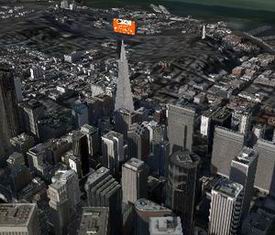
Microsoft has come out with a update to Virtual Earth that makes it look more like Google Earth. Most interesting is that this system shows true 3-D images of city landscapes, including the sides of buildings. Unlike Google Earth which shows buildings with blank grey sides. The result is a more realistic view of city scapes. Its incredible how much data would be required to paint a city. Mapped with low-flying airplanes?
AdAge points out that Microsoft can add floating billboards, and they have already sold space to several companies. There are several floating over San Francisco for ZipRealty (above). Its more of a fun thing to find rather than a easily seen ad. How different is this from billboards in Second Life? .... here it is aligned to a real geographical space. In the US VE uses identical satellite 2D image databases to GE. In Europe, VE appears to be using less detailed image databases, based on my small sample of locations. London shows its 'eye' impressively in 3D, but not much else.
They are still gathering data: "... The 3-D models will initially be available for 15 U.S. cities--San Francisco; San Jose, Calif.; Seattle; Boston; Philadelphia; Los Angeles; Las Vegas; Detroit; Phoenix; Houston; Baltimore; Atlanta; Denver; Dallas; and Fort Worth, Texas--and will be expanded at a rate of eight new cities a month until next spring, when that is ratcheted up even more...". Some of these city databases are glaringly incomplete, with skyscrapers missing. Compare it with Google Earth's 3D images. VE is entirely a web app, and is still a beta. Update: Its much slower than Google Earth too.
Subscribe to:
Posts (Atom)