/* ---- Google Analytics Code Below */
Showing posts sorted by relevance for query "Second life". Sort by date Show all posts

Saturday, November 18, 2006

Journeys in Second Life


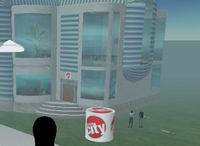
Above is a picture I recently took in one of my journeys in the virtual world Second Life. Well no, not exactly, its a picture I took on one of my frequent walks around Sharon Woods Park. That's an element of my first life. In my Second Life I have been doing some exploring as well. Inspired by a number of recent articles about businesses using Second Life (SL). I have taken a deeper dive.

Virtual worlds are not new. In the 90s we talked to a company called Blaxxun, which still exists. They tried to get us to advertise in their world and a number of well known companies did. But for a number of reasons, including underpowered computers and uncommon broadband, it did not succeed.

Now SL appears to be succeeding. A million members, over ten thousand online at any time. A half million US dollars being spent in every 24 hours. Just spend some time at orientation island and watch the folks arrive. So whats it about? A visual augmentation of chat, a way to collaborate, a way to shop in new ways. Edward Castronova recent explored the economics of virtual worlds. His take is that the economics is exploding.

What businesses exist in SL? Publicly IBM, Addidas, Nissan and Reuters are just some examples. And there are hundreds of other that largely deal only in virtual goods.

Dell just opened a space that consists of a number of islands. There you can design your own PC or laptop and have it delivered to your (physical) world. I visited it and spent some time looking at their wares. Like most Second Life spaces Dell is an austere world. Lots of sharp angles, no green space. Lots of vertical design that has you flying and bumping your head. Kiosks are all around that seek to interview you about your computing needs, a project with the University of Innsbruck. I thought that was interesting but the actual questioning was pretty cold, like the space itself. You can seek a map to see how many people are sharing the space with you. In the hour I was there there were only a handful at any one time, and most of them teleported away soon after arriving. I talked briefly to two people ... the lack of clues as to who people are ... young, old ... professional, tourist ... even male, female is unnerving to me, you have to do quite a bit of typing to establish any context. Almost too easy to disengage, no notion of investment or depth, just teleport away. No Dell reps that I could see, perhaps that would make sense to humanize the space. In fact I found emptyness to be common in commercial spaces. Even IBM's much touted Almaden space was empty when I arrived. A few spaces had signs warning that if someone said they represented a space, they were frauds.

You can zoom out in the map and see roughly how many people are in what island. Most of the ten thousand or so were in places where people could interact socially, in every sense of that word.


So what is my take? I am less skeptical than I was previously. It is yet another reason to sit on your butt for long periods. And we certainly have enough excuses for that now. Its not a game but a social experience addictive for some. My hard-boiled retailer wife took one look and shook her head. There is even recent unrest in the world. More commentary on that. Not for the socially squeamish. Many spaces are depressingly austere. Still worth understanding in some detail, My explorations continue.

Wednesday, February 28, 2007

New Views of Synthetic Worlds

In a recent post I mentioned a symposium I attended sponsored by Cisco and The Santa Fe Institute. All about synthetic worlds. Second Life and games like World of Warcraft are now well publicized examples of these ideas. Interfaces, really, with a new capability to expand interface into a third dimension .... plus another dimension ... a fourth synthetic and social dimension, allowing new kinds of interaction with people, especially in groups.

This is all not new. Back in the 90s we connected with a company called Blaxxun that wanted to do some of the same kinds of things. Bandwidth was still uncommon outside of universities. We were asked to advertise there, but there was little social component, and we passed. Even before then, back to the 70s. the military was building 3D worlds to help trainees interact with battle environments.

Edward Castronova of Indiana, author of Synthetic Worlds: The Business and Culture of Online Games, gave a talk, perhaps too tongue-in-cheek, about how the Second Life currency of Lindens was becoming more real to many than dollars. Well, OK, but then it has not been taxed yet. Still Castronova made the point that alternative currencies are making people take notice. They are being used on E-Bay, exchanged for actual labor. Economists know what that means. Cisco's Christian Renaud talked about their new space in Second Life and how they were seeking to use it as an engagement space for clients. MillionsofUs CEO Reuben Steiger gave a pep talk about where all of this is going and what we should expect, and not expect. Byron Reeves of Stanford gave a talk on some extensions of work he had reported on in his book The Media Equation. That work had inspired us to do early work on having advertising avatars talk to consumers. A good meeting, with lots of interesting ideas being posed.

The meeting turned out to also be a revealing view into how easy (and not-so-easy) it was to use SL as a collaboration space. The talks were delivered in real and second life, and then transmitted to both. There were some problems, created by lag, that occurred along the way, making it unclear who had seen what, except for the people in Real Life, who could nod in acknowledgement.

From an engineer's perspective we have worked with synthetic worlds for a long time. Simulations (sims) have been used since before computing became personal to model proposed worlds to test them before construction. Synthetic Worlds are places where a very general purpose interface has been constructed, mostly with social interactions in mind. Its still not easy to do complex specific things there. As Steiger suggested, its still a place where you can do mostly chaotic, unplanned things, not precisely scripted or planned actions. Sure you can build, construct 'scripts' of object interaction, and text chat all you want. But the interface is still mostly limiting, as opposed to enabling. I have seen things there that are breathtaking, but they are mostly about art as opposed to about engineering and science.

I remain optimistic about where all of this is going. In its current form its really not completely ready for business, but I can see how its evolving in that direction. The enterprise needs some help in making this work. Even better interfaces, stability and interaction. It may not happen in this go around. Looking forward to it.

Thursday, February 01, 2007

BMW in Second Life

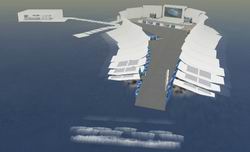
An article in the Second Life Herald talks about BMW's relatively recent build in Second Life called BMW New World. At the right is an aerial view. The article complains that most corporate sites are usually empty. I agree, whenever I visit SL, I make a point of quickly scanning several of the corporate spaces. The much vaunted Dell site, with multiple islands and some clever 'AI Agent' ideas, rarely has any visitors, and I have yet to see an actual Dell employee there. Artificial agents can be clever, but you need the intelligence of real people to make the experience noteworthy.

The exception is IBM, who appears to have taken a very different approach. At any one time there are dozens of their employees 'in world' in their dozen plus sites. Some of their employees are performing tasks, meeting with clients and many of them are willing to engage in conversations. The most recent activity was the build of a Lotus Sphere area that mirrored some meetings in the physical Lotus conference. While IBM's build investment, compared to their TV ads, has to be insignificant, the investment of researchers time is considerable. I have met several researchers I knew from the real world in their Second Life Almaden site.

New IBM employees (based on their 'born' date) appear to be arriving every day, learning and experimenting. I witnessed a number of small group training exercises of IBM users and their clients. Its a great way to speak to researchers off-the-record. Its possible that this works well because the experience is novel, and that may wane. Clearly there is some corporate direction to do this.

Wednesday, June 09, 2010

Second Life Downsizes

Second Life, the well known virtual world that attracted large investments in time and money from companies like IBM, Kraft and Circuit City, announced a 30% downsizing. In addition they plan to make major changes in their interface that will make it browser based. Our enterprise built a life-like central office there for experimental purposes. I saw dozens of IBM employees building research, laboratory and meeting spaces. Witnessed the opening of a virtual supermarket being built and experienced its aisles. I interviewed a number of researchers working there.

I was particularly intrigued with some experiments underway that would allow people to experience complex data in novel 3D ways. Yet there seemed to be few useful business experiences happening and graphically impressive but empty mock ups of real spaces. The well known Second Life economy did not lend itself to consumer goods experiments. It is certainly not dead yet, but its demise may be close by.

The avatar centric 3D world has evolved remarkably since I examined it five years ago. Something like it may eventually be a new way that we interact remotely with people and machines. Its not ready for business prime time yet. Many did and do enjoy it as life-mimicking game environment. It still claims to be profitable.

There are alternatives than can be used for complex remote business interactions by people, such as Teleplace (formerly called Qwaq) that is worth examining, providing ' virtual spaces for real work ... ' ... I have posted some of my early thoughts on it here.
.

Tuesday, May 08, 2007

Supermarket Opens in Second Life

I attended the opening of Phil's Supermarket in Second Life (138,93,29) today. The ribbon cutting was held as part of the Food Marketing Institute's Marketechnics meeting. The supermarket is a joint effort between IBM, Kraft and supermarket technology writer Phil Lempert. IBM was showing it as part of their exposition, and several hundred people attended in all. It includes dozens of new Kraft products, which can be manipulated in 3D. Particularly surprising was the very high graphics quality of the Kraft product packaging shown, better than I have seen in SL before. More details. SLNN article on the opening. The site
" ... creates real world benefits through this unique new frontier of a virtual world experience. Shoppers can browse the store as they wish - or they can pre-shop for the real world. Consumers can personalize product lists, recipes, nutritional profiles and soon even be able to avoid specific ingredients or allergens. Although products are not actually for purchase with US Dollars, shoppers can participate in a variety of programs and frequent shopper incentives where they can obtain a combination of cyber and real life "stuff" such as product coupons, tote bags, t-shirts and more ..."
Also, Chicago Tribune article on Kraft's presence.

Interesting here is that the store does not seem to be mimicking the architecture of real-life stores, but trying some things that are more appropriate to the granularity of Second Life.

Thursday, May 11, 2023

Sample Virtual Worlds Examined

For an upcoming effort I have been asked for an overview of Virtual-Meta worlds and their potential uses in areas like retail and beyond. Recall we worked with IBM on an experiment with 'Second Life' in the 80s.   Below are a list of such worlds, only a few that I have looked at,  via ChatGPT.  Looking in particular how these do/can link with AI enhancement. 

There are many virtual worlds that exist, each with their own unique features and user communities. Here are some examples of popular virtual worlds:

1. Second Life: As mentioned earlier, Second Life is a virtual world where users can create their own avatars and explore a vast virtual world.

2.Minecraft: While Minecraft is primarily a game, it can also be considered a virtual world. In Minecraft, users can build and explore their own virtual environments, and interact with other players in multiplayer mode.

3.Roblox: Roblox is a platform that allows users to create and play their own games, as well as socialize and interact with other users in a virtual world.

4.VRChat: VRChat is a virtual reality platform where users can create and customize avatars, explore virtual worlds, and interact with other users in real-time.

5. IMVU: IMVU is a virtual world where users can create and customize avatars, socialize with other users, and even shop for virtual goods using real money.

6. Entropia Universe: Entropia Universe is a virtual world where users can explore a vast universe, hunt creatures, mine resources, and even engage in real-money transactions.

7. Kaneva: Kaneva is a virtual world that allows users to create and customize avatars, explore virtual environments, and interact with other users in real-time.

These are just a few examples of the many virtual worlds that exist. Each virtual world has its own unique features and user community, and users can choose to participate in the virtual world that best fits their interests and preferences.

Tuesday, August 01, 2017

Sansar is a Virtual World using VR

We explored SL, built locations, thought of advertising there, swam through our data, had group meetings.  Click the tags below for more on all that.

The VR successor to 'Second Life' is now in public beta

Explore Sansar with a HTC Vive, Oculus Rift, or a regular Windows PC.

Sansar, the VR platform by Second Life creator Linden Lab, is now available for everyone to explore. The public "creator beta" follows a private "creator preview," which allowed developers and aspiring level designers to try Sansar's building tools. That period was crucial given, like Second Life, Linden Lab is banking on the community to populate Sansar with interesting experiences. Today, there are "hundreds" of places to explore, including museums, theaters and tropical temples. Some are virtual postcards, while others have games and stories inside them. Everything is free to try too, whether you're playing on a PC, Oculus Rift or HTC Vive.  .... " 

Wednesday, May 03, 2023

Metaverse Seoul?

 Have seen this kind of thing proposed way back, can it work?

Metaverse Seoul: How One City Used Citizen Input to Pilot a Government-Run Metaverse

In May 2022, the Seoul Metropolitan Government in Seoul, Korea launched the pilot of Metaverse Seoul, a virtual version of Seoul’s mayor’s office. As they worked towards building a broad, immersive, online government platform, they hoped to gain insights from citizens about everything from popular local tourist sites that could be experienced virtually to government services that could be delivered in the metaverse. But to do that, the team had to figure out how to solicit ideas from citizens and then determine which ideas to put to use. Professor Mitchell Weiss discusses their approach, as well as questions relating to his research on public entrepreneurship and what he calls “possibility government,” in his case, “Metaverse Seoul.”

SUBSCRIBE ON iTUNES

+More Ways to Listen

Brian Kenny:

In April of 2006, Beth Goza, a programmer at Linden Lab, excitedly showed off her image on the cover of BusinessWeek Magazine. But only those who understood Beth's true passion would've recognized the image as her, because it was actually an image of her avatar, Kealiaha Trudeau, who resided in Second Life, a virtual 3-D world that many considered to be the stepping off point for the Metaverse. Launched in 2003, Second Life allowed users to interact with each other in real time. The open source virtual world hosted a thriving economy that scaled quickly on the wings of user generated content. The site plateaued at about a million users by 2006, but proved too technically clunky for the casual user. But Second Life stoked the imagination of a generation of digital natives, who now have the benefit of working with significantly advanced technology, to create virtual worlds that might in some ways surpass the real thing. Today on Cold Call, we've invited Professor Mitchell Weiss to discuss his case entitled, “Metaverse Seoul.” I'm your host Brian Kenny, and you're listening to Cold Call on the HBR Presents Network. Mitch Weiss studies digital transformation and innovation ecosystems and is an expert on public entrepreneurship. He also holds the record for most appearances on Cold Call at six.  ...

Wednesday, October 22, 2008

Second Life for Business

I recently tore into the current applicability of Second Life to real business collaboration. I was sent this short article about how Linden labs and River Runs Red are partnering ... to create 'Immersive Workplaces', a new business collaboration suite built on the Second Life Grid platform ... . (video on the rrr site) Also work is going creating behind corporate firewall versions of SL to provide security and shield participants from griefers. Go for it. Agree with the direction.

Monday, October 23, 2017

Looking Back at Second Life

Yes, it still exists, and has roughly the same number of users.   Surprised me.   This all came out a decade ago.  We did quite a bit of experimentation with it.  Worked with several large IT  groups looking at ways to make it useful.  Even a way to do research in that other world that might mirror our real world.    At the end of the day it was not very useful for us.  Does it still merit examination as an environment for marketing experiments,  or a retail architecture?  Experimented with using worlds to interact with the abstractness of data.  Virtualitics is doing that today.  Good piece that shows what Second Life is today. 

Returning to Second Life
Long after its grandest ambitions have faded, the platform still boasts people and profit.   By Samuel Axon in ArsTechnica .... " 

Thursday, May 15, 2008

Science in Second Life

Some interesting examples of science being done in Second Life. It's fine to use a virtual world as a social environment, but how can we construct virtual 3D labs to use for collaborative science? The only examples I have seen live is IBM's virtualization of proteins, and a visualization of starts in 3D. mainly useful for instruction, rather than experimentation. I think there is still some possibilities for exploring other kinds of 3D visualization. If the manipulation of point-of-view could be made more natural. At the right, an avatar explores a virtual 3D portion of the stellar neighborhood. Below, IBM's protein display at Almaden labs.


Update (from the comments): Chemistry in Second Life.

Friday, March 27, 2020

Linden Labs Gives up on VR Spin off

Note our examination of virtual world retail, mentioned here earlier.  This piece gives us a look at the current status of world tech with current supporting tech like VR.   Last I looked SL was not heavily used.

Why 'Second Life' developer Linden Lab gave up on its VR spin-off
'We decided that Linden Lab wanted to become cash-positive.’
Nick Summers, @nisummers in Engadget
  
Second Life developer Linden Lab has sold Sansar, a platform for virtual 'scenes' that could be explored with a VR headset or traditional PC setup.

Back in 2016, I described the service as "WordPress for social VR." A foundation that allowed creators to import custom assets and quickly build their own shareable world. The company hoped that this mix would attract commercial clients — think museums, car manufacturers and record labels — that want their own VR experience but don't have the technical expertise to deal with game engines and digital distribution.

Similarly, Linden Lab hoped Sansar would attract users who crave diverse worlds — like those promised in movies such as Ready Player One — and, if they have a creative spark, possibly make their own assets that can be shared and sold to the rest of the community.

Sansar's VR compatibility was a big draw. At the time, there were many 3D chat room experiences — including Second Life — but few that allowed large groups to strap on a headset and freely converse. Linden Lab knew that the number of people with high-end VR headsets was small, though. And the team didn't want to dilute the experience so it could run on mobile-powered hardware like Google Cardboard and Samsung's Gear VR.    ... " 

Thursday, July 10, 2008

Google's Lively

Much in the news about Google's challenge to Second Life. Called Lively, one thing to observe is that there is no money or ads in it's world, unlike Google's real-life world. Examining and will follow with a review. Some vendors of virtual world concepts, like Millions of Us are already delivering experiences there. The BBC has a good overview. Could these worlds ultimately be innovation centers? Thought of that with Second Life, but it lacked what was needed. Qwaq is another option to explore.
.

Wednesday, December 27, 2006

IBM and Circuit City in a Virtual World

I have been exploring Second Life and had the rare experience of watching IBM and some of its contractors set up their virtual Circuit City store in Second Life. Watching a half dozen avatars 'construct', tune and correct the experience is a revelation. It has been formally opened now. Since the opening I have returned a number of times, its usually not very crowded, have had some interesting conversations with others in the location. Its their first experiment in linking the store experience to the home experience. IBM plans to set up a number of virtual development centers. Have had a number of interesting encounters there. Search for location 'IBM 10'. Below is their text introducing the location:
" ... We've partnered with Circuit City to explore and experiment with how we can apply virtual worlds to their business -- from doing business inside of virtual worlds to connecting the virtual world with the real world to create a richer, more immersive Web environment.

This early build of a virtual Circuit City store is an area where we are experimenting with how to enrich a user experience by using virtual worlds to augment both the Web experience and the real world experience. For example, instead of browsing through a catalogue on a website, people can use their avatars to walk the aisles of a virtual Circuit City store, and pick up and examine products in a way that is closer to real life.

They can also easily link to an order form to shop in these virtual worlds in a way similar to ordering on the Web.
In addition, this build demonstrate a really powerful advantage that virtual worlds have over the Web... in the area of customer service, instead of simply talking someone through technical issues or how to use certain products, they can actually show the user their product in 3-dimensional virtual worlds and explain exactly how and where to fix or examine the product to find the problem and get it resolved.

Other immersive features that IBM and Circuit City are experimenting with include an interactive home theater, where customers can easily recreate their own home environment to do things like setting up a home theater -- users can easily move a couch at the proper distance from where they want to put a new TV, and it automatically tells them the optimal size TV to purchase for their room dimensions, and eventually will add other features like where to place speakers for a surround sound system

This is in the early experimentation phase, and we are eager for feedback from consumers and other businesses on how we can make it better ...."
There is still much to do here, they are attempting to mimic a real-world retail experience in a virtual world that does not effectively support that illusion. Will continue to track.

Friday, February 29, 2008

L'Oreal Sponsors Greenies in Second Life

L'Oreal has become a sponsor of the Greenies alien land in Second Life, much more here. I don't see the useful connection, except that they are giving away virtual L'Oreal product, but worth examining.

Saturday, October 18, 2008

Reuters Leaves Second Life

I am now out of date regards the Second Life virtual world. Followed it for some time as a potential method for science, technology exploration, design and collaboration. I came away intrigued but unimpressed in the SL implementation. It needs lots of work to make it useful. It still attracts tens of thousands every day. I still get and scan feeds of some media that cover it. I see that the Reuters correspondent attached to SL with great fanfare several years ago has now left, and the Reuters structure in SL has been abandoned. I had visited Reuters in SL, but there was rarely anyone there. Not sure what this means overall, but not a good indicator. Some of my previous posts about SL.

Friday, March 17, 2023

Driving Value with the Metaverse in the Enterprise

Irving talks some of the work that IBM did with the Virtual World  'Second Life' in the mid 2000's at IBM which we also participated in, a nice look with lots of interesting links.  This also fills me in on lots of later work, such as metaverse located meetings and task interactions.  Could not get our folks interested  Much of that was documented in this blog.  Is the addition can AI 'Enhancement' enough to make the proposition much more interesting?  Will search, examine these for later comment.

A collection of observations, news and resources on the changing nature of innovation, technology, leadership, and other subjects      By Irving Wladawsky-Berger 

Driving Value with the Metaverse in the Enterprise     (much more at the link)

A killer app is an IT application whose value to individuals and companies is relatively simple to explain, its use is fairly intuitive, and the application turns out to be so useful that it can singlehandedly propel the success of a new product or service. Word processing and spreadsheets, for example, were major factors in the widespread adoption of personal computers in the 1980s.

I got interested in 3D immersive environments in the mid-2000s when IBM launched an exploratory initiative on the topic. As part of these efforts, we conducted a number of experiments on Second Life, a platform that allowed its users to develop a variety of virtual world applications. We built a number of workplace applications, including virtual meetings, and online events, and even built a virtual replica of Beijing’s Forbidden City in partnership with the Palace Museum that was opened to the public. But, despite our high expectations, we couldn’t find any compelling enterprise killer apps, and after about three years, the project was dissolved. In the ensuing years, 3D immersive technologies and applications continued to advance, but mostly focused on video-games and related industries.

The past few years have seen a surge of interest in the metaverse and extended reality. “After desktop computing, the consumer internet and the smartphone boom, the consumer-computing industry is past due its Next Big Thing,” wrote The Economist in  “A reality check for the metaverse is coming,” an article in its 2022 year-end issue. “[A]n internet which is still largely flat — based on two-dimensional text, images and video — is ripe for replacement with one that is three-dimensional and immersive.” ... ' 

Tuesday, July 24, 2007

Art and Interface


Some of you may have seen the recent PBS program on the art of Van Gogh by Simon Schama. A colleague sends a link to a YouTube video that shows a Second Life build by Robbie Dingo that constructs a 3D version of Van Gogh's 'The Starry Night'. This is very impressive if you have, like me, done some simple builds in SL. Its like giving me a set of paintbrushes and paints, and telling me, certainly you can reproduce it, you have all the elements.

Although I have been developing some skepticism that Second Life specifically will succeed, this video does show how impressive, awe inspiring and attention grabbing things can be built in virtual worlds. So what does this mean to a soap company? It means that some of the things you can do on TV or in the movies will eventually be possible in a virtual worlds with complete interactivity. That will mean a very different world for marketing. This video is a demonstration of the first steps in that direction.

Thursday, August 06, 2015

Trying Again in the Metaverse

If has been quite a long time since I heard the term Metaverse.  Yet I attended the building of a huge IBM Second Life complex as a representative of our enterprise.   Shopped in the aisles of a virtual store. Interacted with abstract data as I floated through clusters of learned attraction. (Right)

Virtually walked through the halls of a building we constructed that directly mirrored the physical building I worked in.  Had meetings about doing focus groups with the virtual inhabitants.   Talked to a number of startups there.

It peaked at a million users. But then it seemed every one lost interest in navigable, 3D spaces that mimicked the real world.  Focused artificial worlds, like a 3D CAD system are common.  Yet we don't expect them to allow us to stroll through them with our colleagues, or set up social camp there.

For a business/social example, see Fidelity's Stockcity.

Second Life still exists.  And, they say, is profitable.  An interesting article says they have figured out how to make it and other virtual worlds successful.  New companies involved.  And new technologies to deliver the experience, like Oculus.  And managers of super social networks like Facebook.

Will they achieve really immersive experience that include rich communications with others?  and create profitable businesses.

Saturday, March 13, 2010

New Thoughts on a Second Life

Its been over a year since I have been to the virtual world Second Life. Before that I was a user, watched in real time as IBM programmers build their own spaces there, saw my company set up a (private) space for experimentation, went to conferences held there and thought about how SL could be used for business intelligence. I got a little bored, and backed off, and never really felt like going back. Now I have heard that there is a new viewer that makes SL easier to use. The link also goes to an article that discusses other ease of use issues. The ease of use was always a big thing, experts saying it takes about twenty five hours to gain basic competence there. I think it is more than just the time required ... you just don't get immediate pay-back for the time invested. While I still think there is a place for this idea in the future, its not ready yet.